Does God Get Back Pain? On the Image of God
JD Lyonhart
10 min read ⭑
“In the beginning God created the heavens and the earth . . . Then God said, ‘Let us make mankind in our image, in our likeness.’ . . . God created mankind in his own image; . . . male and female he created them.” (Genesis 1:1, 10, 26,27).
The Bible says I am made in God’s image. So . . . does that mean God is one handsome devil? Does that mean God looks and sounds like me? Does God have a great big bushy beard? Does God have an annoyingly persistent unibrow he’s embarrassed about but emotionally processes through humor? Does God get crow’s feet and hippos’ gut? Does God have a body or bodily functions? Does God get back pain?
Now, on the one hand, when someone says you’re just like your mother or father, that could mean you physically look the same as your parents. It could mean you have a similar nose, equally long legs or comparably hairy arms. Or it could mean there is a deeper, almost spiritual likeness — something about your way, your essence, your unspoken mannerisms, your sense of humor, your wandering spirit, that is just so like your parents at that age. It is in this deeper sense that we are supposedly made in the image of God.
But what is this deeper image? If the image of God is not a literal, physical image but more of a vague, subtle, spiritual likeness, what then is that vague, subtle, spiritual likeness?

Mark Farías; UnsplasH
Now, theologians sometimes focus quite narrowly on what Genesis 1:27 means by image. However, for this excerpt (taken from “The Journey of God”), I’m going to sidestep that more narrow, controversial, textual conversation and use the language of image more philosophically to explore a broader array of proposed ways humans might be like God in general.
Creativity
God loves to create: God sketched the shoreline, dotted the starry night, spun the spider’s web, and brushed the wind into being. If God is real, then God is the greatest, most creative artist of all time, and human artists who draw the world are merely attempting to capture a dim reflection of that first painting — the world itself.
God is creative, and so are we. We build things, invent games, write songs, spin yarns, make crafts, craft jokes, draw doodles, pen poems, paint paintings, take risks and logical leaps, and mix and match and imagine connections where they didn’t exist before (e.g., our eyes saw a horse and a rhino, but it was our creative imagination that combined them into a unicorn). Humans are creators, made in the image of the ultimate Creator.
So what if God’s image is imagination itself? We can imagine other things because we first were imagined; we were once but an image in the mind of our maker. To imagine (from Latin imago) is literally to image something, to picture or conceive an image or representation of something in your mind. It is in this sense that God says, “Before I formed you in the womb I knew you” (Jeremiah 1:5), for you were on God’s mind long before you were on this earth. We are the image of the divine imagination, made in the likeness of one who imagines marvels and then actually makes them. So we too conceive, craft, carve, weave, thread, forge and hammer.
Emotions
We are made in the image of a feeling giant. In the Old Testament, it describes God as feeling joy, love, anger, sorrow, grief and even jealousy. Now, you might assume jealousy is a bad thing, and, in some contexts, it is. If you’re jealous every time your spouse goes to the gym, that’s not great. But if your spouse cheated on you with their personal trainer, then jealousy would be a fairly accurate and healthy emotional response. And when humanity keeps abandoning God to get it on with Satan, it makes sense that God feels a wee bit jealous.
And in the New Testament, Jesus wept at the death of Lazarus. God gets gloomy. Jesus also overturned the money tables in the temple; our maker gets mad. And he had every right to be — those people were oppressing the poor and turning spirituality into a garage sale. Maybe we too should be more enraged at injustice, systemic oppression and global poverty. Perhaps, sometimes, the most Christian thing we can do is get angry for the right reasons.
In which case, to suppress our emotions is to suppress part of what makes us like God. We are not to repress them, nor leave them wild and uncared for, but feel them, wrestle with them, harness them, be harnessed by them and become emotionally mature. Only then will we be fully human, living up to the divine image within us all.
Consciousness
Humans don’t just exist but are awake to our existence. We are not only conscious and aware but self-conscious and self-aware. Rocks do not reflect on their own death, nor wonder whether they were made for something more than the riverbed (if they do, I apologize).
Philosophers and neuroscientists still aren’t totally sure how consciousness works. Some say it’s just an illusion created by our physical brains. Others say that no amount of material neurons firing could create our experience of consciousness, and that robots and computers may mimic human actions on the outside but will never truly become conscious on the inside. These thinkers quickly find themselves going beyond neuroscience and into the realm of the soul. For if consciousness cannot be reduced to matter, nor replicated in a physical computer, then there must be something about consciousness that is not just physical but metaphysical, not just material but spiritual — as if it were a reflection of the divine image. Perhaps there was cosmic consciousness even before there was a cosmos, and we flicker with embers from its eternal flame. Perhaps we are conscious because the divine mind is conscious and we are its brainchild.
Sex
Many refer to God using masculine imagery (Father, Son, he/him, etc.). But notice what Genesis 1:27 says: “In the image of God he created them; male and female he created them.” The very first elaboration on the divine image seems to imply that both men and women are reflections of it. Which means that human maleness is not more indicative of the divine than femaleness. Perhaps that’s why the book of Job refers to the Creator using both male and female imagery in the same breath:
Does the rain have a father?
Who fathers the drops of dew?
From whose womb comes the ice?
Who gives birth to the frost from the heavens? (Job 38:28,29)
Now, it may not be surprising that the Bible primarily uses male images for God, as it was written in an ancient, male-dominated culture. What might shock us, though, is all the places where the Bible also uses feminine imagery for God, such as in Genesis 1, Hosea, Deuteronomy, Isaiah, Psalms or here in Job.
“God has to be somewhat similar to us or else we couldn’t relate to God, know God, or say anything about God.”
Inherent Worth
A key argument on both sides of the slavery debate was whether Africans were made in the image of God. Because if Black people were equal participants in the divine image, then to abuse them was to violate divine goodness itself. Every person has a spark of the eternal flame within them, and woe to those who dare blow it out. If God is within us all, then to violate another image-bearer is like desecrating a temple or holy space. We are, all of us, cathedrals. As Martin Luther King Jr. wrote:
Living with the system of slavery and then later rigid standards of segregation, many Negroes lost faith in themselves. Many came to feel that perhaps they were less than human. Nagging clouds of inferiority actually formed in their mental sky. Then something happened to the Negro. . . . The Negro came to feel that he was somebody. His religion revealed to him that God loves all of his children and that all men are made in his image and that the basic thing about a man is . . . his eternal dignity and worth.
Reason
Isn’t it odd that the world makes sense to us at all? Isn’t it strange that the Pythagorean theorem — an abstract equation of symbols thought up in the mind of Pythagoras thousands of years ago — perfectly parallels the external world? Isn’t it a tad suspicious that reality mostly functions in mathematical, consistent, logical ways that just so happen to align with human reason? I mean, shouldn’t we have expected just the opposite — that there would be no scientific laws, natural order or rational structure to reality? Isn’t chaos far simpler? Shouldn’t our default expectation have been lawless disorder?
As such, it’s hard to know whether reality is rational, or if we are just filtering it through our rational lens, seeing what we want (and expect) to see? Does two plus two actually equal four, or is that just us shrinking infinity to fit into our finite skulls? Are time and space real, or does the human mind just think in spatial and temporal categories and impose that on reality? (Indeed, relativity and quantum mechanics have shown that the commonsense rationality of the human mind cannot be assumed to be true of the broader universe.) And there is no way out of this problem, because anything your mind comes up with to try to argue its way out already assumes your mind can be trusted to tell you the way things really are to begin with. Which is what you’re supposed to be trying to prove.
Given that, belief in God ironically becomes a giant gamble wherein we actually place our chips on human reason. For to believe in God is to say that the human mind really reflects the nature of the divine mind at the heart of all things. What goes on in my head parallels what goes on out there, because I am made in the image of the mind that structured and shaped the whole universe. I can understand the design plan because I speak the same language as the designer. Reason is not just a social construct; it is the image of the one who is the rational foundation and architect of reality itself. Reality aligns with the human mind because reality is itself the product of a mind. Faith doesn’t negate reason, it absolutizes it, seeing it everywhere and in everything.
Which is exactly what the Bible is getting at when it refers to God as the word or logos, through which all things were made (John 1). Logos is the Greek word here, and it’s where we get the term logic. The divine mind is the logos; God is reason itself. Humans are rational because we are made in the image of the one who is reason itself and who designed our rational world. Logos is also the basis for the -logy at the end of the academic disciplines: sociology is the study of the logic — the logos — of the social world; zoology is the study of the logic — the logos — of the animal world. And this applies pretty much across the board: psychology, geology, archaeology, anthropology, proctology. The academic study of the world was built on the assumption that the human mind could actually understand reality, for our minds were made in the image of the divine mind who created, structured and permeates reality. Sigmund Freud said we project our daddy issues onto the clouds and see a bearded father-God staring back; the same thing can be said of reason. To project our intelligence onto the universe means we will inevitably see a higher intelligence staring back at us. And if that means God is a delusion, then so is the rational enterprise itself.
Many assume that having faith means not having a brain, but I think it’s just the opposite: I think when all of our humanity is firing at once — when we are creative, emotional and rational — we are closer to our Creator and closer to ourselves. Any Christian who neglects the mind is neglecting part of their own humanity, part of the image of God implanted within them.
However, an interesting question here raises its head: when do you think Christians most emphasized that God’s image was our reason? During the scientific enlightenment, of course. How convenient. We’d previously said the image was reason, but not to the extent that we began to say and emphasize it during the Age of Reason. A rational time sees a rational god. Which raises the question: Did God create us in his image, or do we create God in our own image? If we were goats, would we think God was a goat? If we were cows, would we think God was a cow? As our heavenly heifer taught us, we are bold to say: This is my ground chuck, shed for you. Drink milk in remembrance of me.
And I think it’s a fair critique. Yes, God has to be somewhat similar to us or else we couldn’t relate to God, know God, or say anything about God. But any God who just looks like you, talks like you, and thinks like you probably isn’t God at all — it’s just you, reflected off the clouds. As soon as we forget that, we turn God into ourselves, worshiping our own image instead of the one who drew it. Which is why I always add one final category, to remind myself of the tentativeness of this whole bloody exercise.
Mystery
God is ultimately a mystery. Yes, I think God is creative, emotional and rational in a way that is somewhat analogous to human creativity, emotion and reason. God is all those things, but God is also more; more than anything I could ever put in this excerpt; more than all the libraries in all the world could ever contain; more than all the run-on sentences and excessive semicolons could allow. Which, on the one hand, seems to make God inhuman and unknowable. God is so mysterious, so beyond us, so different from us, so other from us, that God seems inhuman.
But that is also what makes God the most human. For we too are mysteries. Each person is made unique; no one fits perfectly into any category or preconception. Just when you think you’ve figured someone out, they surprise you. I’ve been married to my wife, Madison, for over a decade, and she’s still surprising me all the time. Even old folks who’ve been married fifty years can still find themselves shocked when their partner’s defibrillator goes off.
Others are truly other. As soon as you try to reduce another human to a mere extension of yourself and your own ways of seeing or thinking or feeling, you lose what makes them them and not you. To admit that God is mysterious takes no more faith than to accept your fellow humans on their own terms. The same fragile dance of a human reaching beyond themselves for another is mirrored in humanity reaching out for the holy. Ironically, it is when God is least human, least like us, least understandable, least knowable, least reducible to a manmade scalpel or sermon or textbook, that God is most human. For we are made in the image of a mysterious God.
So we too are mysteries.

J.D. Lyonhart is a British-Canadian theologian, philosopher, author and ordained minister. He is an associate professor of religion and philosophy at the University of Jamestown, a fellow at the Cambridge Center for the Study of Platonism at Cambridge University and a co-host of the Spiritually Incorrect Podcast. In addition to The Journey of God: Christianity in Six Movements, he also authored Space God: Rejudging a Debate Between More, Newton, and Einstein, as well as MonoThreeism: An Absurdly Arrogant Attempt to Answer All the Problems of the Last 2000 Years in One Night at a Pub.
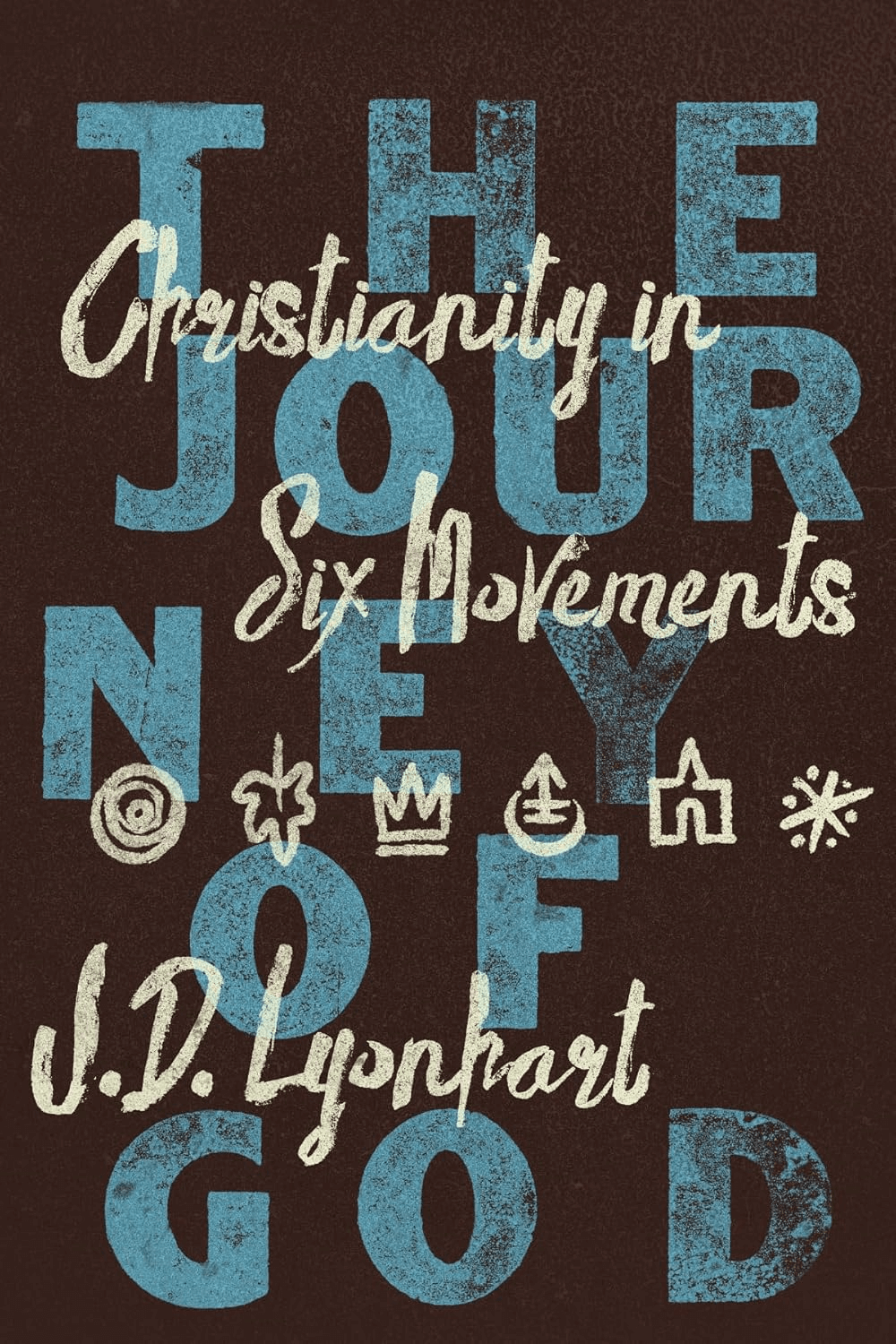
Taken from The Journey of God by JD Lyonhart. Copyright © 2025. Used by permission of InterVarsity Press.