
Father, Into Your Hands: A Prayer for Whatever's Coming
George MacDonald
5 min read ⭑
TROUBLEMAKERS & SAINTS
Dangerous wisdom from the departed
George MacDonald · 1824-1905 · Scottish preacher
MacDonald spent his writing life urging one surrender — give yourself back to the God who gave you. Then a stroke took his speech, and his last seven years passed nearly wordless, nothing left to say, only a self long since handed over. He had practiced. Read this as practice too, so that when your own words run out, the giving is already done.
Every highest human act is just a giving back to God of that which he first gave to us. Thou God hast given me: here again is thy gift. I send my spirit home. Every act of worship is a holding up to God of what God hath made us. Here, Lord, look what I have got: feel with me in what thou hast made me, in this thy own bounty, my being. I am thy child, and know not how to thank thee save by uplifting the heave-offering of the overflowing of thy life, and calling aloud, ‘It is thine: it is mine. I am thine, and therefore I am mine.’ The vast operations of the spiritual as of the physical world are simply a turning again to the source.
The last act of our Lord in thus commending his spirit at the close of his life was only a summing up of what he had been doing all his life. He had been offering this sacrifice, the sacrifice of himself, all the years, and in thus sacrificing he had lived the divine life. Every morning when he went out ere it was day, every evening when he lingered on the night-lapt mountain after his friends were gone, he was offering himself to his Father in the communion of loving words, of high thoughts, of speechless feelings; and, between, he turned to do the same thing in deed, namely, in loving word, in helping thought, in healing action towards his fellows; for the way to worship God while the daylight lasts is to work; the service of God, the only “divine service,” is the helping of our fellows.
I do not seek to point out this commending of our spirits to the Father as a duty: that is to turn the highest privilege we possess into a burden grievous to be borne. But I want to shew that it is the simplest blessedest thing in the human world.

Bailey Alexander; Unsplash
For the human being may say thus with himself: Am I going to sleep — to lose consciousness — to be helpless for a time — thoughtless — dead? Or, more awful consideration, in the dreams that may come, may I not be weak of will and scant of conscience? — Father, into thy hands I commend my spirit. I give myself back to thee. Take me, soothe me, refresh me, ‘make me over again.’ Am I going out into the business and turmoil of the day, where so many temptations may come to do less honourably, less faithfully, less kindly, less diligently than the ideal man would have me do? — Father, into thy hands. Am I going to do a good deed? Then, of all times, — Father, into thy hands; lest the enemy should have me now. Am I going to do a hard duty, from which I would gladly be turned aside, — to refuse a friend’s request, to urge a neighbour’s conscience? — Father, into thy hands I commend my spirit. Am I in pain? Is illness coming upon me to shut out the glad visions of a healthy brain, and bring me such as are troubled and untrue? — Take my spirit, Lord, and see, as thou art wont, that it has no more to bear than it can bear. Am I going to die? Thou knowest, if only from the cry of thy Son, how terrible that is; and if it comes not to me in so terrible a shape as that in which it came to him, think how poor to bear I am beside him. I do not know what the struggle means; for, of the thousands who pass through it every day, not one enlightens his neighbour left behind; but shall I not long with agony for one breath of thy air, and not receive it? Shall I not be torn asunder with dying? — I will question no more: Father, into thy hands I commend my spirit. For it is thy business, not mine. Thou wilt know every shade of my suffering; thou wilt care for me with thy perfect fatherhood; for that makes my sonship, and inwraps and infolds it. As a child I could bear great pain when my father was leaning over me, or had his arm about me: how much nearer my soul cannot thy hands come!—yea, with a comfort, father of me, that I have never yet even imagined; for how shall my imagination overtake thy swift heart? I care not for the pain, so long as my spirit is strong, and into thy hands I commend that spirit. If thy love, which is better than life, receives it, then surely thy tenderness will make it great.
Thus may the human being say with himself.
“Graciousness and truth are around, above, beneath us, yea, in us.”
Think, brothers, think, sisters, we walk in the air of an eternal fatherhood. Every uplifting of the heart is a looking up to the Father. Graciousness and truth are around, above, beneath us, yea, in us. When we are least worthy, then, most tempted, hardest, unkindest, let us yet commend our spirits into his hands. Whither else dare we send them? How the earthly father would love a child who would creep into his room with angry, troubled face, and sit down at his feet, saying when asked what he wanted: “I feel so naughty, papa, and I want to get good”! Would he say to his child: “How dare you! Go away, and be good, and then come to me?” And shall we dare to think God would send us away if we came thus, and would not be pleased that we came, even if we were angry as Jonah? Would we not let all the tenderness of our nature flow forth upon such a child? And shall we dare to think that if we being evil know how to give good gifts to our children, God will not give us his own spirit when we come to ask him? Will not some heavenly dew descend cool upon the hot anger? Some genial raindrop on the dry selfishness? Some glance of sunlight on the cloudy hopelessness? Bread, at least, will be given, and not a stone; water, at least, will be sure, and not vinegar mingled with gall.
Nor is there anything we can ask for ourselves that we may not ask for another. We may commend any brother, any sister, to the common fatherhood. And there will be moments when, filled with that spirit which is the Lord, nothing will ease our hearts of their love but the commending of all men, all our brothers, all our sisters, to the one Father. Nor shall we ever know that repose in the Father’s hands, that rest of the Holy Sepulchre, which the Lord knew when the agony of death was over, when the storm of the world died away behind his retiring spirit, and he entered the regions where there is only life, and therefore all that is not music is silence, (for all noise comes of the conflict of life and death) — we shall never be able, I say, to rest in the bosom of the Father, till the fatherhood is fully revealed to us in the love of the brothers. For he cannot be our father save as he is their father; and if we do not see him and feel him as their father, we cannot know him as ours. Never shall we know him aright until we rejoice and exult for our race that he is the Father. He that loveth not his brother whom he hath seen, how can he love God whom he hath not seen? To rest, I say, at last, even in those hands into which the Lord commended his spirit, we must have learned already to love our neighbour as ourselves.
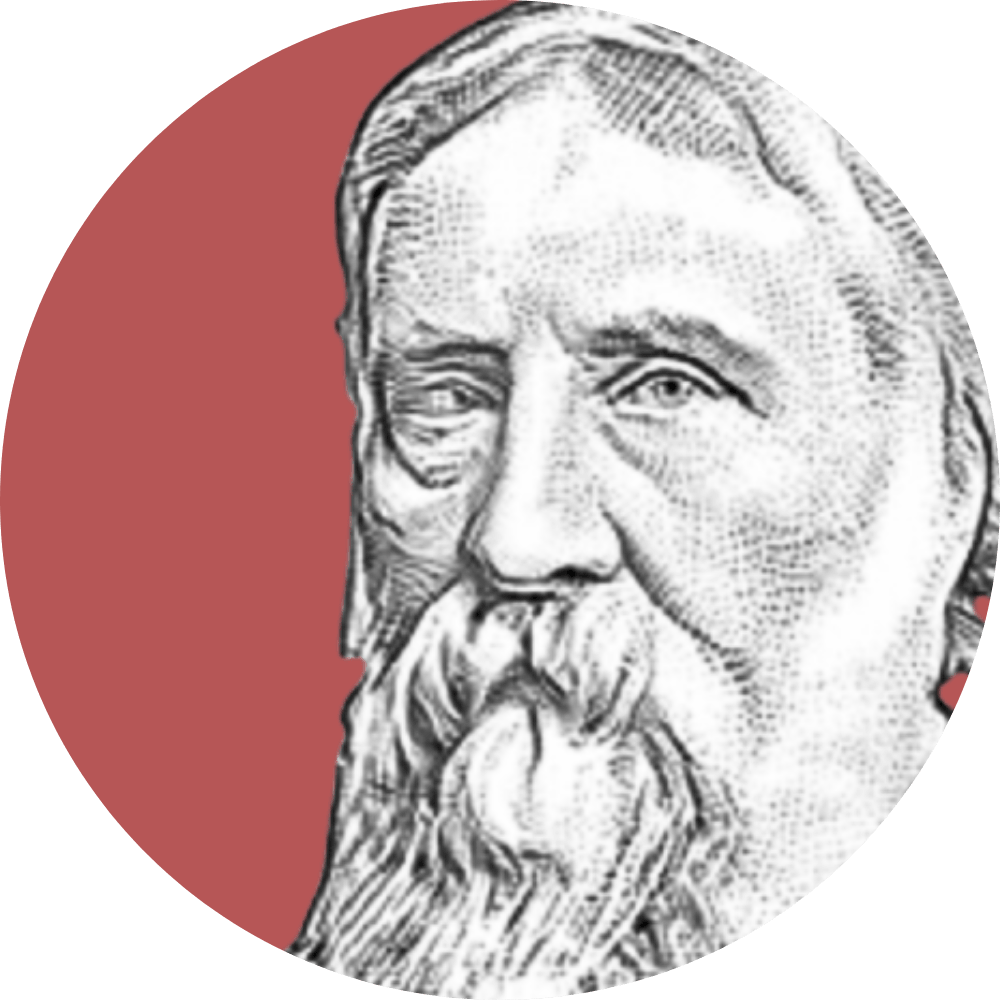
George MacDonald was a Scottish author, poet and Christian minister whose writing blended theology and imagination with a strong emphasis on God’s fatherhood. After serving briefly as a Congregational pastor, he became best known for his novels, fairy tales and spiritual writings, including Unspoken Sermons. His work later influenced writers such as C.S. Lewis, who regarded MacDonald as one of his most important spiritual and literary influences. In Unspoken Sermons, MacDonald focuses less on abstract theological systems and more on obedience, love, trust and becoming like Christ.
Adapted from “The Hands of the Father” in “Unspoken Sermons Series One” by George MacDonald. Copyright ©1867. This work is in the public domain. Text sourced from CCEL.