J.I. Packer
6 min read ⭑
A lifeline is a rope to which a drowning person clings while being pulled ashore. Drowning is a condition of being invaded and overwhelmed by water, which gets into your lungs so that you cannot breathe. Metaphorically, you can be said to drown in sorrow or grief or any other invasive mood that disrupts normal personal life. Now we are surrounded today by people who are drowning inwardly in the raging waters of hopelessness. The proverb rightly says that while there’s life there’s hope, but the deeper truth is that only while there’s hope is there life: when the light of hope goes out, and there really seems nothing to live for anymore, life itself becomes a killing burden. We are so made that we live very much in our future, and the desolation of feeling that there is nothing worthwhile to come, nothing good ever to be expected again, eats the soul away like a corrosive acid. To moderns drowning in hopelessness, disappointed, disillusioned, despairing, emotionally isolated, bitter and aching inside, Bible truth comes as a lifeline, for it is future-oriented and hope-centered throughout. The God of the Bible, whom Christians know as the Father, the Son and the Holy Spirit united in a shared divine life, is both a very present help in trouble and a very potent hope in times of despair. The triune God, we might say, is the lifeguard, who comes in person to the place where we are drowning in order to rescue us; the Holy Scriptures are the lifeline God throws us in order to ensure that he and we stay connected while the rescue is in progress; and the hope that the Scriptures bring us arrests and reverses the drowning experience here and now, generating inward vitality and renewed joy and banishing forever the sense of having the life choked out of us as the waves break over us.
That the Bible throughout is a book of hope is not always appreciated, but it is so. From the giving of the promise that the woman’s seed will crush the serpent’s head (Gen. 3:15), the Old Testament constantly looks forward to great restorative things that God will do for his people and his world. The New Testament nails down this hope by its repeated assurances that the Lord Jesus Christ, our divine sinbearer and present heavenly friend, is with us by his Spirit to keep us sane and safe till he returns to re-create the cosmos and lead us all into unimaginable endless glory with himself. In the meantime, he gives our lives permanent and satisfying meaning by making us his servants, with jobs to do, and that is a relationship that will continue forever. In a world in which the individual’s natural sense of significance is so largely snuffed out, such a hope is a lifeline indeed.

ANGÉLICA SABINA; Unsplash
To illustrate the power of Scripture as a lifeline that sustains hope, let me be autobiographical for a moment. I do not think of my experience as having any special significance except to me, but I would like to share it because it happened. For 15 years I worked to fulfill a vision of evangelical quickening in England through theological education, spiritual formation, pastoral enrichment, profound preaching, wise evangelism, functional Christian unity and every-member ministry in local congregations — a vision generated by the type of pure biblical theology that some label Puritan Calvinism. Put like that, of course, this vision sounds grandiose to a fault, and though I retain my hold on it — or, rather, it retains its hold on me — I am not here concerned to defend it against its critics. I simply record that after 15 years of actively promoting it came several years during which, through what people with other visions did in perfectly good faith to block, more or less directly, the things I was after, I lost all the vantage points I had had for implementing the purposes that the vision dictated. I found myself marginalized, isolated and required to work to unfulfilling and, I thought, flawed agendas, in a manner that made me think of the Israelites having to make bricks for Pharaoh; and for political reasons I was not free to say what I thought about this state of affairs. Outwardly appreciated, at least by some, as a useful Christian performer, I lived, like Moses in Midian, with frustration in my heart, wondering what God, who, as I believed, gave the vision in the first place, could possibly be up to. The Bible, however, kept assuring me that God knows his business, so even though I expected to soldier on where I was till retirement, I had hope.
During those years, my spiritual education was proceeding. Here are the main lessons that God, through his Word, hammered into my heart.
Goodwill — I should not get bitter or lapse into self-pity or spend time complaining or angling for sympathy. God was using my ministry, and I was forbidden to get fixated on my frustrations.
Hope — I was not to become cynical or apathetic about the vision I had been given or to abandon it because there was no immediate way of advancing it. God is never in a hurry, and waiting in hope is a Christian discipline.
Faithfulness — As husband, father, teacher, honorary assistant pastor and occasional author, I had plenty each day to get on with, and I could not honor God by slackness and negligence, whatever discontents I was carrying around inside me.
Compassion — Clearly I was being taught to empathize more deeply with the many Christians, lay and ordained, male and female, who live with various kinds of disappointments and thus were in the same boat as myself.
Humility — I must never forget that God is supreme and important, and I am neither, and he can manage very well without me whenever he chooses to do so.
God alone knows how far I managed to live out these lessons, but there was no lack of clarity as he presented them to me from the Scriptures.
“The Bible a lifeline? It has certainly been so for me.”
In due course, things changed. With clear guidance from inner conviction and outward circumstances, both biblically judged, my wife and I emigrated, and today I follow the gleam of the original vision of reformation and revival in a larger world than England. Tabasco sauce (often imitated, never duplicated, as its labels say) gains its flavor from the oak barrels in which it matures. I suspect that those final years in England were a sort of oak barrel period for me, but I leave that for others to decide.
There are many things about my life that I do not know and do not expect to know till the books are opened. The mother of a school friend was clairvoyant, though as a Christian she wished she was not, and in any case she was not always able to tell her genuine second sight from her own wishful thinking. Before I was a believer, she surprised and, I confess, amused me by assuring me that I would end up in the Christian ministry. I remember her also admonishing me in those far-off days that I should need to remember the proverbial wisdom that Kipling versified in the line “he travels the fastest who travels alone.” Her first word was verified; whether the second has been, I cannot tell as yet. But I have totally verified the wisdom of David’s words in Psalm 27:14 — “Wait for the Lord; be strong and take heart and wait for the Lord” — and so far as ongoing hope is concerned, truths I keep meeting in Scripture have taken me back over and over again before, during and since the years of frustration, to words of Anna Waring that have been in my heart since I learned them as a student more than 50 years ago:
In heavenly love abiding
No change my heart shall fear;
And safe is such confiding,
For nothing changes here.
The storm may roar without me,
My heart may low be laid;
But God is round about me:
And can I be dismayed?
Wherever he may guide me
No want shall turn me back;
My shepherd is beside me,
And nothing can I lack;
His wisdom ever waketh,
His sight is never dim;
He knows the way he taketh,
And I will walk with him.
Green pastures are before me,
Which yet I have not seen;
Bright skies will soon be o’er me
Where the dark clouds have been.
My hope I cannot measure,
My path to life is free;
My Savior has my treasure,
And he will walk with me.
The Bible a lifeline? It has certainly been so for me, and I hope it will prove itself similarly so for everyone who ever reads this book.

J.I. Packer (1926-2020) was the Board of Governors' Professor of Theology at Regent College in Vancouver, British Columbia. An ordained Anglican minister, he authored numerous influential works, including Rediscovering Holiness, Evangelism and the Sovereignty of God, and the bestselling Knowing God. He was widely regarded as one of the most influential evangelical theologians of the 20th century.
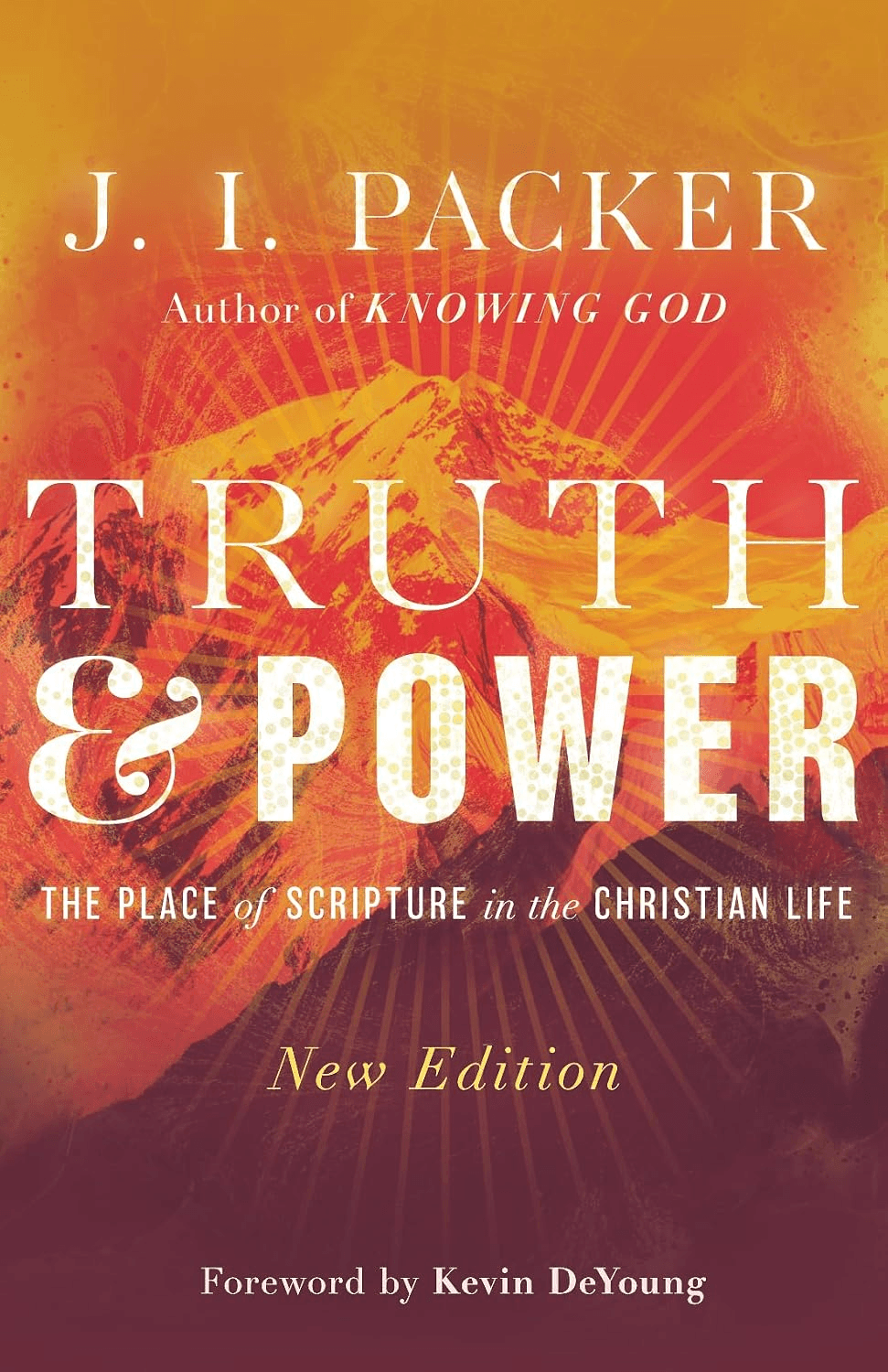
Adapted from “Truth and Power” by J.I. Packer. Copyright © 2026. Used by permission of InterVarsity Press.