John Mark Comer
5 min read ⭑
21 days.
In an isolated cabin, tucked into a moody, coastal forest above a remote beach in Puget Sound.
All alone.
No phone.
No computer, email or internet. You are required to hand over any devices upon check-in.
No books.
A Bible is “allowed,” but with a gentle warning not to use it as a “distraction from God.”
No alcohol, no more than one cup of coffee per day, no exercise, even — nothing to “discharge the anxiety from your body.” A daily walk along the remote coastline is fine, but nothing that will get your heart rate up.
And no contact with people. I pack in all my own food, do all my own cooking — totally cut off from the outside world.

Wolfgang Hasselmann; Unsplash
My sole human interaction takes place five mornings a week, at 5:50 a.m. — “because early in the morning your mind is more open to its subconscious” — when I sit for 90 minutes of depth therapy with a clinical psychologist. In his 70s, he is a true doctor of the soul. Thin white hair cascades past his shoulders; he looks suspiciously like Gandalf from “The Lord of the Rings.”
Depth therapy is similar to regular therapy, minus the happy feelings at the end of a session. It’s aimed at identifying how your early childhood experiences created the subconscious patterns you live by today, which generally means facing a lot of your pain. I lie on a couch, feeling more than a little anxious, with Gandalf sitting behind me. We begin day one with my relationship with my father: “Let’s bring Dad into the room.” By day three, my mother. Then we trace the story of my life in concentric circles up to the present day. Over the next three weeks, we work through all of it.
As the sun comes up, it’s me and the wizard. We’re usually done by 7:30.
Then, until the sun goes down, it’s just me, the broken pieces of my soul and God.
Each day, Gandalf gives me an assignment of some kind: to think about an aspect of my past; to journal about this, that or the other; to occasionally do something theatrical (like the time he had me sit in the back of my car and re-create an experience of almost dying from SIDS in the car seat at six weeks old). The assignment usually takes me about an hour.
Nine a.m.: 12 more hours to go.
Seven hours a week in therapy.
161 hours utterly, completely alone.
This program is more than 50 years old, yet it has no name, no website and no marketing strategy. I heard whispers of it for years but, honestly, what kind of person has time to go fully off-grid for three weeks? Not me. Until I did. After stepping down from a 20-year run pastoring a church, I was gifted a once-in-a-lifetime sabbatical — and with it, a chance to go into monk mode for a little while.
It’s now or never.
As an isolophile (an introvert with a natural affinity for time alone in the quiet), I was betting on myself to nail it. Not only am I wired to enjoy time alone, but I’ve been teaching on solitude for years. Honestly, I was looking forward to it. I was bone-weary after two decades of pastoring. If nothing else, 21 days away from my phone would offer a much-needed digital detox. I figured the effect on my central nervous system alone would be worth the monkish austerity.
Easy, I thought.
It was one of the most painful, harrowing, terrifying things I have ever done.
I barely made it through.
What did you do with all that time alone, you ask?
Reasonable question. I’m still not sure. I drew out every possible distraction — cooking, cleaning, walking-walking-walking, a daily cold plunge in the winter sea. But mostly I just sat there, feeling my pain, facing a life I’d been running away from and listening — for God, and for the skittish fawn of my own soul.
By day three, I’m dying, more depressed than I’ve been in years, my dopamine levels in free fall. I realize that while I’ve spent a lot of time in “solitude, silence and stillness,” I’ve always gone in with a bag of emotional props to keep me busy — books to read, a laptop for writing and calendar planning, a to-do list of projects, the occasional bottle of wine. What I had been calling a spiritual discipline was really more like alone time for a Christian introvert to do deep work.
“The desert teaches by subtraction, by stripping things away until the soul is naked before its Maker.”
Sure, I would pray and read Scripture and seek God, but it’s not like I would just sit there.
A few days in, I’m already over it. I mean, there is nothing to do; the boredom is crushing. And I still don’t understand the why behind all the rules.
“Why no books?” I ask the wizard. “Books are a vital part of my spiritual life.”
He is quiet for a moment, gathering his thoughts.
“This program was designed to re-create the experience of Jesus in the desert. All the great ones went into the desert — Jesus, Moses, Elijah . . .”
Then he says a line that is still with me: “And the desert teaches by taking away.”
I realize I’m used to learning by addition — by reading books like this one in your hand or hearing teachings or listening to podcasts or asking a mentor a flurry of important questions while scribbling down their sagacious replies in my journal.
All good things.
But the desert teaches by subtraction, by stripping things away until the soul is naked before its Maker.
In the desert, all our props — our coping mechanisms, our escapist behaviors, our cultural narcotics, all the things we use to numb our pain and hide from the reality of our lives — are burned away, and our souls are laid bare.
Until you go into the desert, you don’t really know what’s in you.
In my “desert” of the rainy Pacific Northwest, I discovered a lot that was in me — good, bad and ugly.
So many things came up from the substrata to the surface of my heart: how much of my life was run largely by the animating energy of fear; how much I loved my family, and how much I’d hurt them, too; all my regrets, the wounds inflicted over so many years of life and leadership, both on me and by me.
It was like I finally stopped running, and the accumulated pain residue of half a life finally caught up with me and had its way.
I was undone.
And yet, as the days passed, I began to learn by direct experience what I had only heard rumor of thus far: the raw power of simply being alone with God. What the Desert Father Abba Ammonas called “the power of silence.”
Yes, there were incredibly helpful insights gained in therapy sessions (thank you, Gandalf). I’m sure the lack of digital stimulation reset my neurobiology a few notches toward health and the daily walks on the beach were good for body and soul. But the power — what really changed me and made my retreat a before/after moment in my life — was simply setting myself before God. Waiting there in the silence of the woods, deeply aware of my wounding and need, just listening for his voice, the only thread that could possibly lead me from the murky fog of my pain into the bright sun of a new day.
And he did.
I thought to myself, If only people knew the power of the desert.
If only they knew it’s available to all for free.
If only they knew what God could do if they would simply follow Jesus into the quiet.
John Mark Comer is the New York Times bestselling author of eight books, including Practicing the Way, which was named the 2025 Christian Book of the Year by the ECPA, and The Ruthless Elimination of Hurry, which has sold more than a million copies and been translated into over 20 languages. He is a pastor and the founder of Practicing the Way, an organization working to see the renewal of apprenticeship to Jesus in our time. The Comers live in the Santa Monica Mountains just outside Los Angeles.
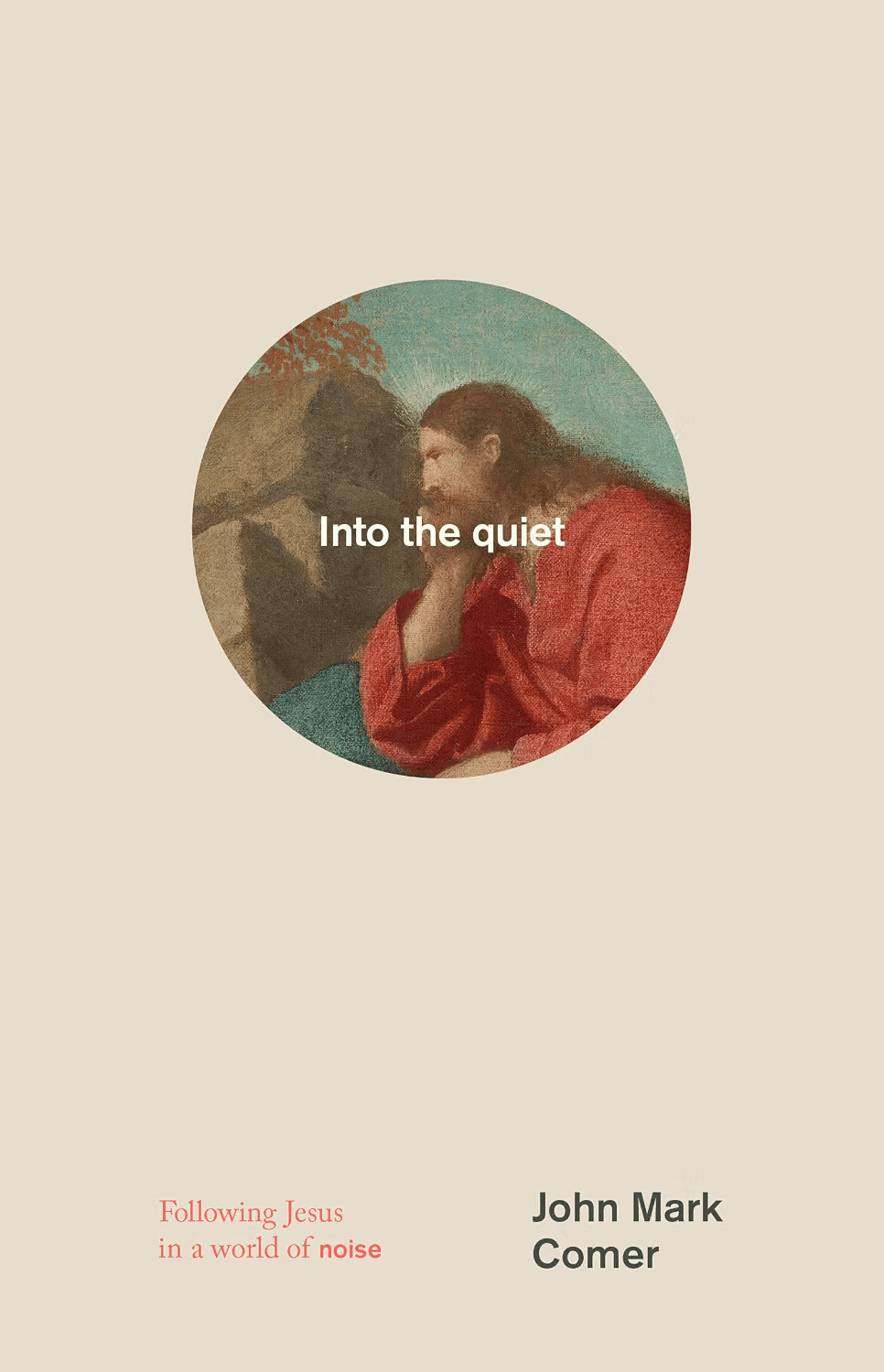
Taken from “Into the Quiet” by John Mark Comer. Copyright © 2026. Used by permission of WaterBrook.