Personal Spiritual Retreats: Fresh Water Your Soul
Alyson Pryor
4 min read ⭑
“I’m so tired,” I offered as a prayer. I pictured Jesus beside me, nodding solemnly. Yes, you are. “How do I fix it?” I asked, but the fading image was gone. Still, I felt the sturdy presence. Yes, yes, you are. I felt a wave of desire, hunger and thirst for rest and let myself feel it more thoroughly, more dangerously than I ever had before. The wave brought with it anger. Tears pricked at the back of my eyes. “God, why don’t you give me more rest? How am I supposed to teach and disciple and serve at church with all these demands at home? I can’t keep going. I’m so tired,” I said over and over and over.
Once I was done talking, I felt the tears dry on my face. Matthew 11 began to crystallize as my mind pulled at its edges from memory, “Come to Me, all who are weary and heavy-laden, and I will give you rest. Take My yoke . . . I am gentle and humble in heart, and you will find rest for your souls” (Matt. 11:28-30, NASB). The call of Jesus, offering me rest, felt like a raindrop falling into a still body of water, the echoes of those words extending, invading some new part of me.

Leyla Gulami; Unsplash
The imagery of Matthew 11, to come to Jesus, is to be with him where he is, and only there will our souls find rest. It is to be so close to him that we are tied to him like one animal tied to another, moving when he moves, pausing when he rests. The invitation is to keep pace with Jesus so that we similarly come away to rest as “often” as possible. If we are honest, many of us would prefer to be released into the fields as autonomous work animals. We would feel more comfortable with the Christian life if it included a GPS location for God’s will. But we misunderstand the call on our lives to be primarily people who get things done as opposed to people who stay close to Jesus.
In retreat time, sacred time, we come face-to-face with who we think God to be. Is he demanding, tapping his toe while we sit in the breakroom, waiting impatiently for us to return to our Important Kingdom Activities? Is he distant and aloof? Is he mad? Is he benign like a celestial Santa Claus, with good intentions but perhaps a tad helpless to give our souls the rest they so desperately need? As A. W. Tozer aptly points out, “What comes into our minds when we think about God is the most important thing about us.” But what comes to mind for us when we think on God is not nearly as important as what comes to his mind when God thinks about us.
This face-to-face, thinking on him as he thinks on us, is called beholding. And beholding is the only path to transformation, “Now the Lord is the Spirit, and where the Spirit of the Lord is, there is freedom. And we all, with unveiled face, beholding the glory of the Lord, are being transformed into the same image from one degree of glory to another” (2 Cor 3:17,18). Here Scripture offers us an additional image of being yoked to Jesus, an Old Testament image, of humanity face-to-face with God. When we come away with God, we are being changed; the more we look at him the more we look like him. What I perceived initially as an unexpected consequence of retreat — the terror of being face-to-face with the living God — was actually the plan all along.
“Many of us have yet to connect the abundant life Jesus offers with the pace at which he lived.”
A central question of retreat is: Do I see God as he is? Retreat offers an invitation to extended beholding, like a honeymoon for lovers or those gauzy, disorienting first days with a newborn, gazing into their bottomless gray eyes full of stars. The Holy Spirit needs time and space to do the deep internal work only he can do. None of this happens immediately, and usually not even quickly.
Whatever we behold transforms us. It forms our souls in a certain way to only and ever behold the finite when eternity is implanted within our hearts (see Eccles 3:11). Distraction is the enemy of the soul, and today’s souls are up against more distraction, disengagement and numb escapism than ever before. If we become what we behold, for the vast majority of us we are becoming whatever is on the screen of our phones. This screen, designed to addict, sparks to life whenever it recognizes our faces. When our eyes and minds and hearts are full of the here and now, the urgent, the popular, the newsworthy — it creates fear and compulsory action. Our culture might assert we are only and ever about what we do — our toil and our turnout. But sacred time away with God “dissolves the artificial urgency of our days,” exposing what is most real and true.
Many of us have yet to connect the abundant life Jesus offers with the pace at which he lived. For Jesus, retreating wasn’t a pause from his “real life,” it was life. He goes before us, showing that face-to-face time alone with God is the very thing our soul is most desperate for. It is the fresh water the animal within us has been hunting. In that fresh, clear pool we see God as he is, and eventually we even begin to see ourselves as we are — if we pause long enough for our rushed work to subside, the pebbles and sand to settle, and our thoughts like so much silt to descend so that we might see clearly.

Alyson Pryor is a marriage and family therapist and spiritual director. She currently serves as a staff spiritual director and adjunct faculty member at Biola University.
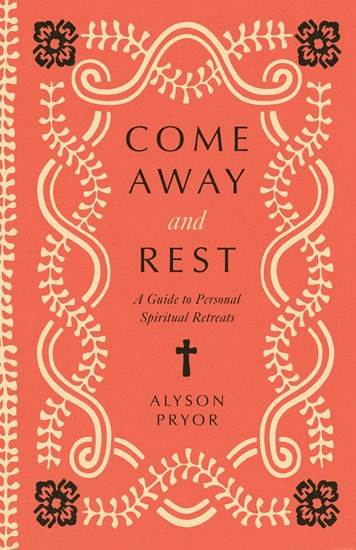
Taken from Come Away and Rest by Alyson Pryor. Copyright © 2026. Used by permission of InterVarsity Press.