Quiet Saints: The Practice of Living Quietly
Ryan Tinetti
7 min read ⭑
When the apostle Paul encouraged the Thessalonians to “live quietly,” it was a message that would have resonated with many in the ancient Greco-Roman world. Abraham Malherbe notes that the Greek word hesychazein (it’s as easy to pronounce as it looks), which literally means to “be quiet,” had “long described withdrawal from active participation in political and social affairs.”
The famous Stoic Seneca, for instance, viewed living quietly as a salutary substitute for the frenzied life of public officials; instead, one ought to “meditate and engage in more noble activities.” But Malherbe observes, “Sometimes a principled desire to retire from the demands of society to pursue a higher spiritual good is difficult to distinguish from a romanticization of the countryside.” Biblically speaking, however, living quietly isn’t a romantic ideal; it’s a gift of grace. It flows from a heart that is at peace with the Lord and can be lived out most anywhere.
We hear of this throughout the Scriptures. It first appears in dramatic fashion at the shores of the Red Sea. The Israelites have been hunted down by Pharaoh’s army and now are grumbling that God ought to have left them in slavery: “It would have been better for us to serve the Egyptians than to die in the desert!” (Ex 14:12, NIV). But Moses gives the emphatic reply: “The Lord will fight for you, and you have only to be silent” (Ex 14:14). Quietness signals confidence in God to save.

Unsplash+
The prophets also pick up on this theme. For instance, the Lord says through the prophet Isaiah, “In repentance and rest is your salvation, in quietness and trust is your strength” (Is 30:15 NIV; the next phrase, however, is instructive: “but you would have none of it.” Noisemakers aren’t so easily silenced.) And Zephaniah speaks movingly of this when he says, “The Lord your God is in your midst, a mighty one who will save; he will rejoice over you with gladness; he will quiet you with his love” (Zeph 3:17). The love of the Lord alone can still our restless souls.
The Psalms poetically and prayerfully capture this posture like nothing else can. “For God alone my soul waits in silence,” David prays. “From him comes my salvation” (Ps 62:1). And once more, in the famous verse of Psalm 46: “Be still, and know that I am God.” Living quietly, above all, means leaning on the Lord.
It’s with this cultural and biblical background that St. Paul will then tell us that living quietly is an aim worth praying for: “First of all, then, I urge that supplications, prayers, intercessions and thanksgivings be made for all people, for kings and all who are in high positions, that we may lead a peaceful and quiet life, godly and dignified in every way. This is good, and it is pleasing in the sight of God our Savior” (1 Tim 2:1‑3). God approves of the quiet life.
Which brings us back around, then, to our theme verse of the unambitious ambition: “Make it your ambition to live quietly.” The ancients commended it; the Scriptures, while modifying the vision, extolled it. But what does it look like to live quietly? I suspect that for many of us, though we might not be able to name Five Steps to a Quiet Life (which in any case seems contrary to it), we can recognize those people who are doing it, who in some respects embody, if you will, a “godly quietude.” They’re likely not monks, but rather folks who have a quality of spirit and clarity of vision such that their very lives, to paraphrase the famous line about Teddy Roosevelt, speak softly and carry a big stick.
Over the last few years, as the notion of quiet ambition has stuck with me, I’ve begun to notice and collect stories of quiet exemplars: people of faith who demonstrate the characteristics of living quietly.
I want to include one such sketch here.
Saint Helen: Quiet Gratitude
Helen had every reason to be bitter. They say that some people are dealt a bad hand in life, and Helen couldn’t muster a pair of twos. She had it hard, and for a long time.
Helen was a member of my congregation. She came into the world amid the Spanish flu epidemic, born in 1919, and lost a sibling before she could speak. Her father died in the shadow of the Great Depression, leaving Helen and her mother alone. “It’s just you and me now, sis,” Helen recounted her mom saying after the funeral as they walked down the street in Milwaukee, bereft. “We don’t have two nickels to rub together.” But no sooner had Mom said that than young Helen looked down and saw a shiny new nickel resting innocently on the ground. “Look mom!” Helen exclaimed. “Now we do!”
She married young and became a widow young. Ever a can-do gal, Helen found ways to make a living and keep herself and her two children afloat. She started a printing business. Though it wasn’t a money maker, she’d print little prayer cards with that iconic painting of Jesus on one side — the headshot in which he has brown, flowing locks and is looking off in the distance — and on the other a simple cry of faith: “You can get me through today, Lord!”
“We live in a restless, noisy age, fraught with myriad noisemakers, from digital technology to traffic to the wiles of the devil. All that noise threatens to distract us from the truth of Christ and his word.”
Helen remarried, only to become a widow for the second time before sixty. She lost a daughter, too, well before her time. Life kept dealing her body blows. But that’s when Helen got the idea of starting a support group for widows. Her pastor at the time gave her his blessing to host it at church, and the group blossomed into a haven of healing for dozens of women. At the center of it all was the slight, twice- widowed woman who just couldn’t stop smiling and pointing people to Jesus.
By the time I met her, Helen was pushing the century mark. She lived alone in a tired old mobile home, plastic flowers “planted” out front and porch lights flickering endlessly like a horror film. It was the world headquarters for an ongoing ministry of listening, care and prayer. Helen still fielded phone calls from all over the country. People who came over supposedly to help her, like the cleaning lady who visited twice a week, would invariably leave as the beneficiaries of more aid than they gave.
Helen’s one hundredth birthday party filled the fellowship hall at church. Sometimes the birthdays for older folks can be a melancholy affair; so many friends have passed on that there are more empty seats than occupied ones. But Helen was a perpetual friend-generation machine. Thus, there were folks from all walks of life — the young girl that she encouraged in drama, the Meals on Wheels volunteers, the director of the Council on Aging — whose lives had been touched by the woman I have come to think of as “St. Helen.” She regaled us with tales from the past century and how she had seen things change. (“From a carriage on the road to a computer in your pocket!”) But then she was sure to remind us all what hadn’t changed, singing a stanza from one of her favorite hymns:
Great is Thy faithfulness, O God my Father!
There is no shadow of turning with Thee!
All I have needed Thy hand hath provided.
Great is Thy faithfulness, Lord, unto me.
And then we stuffed ourselves with what looked like a wedding cake . . . at Helen’s request, of course.
Every time I visited her, Helen had the same anguished plea. At the conclusion of an hour or more spent talking, reading Scripture, celebrating the Lord’s Supper and praying, Helen would reach out her frail hand and grab hold of me. With tears streaming down her face and a smile that glowed, she would ask, “Who could help me count all these blessings? How will I ever number all these gifts from God?”
During her 101st year, she died like she was born: at home, in the midst of a global pandemic. Her life was poetry in more ways than one.
Hope abounded in Helen’s life, buoyed by thanksgiving. She lived quietly as she lived gratefully — even (especially) when circumstances didn’t seem to warrant it. And to be sure, Helen wasn’t Pollyanna; she could be incensed by the world, the devil and her own sinful flesh as much as the next guy or gal. But in the midst of it all, still she saw nickels from heaven.

We live in a restless, noisy age, fraught with myriad noisemakers, from digital technology to traffic to the wiles of the devil. All that noise threatens to distract us from the truth of Christ and his word. “For God alone my soul waits in silence,” prays the psalmist. “From him comes my salvation” (Ps 62:1). We endeavor to follow in the footsteps of the countless “quiet saints.” What are some steps in that direction?
Suggestions for practicing the quiet ambition:
Make your commute a time of quiet for prayerful communion with God, or listen to psalms, hymns and spiritual songs that lift your heart in praise (perhaps one of those in the morning and one in the afternoon).
Enjoy a walk without headphones at the end of the workday or over lunch.
Schedule an annual all-day retreat for rest, study and prayerful planning for the months ahead. This can be a challenge if you have a family; set aside the time in advance and arrange additional childcare if necessary. It’s worth the investment.

Ryan Tinetti is the assistant professor of practical theology at Concordia Seminary, St. Louis, where he teaches pastoral theology and the art of preaching. Before being called to the seminary, he spent 14 years as a parish pastor. He is the author of Preaching by Heart and The Quiet Ambition. He and his wife, Anne, have four kids and live on the campus of the seminary.
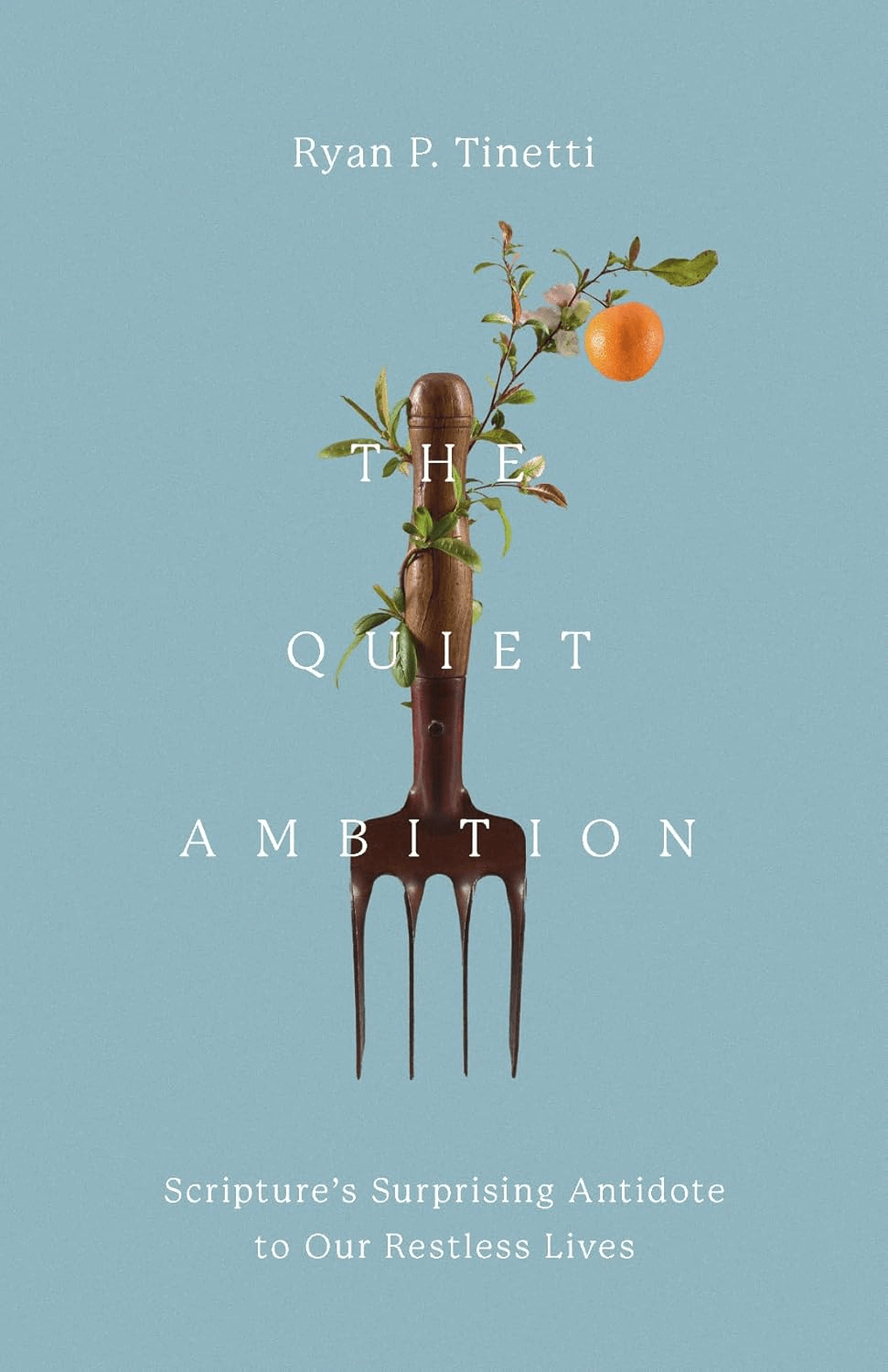
Taken from The Quiet Ambition: Scripture’s Surprising Antidote to Our Restless Lives by Ryan Tinetti. Copyright © 2025. Used by permission of InterVarsity Press.