The Longest Table in the World
Hannah Miller King
7 min read ⭑
For most people, growing up was a mixed bag of happiness and dysfunction. There are good memories, like the smell of cinnamon rolls baking on Christmas morning, the summer evenings chasing fireflies with siblings, the sweet warble of a grandmother’s voice singing in church. But there are also difficult memories. These are harder to articulate but also harder to forget: the silent treatment of a moody parent, the predictable smell of alcohol on adult breath, the loneliness of feeling unseen in a full room.
Given these complex histories, our ambivalence about home makes sense. As a college student in New Jersey, I invited friends to join me on monthly pilgrimages to the closest Chick-fil-A — a 45-minute drive — to buy gallons of sweet tea for my dorm room fridge. I felt somehow alienated from my home in the South, but I still wanted a taste of it with me to share with others.
I was fortunate to grow up with innumerable stories to savor and hold near, even while I processed the pain in some of them. But for many people I’ve met, the scales tip in the other direction. For them, home was not a nest from which to fly; it was a prison from which to escape. They want no taste of it in their mouths. These brave men and women know homesickness of a different kind — they miss the very things they never experienced. Our universal longing for safety, welcome and belonging are like breadcrumbs that lead us, if not back to our childhood tables, in search of another table altogether. Our hunger for what we’ve not yet tasted can convince us we’re crazy, or it can convince us that food exists.

Gaman Alice; Unsplash
In my spiritual journey, this other Table dared me to believe that my own experience of home was more than a passing memory. In Christ, I found a belonging that can’t be interrupted by cancer or a move to a new city or a poor behavioral record. His love is stronger than death. This love healed my ambivalence by integrating those things I most cherished about my childhood with my ongoing hunger to experience them: I didn’t need to hoard the memory of wholeness, because it remained on offer, my daily bread.
The almost-promise that tugged on my heart as a child was a signpost of a more solid reality, a more permanent presence than I knew to hope for growing up. This is true for all of us: The home we knew, as Frederick Buechner coined it, is only a window into the home we dream. One of the great surprises of the gospel is that in his mercy, God continues dreaming for us when the window goes dark.
* * *
For now, the Christian life is like living out of a suitcase.
We are called to be fully present where we are, to “seek the welfare” of our neighborhoods and cities. And yet we know that we aren’t sovereign over these places or the people within them — that they, too, are captives of an age that is subject to decay. We are invited to settle in, but without fully unpacking our belongings. The land is ours, but the house is still being built.
This is hard work.
In many ways, it is the original human challenge: to wholeheartedly love the world God gave us without making it an idol. When our first parents decided they needed the fruit of the tree more than they needed the closeness of God, they failed to rightly order their priorities. When we elevate any of God’s gifts — blessings like a spouse, a child, a hometown, a career — to a place of primacy in our lives, we are seeking a city without foundations.
These things can never bear the weight of our well-being.
In reaction to this, sometimes we err in the other direction. We practice such a thorough detachment from the material world that we fall short of loving the very things God has called us to love. We refuse to open our hearts to the beauty around us, believing instead that we must save ourselves for a far-off “heavenly home.”
In her book “This Homeward Ache,” Amy Baik Lee describes the learned temporariness of frequent moves and her reticence to fully enjoy the first house they bought for their family: “I am surprised to discover how hesitant I am to let myself love this place. I tell myself I want to hold it loosely, knowing that the Lord I follow had ‘nowhere to lay his head.’ . . . But if I’m honest, my stance is also a defense; a loose grasp will make things easier if a catastrophe strikes or we have to move on someday.” It was the writing of Anthony Esolen that helped her embrace the tension inherent in the call. She quotes him: “We have no abiding place on earth. But that does not mean that we are to love no place at all” (quoting Anthony Esolen’s introduction to “Nostalgia: Going Home in a Homeless World”).
How do we keep our hearts alive to what we know we will lose? How do exiles learn the art of homemaking?
When the Israelites were sojourning from Egypt, they knew they were headed toward a fertile and free homeland. God had told them it was a “good and broad” place, “flowing with milk and honey” (Ex 3:8). But the journey was hard and the desert was hot. Along the way, they wondered if captivity in Egypt was actually preferable to hunger and homelessness on the road. In response, God provided manna for them to eat.
“Thin places are believed to create a particularly hospitable environment for sensing God’s presence. The Lord’s Table is such a place.”
We’ve already seen how this miracle bread met their physical needs and bolstered their faith in God’s provision. But biblical scholars note another detail about the manna and therefore its meaning for God’s people: It tasted “like wafers made with honey” (Ex 16:31). Brant Pitre elaborates, “Why did the manna taste like honey? The answer is simple, but important: it was a foretaste of the promised land — the ‘land flowing with milk and honey.’ In other words, by means of the manna, God was calling the Israelites to place their trust in his ability . . . to see them home.”
In our long sojourn, we also have been given a heavenly meal.
The Lord’s Supper doesn’t fully ease the discomfort of this in-between place in which we live, but it does nourish us with the life of the One who became homeless for our sake. Jesus knows the ache of exile, homelessness and loss. He embraced these things so that we could ultimately be rescued from them. When we take the bread that Jesus called the true manna, we receive the strength to follow him to the land that he has prepared for us (See Jn 6:3233). The Eucharist reminds us that God’s provision here and now isn’t a finish line; it’s the sustenance to keep putting one foot in front of the other on the trail that he has blazed.
But that sustenance is more than mere utility. It also comforts us with a taste of our ultimate home. Our celebrations around the Lord’s Table whet our appetite for the final feast that Jesus is preparing upon his return. “The Lord’s Supper,” writes J. Todd Billings, “as a foretaste of the wedding banquet of the lamb and his bride, gives us a taste of God’s New World.” This taste is both familiar to us and foreign: The ordinariness of bread and wine is evidence that whatever God’s new world will be, it will bear some resemblance to this one. Like the sweet tea that comforted me in college, there will be aspects of the home we knew in the home we dream. The things we’ve loved along the way, insofar as they belong to him, won’t be lost but transfigured in the age to come. This emboldens us to open our hearts to the world we know now, because we understand even if we can’t hold onto it, he can and will.
But new creation also contains flavors that our palates can’t yet name. We don’t yet know what eternity tastes like. We’ve not yet lived in a place where “death shall be no more,” where crying and mourning and pain have passed away, where all things are made new. This is how Revelation describes the city that is coming, the “new Jerusalem” where God will dwell with us forever (Rev 21:15).
This future is not just a plan, it’s a promise. I don’t pretend to understand it. But in our shared Supper, I do believe that we are glimpsing it, even if only in part.
* * *
In Celtic spirituality, there’s an ancient recognition of “thin places,” where the veil between heaven and earth is especially translucent. Thin places are believed to create a particularly hospitable environment for sensing God’s presence. The Lord’s Table is such a place. We find it in grand sanctuaries with stained glass windows and in borrowed school cafeterias where new congregations gather. We find it in beautiful mountain towns and in war- torn countries; in national cathedrals and in illegal underground churches. In every place that God’s people gather to commune with him, heaven touches earth and we experience, in part, the fellowship that characterizes our forever home.
A colleague of mine used to say that the Eucharist creates “the longest table in the world.” It was his way of reminding us that there are people communing with Jesus on another side of the Table, just beyond the veil. We can’t see them now, but one day we will. My father is among them and also, I believe, my brother, my grandmother, and countless children of God I’ve yet to meet. Some days this veil feels especially thin to me, and I can sense their presence. Most days it doesn’t. But when I take the bread and the wine, I am reminded that the full table I long for is real and is coming. And that is enough for now.

Hannah Miller King is a writer and a priest in the Anglican Church in North America. She writes for Christianity Today and serves as the associate rector at The Vine Anglican Church in western North Carolina.
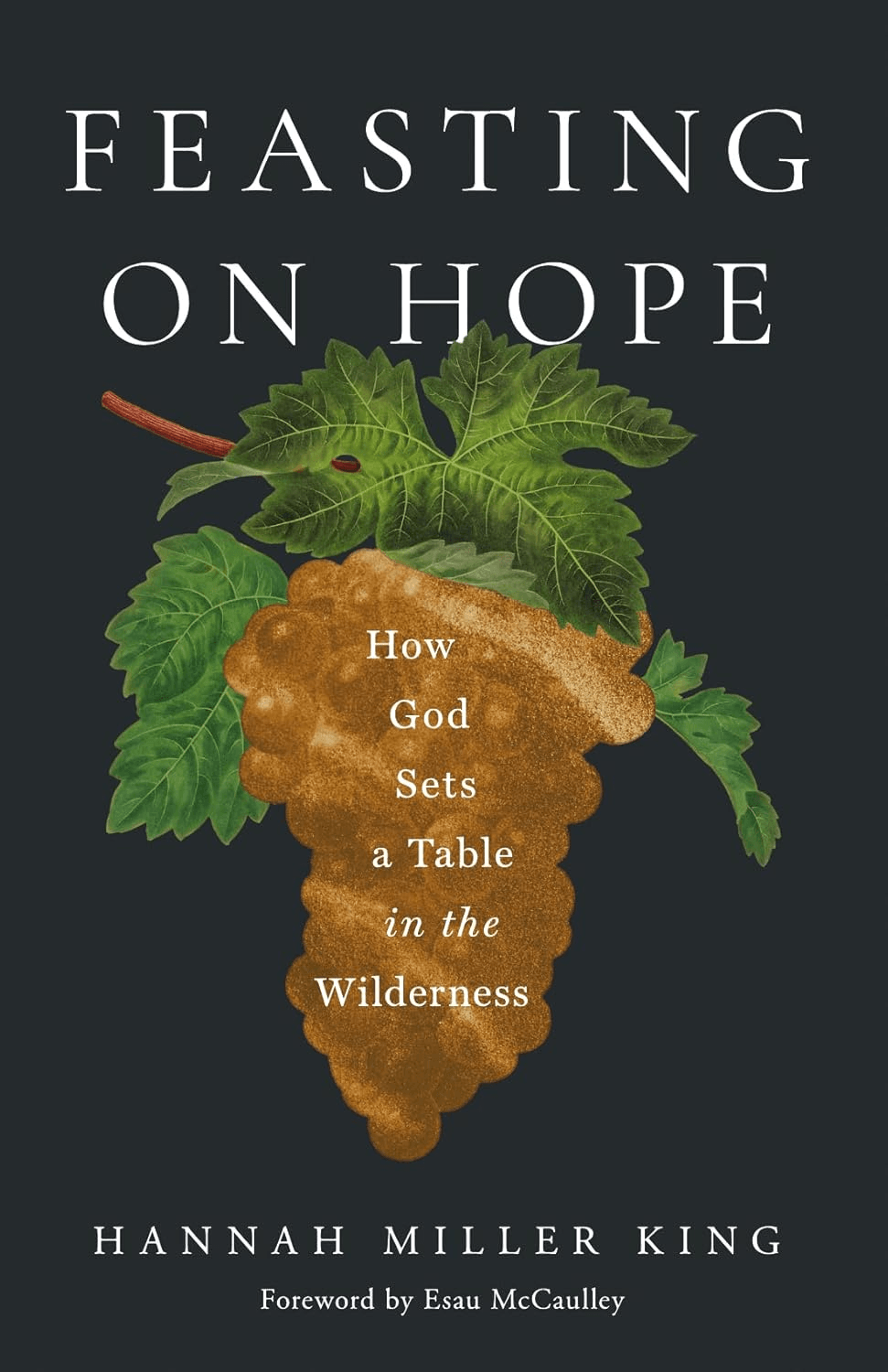
Taken from Feasting on Hope by Hannah Miller King. Copyright © 2026. Used by permission of InterVarsity Press.