A Pot Without Handles
Sydney Anne Bennett
6 min read ⭑
Suffering will either seal you forever in the grip of despair and anger or seal you deeper in the grasp of God. Suffering itself is not sin. Pain isn’t punishment. Struggle isn’t a consequence of some secret failing. But sin does crouch at the door of suffering, waiting to twist it open. Not usually through sudden rebellion or dramatic disbelief, but something much quieter — a subtle tinkering of the emotions, a vague “giving in just this once” to the indulgence of secret feelings that whisper untruths we don’t fully believe.
Sin whispers, “Let yourself feel — just for this moment — that everything is a little unfair. Just feel that God is being unkind to you. You’re not really believing that you’re just so tired . . . so disappointed . . . so aggrieved. It wouldn’t be so hard except for the timing of it all. It’s just one thing on top of another. You could bear it if only this were different.”
But you should know what is happening. Sooner or later, your unguarded feelings shape untrue thoughts — thoughts about God— the way you perceive him — not because your doctrine has changed, but because you just “feel” differently about him. This is why Isaiah warns, “Woe to him who strives with him who formed him, a pot among earthen pots! Does the clay say to him who forms it, ‘What are you making?’ or ‘Your work has no handles’?” (Isaiah 45:9 esv).

Unsplash+
I often feel like a pot without handles. Clumsy, useless, awkward — the one in the kitchen that no one takes off the shelf. “God, I could do so much more for you if you hadn’t given me this exhaustion that weighs on every cell, these seizures that sap my mind and strength, this pain that steals my focus — all these extra obstacles between me and doing the right thing. God, I would be so much more useful if you had made me with handles!” I mask my resentment under a guise of suffocated holiness.
My feelings are the god I worship in a field of outcast prayers.
Isaiah 45:11,12 provides God’s answer to me: “Will you command me concerning my children and the work of my hands? I made the earth and created man on it; it was my hands that stretched out the heavens, and I commanded all their host” (esv).
If you are confused, wondering what on earth God is doing with you, asking, “Why this, Lord? And why me?” then you are in good company. You ask alongside Abraham and Moses, the whole nation of Israel, the psalmists, the prophets, the judges, the exiles, the disciples, and the church. You are alongside a cloud of witnesses who also wondered and asked God, “Why?” God didn’t always tell them the answer — in fact, he usually didn’t. He told them to obey and trust him, walking forward into the unknown in faith. God promises to use all his pots well. Even — especially — when they’re handle-less. One night, I cried and struggled in terror as I saw someone I loved trying to kill me. My husband, Colton didn’t know — couldn't possibly know — what I was seeing on the dark edge of our living room wall. When I started to stagger at the kitchen sink, he held me up and pulled me into the room where I could lay down on the floor. I fought against him as he pulled me in there. He lowered me onto the ground and I struggled harder, barely feeling the flood of tears on my cheeks, the crack in my screams. I screamed, feeling the exposure, the vulnerability of being laid on my back in that awful place.
“Please don’t hurt me — please don’t hurt me!”
“Darling, no. Sydney . . . Sydney, I would never hurt you. Please. no . . . please, baby.”
He bent over me, his arms around me, his head against my chest, the weight of his legs curled around the sides of my waist.
I heard the pain in his voice. I knew somehow, I had caused it.
Fresh guilt and terror and confusion surged into my chest.
“I’m sorry, I’m sorry,” I sobbed to his shadow. Then, “I’m sorry, I’m sorry,” and I spoke to the shape behind him, the shape that was clearer than everything else, my brother lying on the floor, and them, a monstrous visage, crumpled with grief and wild with pain, coming for me.
“Get off! Get off! Don’t touch me!” I screamed, flailing my arms wildly against Colton’s chest.
“Coming to the Lord with your shame, your anger, your confusion, your grief, and your pain is not sin — it is faith.”
I saw his shape retreat against the door, distant and blurry, the red of his shirt the brightest part of him. I sobbed into the carpet and convulsed for a long time. Then, my mind went blank. No terror anymore, only heavy, weight-filled exhaustion. I lay still, feeling my own breathing, the threads of the carpet against my face, the weight of my chest across my arms, the wetness on my cheeks. I opened my eyes. Colton sat against the door, staring at me, clear and real. His red shirt, quite close. I saw his face. He told me later the episode lasted just shy of two hours. I slept most of the next day, exhausted.
I had episodes like this — every night — when my mind forsook me, moments of total fear and confusion, seeing and hearing things that weren’t there, speaking and thinking as a frightened child.
Waking up always felt like realizing I had dragged someone else into my own nightmare, except he knew I was dreaming, but I did not. I stood literally helpless, vulnerable, naked before my husband. But rather than see my shame, Colton held me, comforted me, loved me, helped me, protected me, served me. He listened to my confused fears and childish questions and explained things to me again and again. He held me when I fought and screamed against him; he undressed me, washed me, and clothed me again. I saw shame, brokenness, exposure. Colton saw the woman he loved.
That is what Isaiah promises. He is saying, “You feel like you cry out to God and he doesn’t hear you! You think this is all in vain! You think you are a useless lump of clay! You live in fear and confusion and pain! But God hears you. God knows. And God promises you will not be ashamed and confused forever. He is forming you for something beautiful and glorious. He looks at you and sees his beautiful bride, whom he loves. He will hold you, protect you, comfort you, love you, clothe you. You say you are broken, but God calls you beloved.”
Shame is here, lingering in unspoken corners. The way you shrink into yourself when you need help. The way you smile and hurry through small talk rather than letting someone see your weakness. The way you tell yourself, This isn’t my fault, while still feeling the crushing burden of failure. The shame of needing help when you used to be independent. The shame of a diagnosis people don’t understand. The shame of not being able to hold everything together the way you once could.
Shame and guilt are different. Guilt is objective: a true conviction that follows sin or wrongdoing. But shame can creep in even when you’ve done nothing wrong. It whispers, “You are not enough. You are a burden. You are broken. This is your fault.” It convinces you that needing help is the same thing as failing, that being seen in your weakness is something to fear.
I try to hide it. I want to carry my suffering quietly, gracefully. But deep down, I fear what people would think if they really saw me — if they saw the way my body betrays me at my most vulnerable moments, the way I sometimes still crumble under the weight of it all.
We cry out, feeling we have sought the Lord in vain. But God responds, “I am the Lord, and there is no other. I did not speak in secret, in a land of darkness; I did not say to the offspring of Jacob, ‘Seek me in vain’” (Isaiah 45:18–19 esv, emphasis added). Don’t try to hide your shame from God — he already knows. Hold it up to him with open hands. Show him. Tell him why. Cry to him. Ask him to take your shame from your heart, to help you trust him even when your body cries against trust. Ask him to deliver you. Tell him of your weariness, your burden, your heavy-laden soul. Ask him for rest. Coming to the Lord with your shame, your anger, your confusion, your grief, and your pain is not sin — it is faith.

Sydney Anne Bennett is a writer, disability advocate, and speaker who helps people struggling with chronic illness and pain find confidence and hope again — while pointing them to Jesus. Two weeks after her honeymoon, Sydney became disabled and was later diagnosed with Functional Neurological Disorder (FND), a condition that disrupts the brain’s ability to send correct signals to the body. She experiences daily seizures, chronic pain, and mobility loss — and often uses a wheelchair. In 2022, Sydney began sharing her story on Instagram as a way of processing grief, faith, and the strange in-between of being both young and disabled. Today, she encourages a global audience of over 300,000 people with honesty, humor, and hope that leans hard on Jesus. She lives in Idaho with her husband, Colton, and their two daughters, Hadassah and Felicity.
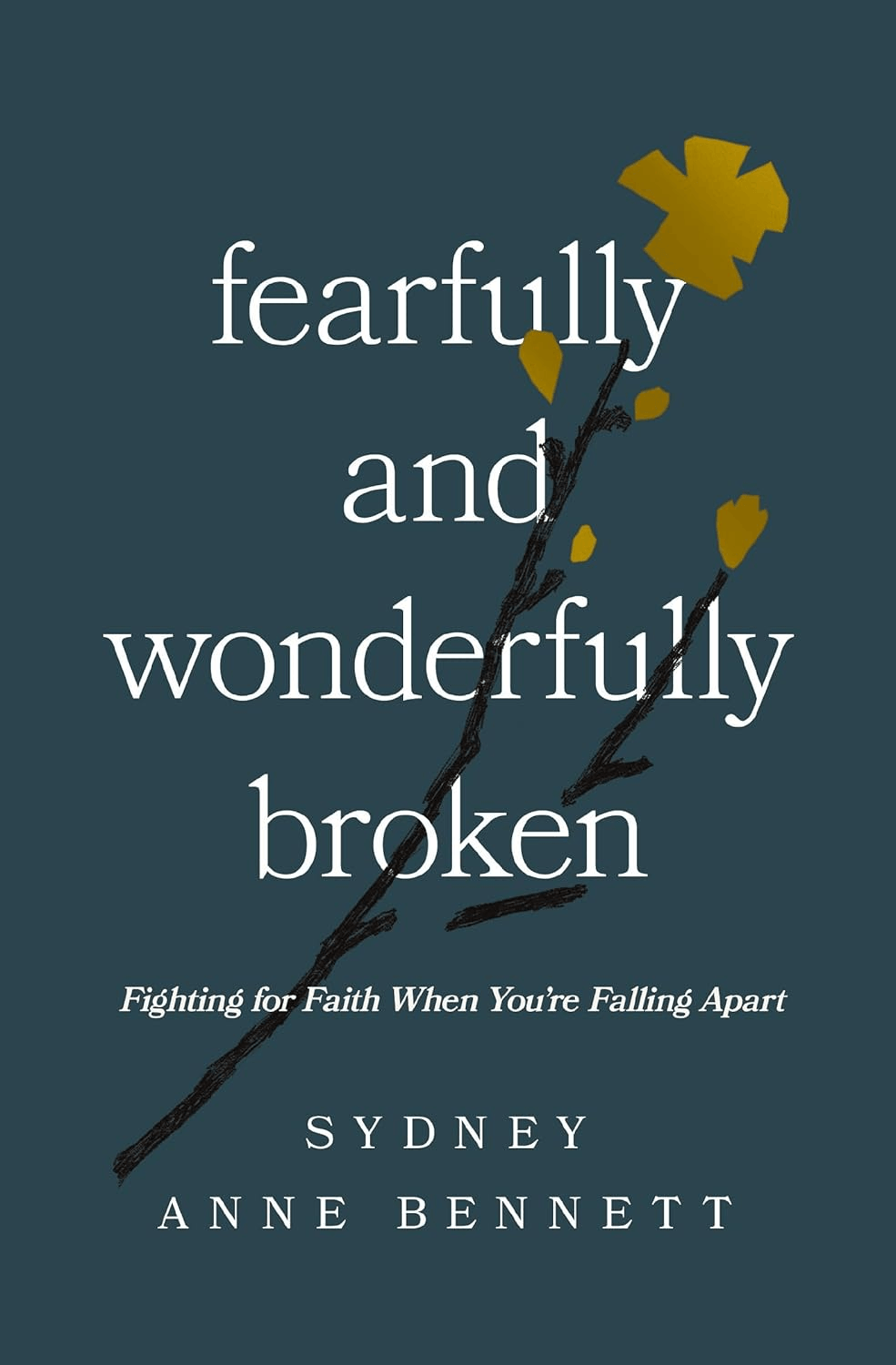
Taken from Fearfully and Wonderfully Broken by Sydney Anne Bennett. Copyright © 2026. Used by permission of Thomas Nelson.