Beyond Reason but Not Against It
Aaron Graham
6 min read ⭑
I was ten years old the first time I feared for my life.
My family was living in Kuwait as missionaries during the Persian Gulf War when Saddam Hussein’s forces invaded. We were taken hostage.
It was terrifying. My mom, my brother, and I were released after six weeks, but my dad remained a hostage for another three months.
People around the world were praying for his release — literally millions. During a specific week when churches had been especially mobilized to pray, something extraordinary happened. Saddam Hussein began having disturbing dreams — so intense that he couldn’t sleep. He later said that God was troubling his spirit.

Dmytro Koplyk; Unsplash
At the time, Saddam had taken hostages from Western countries and placed them at military sites across Iraq and Kuwait to use as human shields. It was his last remaining tactic to prevent an invasion of over 500,000 U.S. troops who were waiting in Saudi Arabia. But after these sleepless nights from troubling dreams, Saddam shocked his cabinet by ordering the release of the hostages. The next day, my dad was on a plane back to the United States.
Even years later, former Secretary of State James Baker and other senior officials couldn’t explain why Hussein made that decision. My dad had the opportunity to speak with President George H. W. Bush, who told him plainly: “I still do not know why Hussein released the hostages. But it made the decision to invade Kuwait much easier.”
He didn’t know. But I do. It was God. It was God who woke Saddam up. God who troubled his spirit. God who moved on the heart of one of the world’s most wicked leaders in response to the prayers of his people.
There is no rational explanation for it. But that’s the point. Some things are simply supernatural.
I grew up Baptist, firmly planted in the “truth” camp. The joke was: We believe in the Father, the Son, and the Holy Bible.
The third member of the Trinity? He’s only mentioned in the context of bringing us to salvation, not for supernatural empowerment for life and ministry. We were taught about the service gifts — leadership, hospitality, generosity — but not the supernatural gifts of healing, tongues, and prophecy, or in signs and wonders.
I am deeply grateful for my Baptist roots and the strong biblical foundation I received. But I also long to experience the fullness of everything God has for us.
The Truth: There Is a Supernatural Dimension
Jesus entrusted us with a mission far too big to accomplish without him. He commanded us to make disciples of all nations and to go to the ends of the earth (Matthew 28:19,20).
In the Upper Room before his death, he made a profound promise: “Whoever believes in me will do the works I have been doing, and they will do even greater things than these” (John 14:12).
Christianity is supernatural at its core.
The very foundation of our faith rests on the miraculous — most significantly, the resurrection. Paul made this clear: “If Christ has not been raised, our preaching is useless and so is your faith” (1 Corinthians 15:14).
To believe in the miraculous is to believe that God does things that are beyond science or human explanation. It could be protection in a dangerous situation, a precise answer to prayer, unexpected financial provision, physical healing, or a broken relationship restored.
These things cannot always be rationally explained, but they are undeniably real. Every Christian has a testimony of God’s supernatural work. At minimum, every Christian believes in the miraculous bodily resurrection of Jesus.
“The invitation here is simple but profound: Live a Spirit-filled life in an age of increasing skepticism.”
Paul understood this need for supernatural, not just rational, encounters with God when he wrote: “My message and my preaching were not with wise and persuasive words, but with a demonstration of the Spirit’s power” (1 Corinthians 2:4,5).
Jesus understood it too: “A time is coming and has now come when the true worshipers will worship the Father in the Spirit and in truth” (John 4:23).
True worship must engage the head and the heart. They must move in the same direction. In other words, faith is beyond reason but is not against reason. “By faith we understand that the universe was formed at God’s command, so that what is seen was not made out of what was visible” (Hebrews 11:3).
The witness of God is this: He doesn’t contradict reason — he transcends it.
Jesus embodies both divine mystery and rational truth in perfect harmony. He is fully God (Spirit) and fully man (incarnate). His resurrection, which is historically verified, defies human logic — and yet it stands at the very center of our faith. It reminds us that God’s reality is greater than human reason.
The Commitment: Walking in the Spirit (Spirit-Filled Living)
The invitation here is simple but profound: Live a Spirit-filled life in an age of increasing skepticism.
Skeptical believers often feel torn — inclined to resist the work of the Holy Spirit for fear of losing intellectual integrity. But Jesus shows us that it’s not necessary to choose between the head and the heart. In his life and ministry, reason and revelation moved in harmony.
The Spirit-filled life is marked by a hunger to discover and operate in the gifts God has given. And these are not reserved for a select few. They are available to everyone who has surrendered their life to Christ.
God isn’t looking for people who have it all together. He’s looking for willing hearts — hearts he can supernaturally equip.
Spiritual gifts aren’t discovered through passive observation. They’re discovered through active service. They’re given to build up the church and bless the world.
The Bible teaches about these gifts in several places:
1 Corinthians 12 — Manifestation gifts: Prophecy, tongues, healing, words of knowledge, miracles, faith, discernment
Romans 12 — Service gifts: Mercy, hospitality, administration, generosity, exhortation
Ephesians 4 — Leadership gifts: Apostles, prophets, evangelists, pastors, teachers
A healthy, growing church operates in all these gifts.

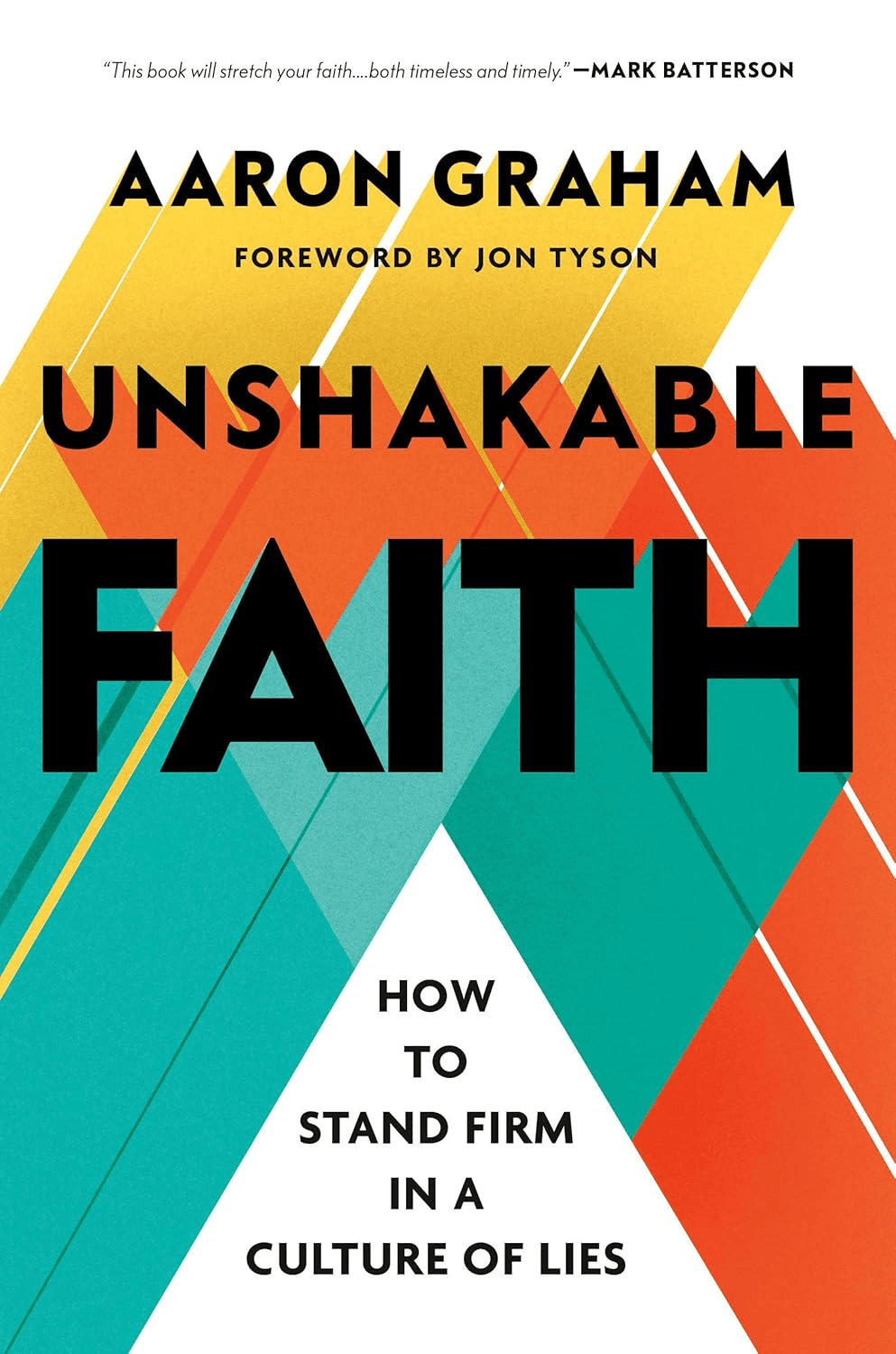
Aaron Graham is the founding and lead pastor of The District Church, a vibrant, multiethnic community in the heart of Washington, DC. He is the author of Unshakable Faith: How to Stand Firm in a Culture of Lies, and he holds a master's degree in public policy from Harvard's Kennedy School and a doctorate in missiology from Fuller Seminary.
Taken from “Unshakable Faith” by Aaron Graham. Copyright © 2026. Used by permission of Multnomah, an imprint of Penguin Random House Christian Publishing.