Da Vinci Is Not Hanging in the Louvre: The Creator/Creature Distinction
J.D. Lyonhart
11 min read ⭑
“Mom, is God real?” the little girl asked, looking down with grim concern. They’d had the Santa talk a few years earlier, and I suppose she was worried that yet another brick from her childhood was about to come crashing down.
Mother didn’t answer that day. Instead, later that week, she took her young daughter on a hike up the local mountainside. After marching upward in sweat and sun, they finally turned around at the tippy-top to behold the beautiful valley below. Glacier mountains stretched from the right side all the way down to the Pacific Ocean, where Bowen Island poked up and out of the choppy, sun-gleamed surf. Greeting the waters at the shoreline were endless pines standing at attention, swayed by the back-and-forth breath of ocean breeze. Enthralled, the mother pointed out that the natural world in front of them, proclaiming with breathless praise, “This is God.”
I learned about this encounter years later from the daughter, and it deeply resonated with me at the time. This romantic merging of God and nature is one of the few ways faith can still seem relevant today. A bearded father figure in the clouds feels distant, dull and outdated. But a cosmic Mother Nature still tickles our spiritual itch, as shown by these quotes from popular thought leaders:
Oprah Winfrey: “I think if you believe in the awe and the wonder and the mystery [of the universe], then that is what God is. That is what God is, not the bearded guy in the sky.”
Lee Bladon: “God/Life/Universe is everything and everyone. ... Life becomes so simple when we remember that everyone is an aspect of God.”
Neale Donald Walsch: “There is no separation between me and God, nor is their [sic] any difference. ... God and I are one.”
John Lennon: “I believe that what people call God is something in all of us.”

Unsplash+
Millions of people today believe that the difference between us and God is an illusion. God is the birds, trees, dogs and bees, and everything in between, including us (because we’re part of nature too). I am God. You are God. We are God. I am he … as you are me … as we are we … and we are legally restricted from quoting more than three lines of a Beatles song in print. Creator and creature are one. And if I am one with God, and God is one with you, then, logically, we are one with each other. Hi, me! I am one with you, and you are one with the ocean, and the ocean is one with the sky. We are in a dream state on earth, and when we wake up, we realize there are no real distinctions between things. There is only God.
And we can really see this seeping into our cultural conversation. By which, of course, I mean Disney movies. In “Avatar,” the goddess Eywa is made up of all living things, connecting the entire forest and the natives into one united consciousness. In “Moana,” the sea and the islands are depicted as gods, with nature alive and full of divinity. In “The Lion King,” Mufasa says, “Simmm-ba, we are all one.” (Five bucks says you read that in a James Earl Jones voice.)
Now, in my last article for this publication on Genesis 1:1, I tried to go back to the beginning and experience the universe as if for the first time, recapturing the beauty, intelligence and awe of creation. And as soon as we do that — as soon as we appreciate how awesome the universe is — it makes sense that our next response might be almost worship-like. Many of our ancestors bowed down and prayed to nature itself, and as someone who used to sneak out and sleep under the stars, I very much understand that impulse. Leave me alone in the woods too long, and I’ll be tempted to worship a goat’s head and make sacrifices to a tree (just kidding, mostly).
However, that excerpt on Genesis 1:1 also made something else clear: God is not the universe but exists before the universe. The Creator and creation cannot be the same thing, because one made the other: “In the beginning God created the heavens and the earth.” That’s precisely why Christians will often refer to the universe as creation — because God created it. God is the artist; we are the art. We exist within time and space; God created time and space. God is the Creator; we are the creatures. We are not God, and God is not us.
This is known as the Creator-creature distinction, which is an obnoxious mouthful of a way to say, “You’re not God, Melissa!” In the Christian story, there is a difference, a divide, a distinction between God up there and us down here. The Creator is not part of creation but exists before and beyond creation. The Bible takes this distinction very seriously, warning us not to worship creation as if it were the Creator and declaring such worship to be idolatry.
But who cares? What’s the big deal? Why does the Creator-creature distinction really matter?

Well, first of all, if my friend’s mom was right and I really am one with God, then where does God end and I begin? If all the things that make me distinct from God are an illusion, then what’s left of me? What’s left of you? You and I would not be different people with unique personalities. No, we would just be one divine hive mind. The differences and distinctions between us would be an illusion of the body. Your unique personality, choices, dreams, heartaches and idiosyncrasies would be deceptions to be shed. All the things that make you you wouldn’t be real. The only thing that would be real would be God. Which is actually what millions of people believe:
What is truly “me” is no other than what is truly “you” and what is truly all. By losing self you find [the universal God].
—Adyashanti, The Direct Way
The tangerine I am eating is me. The mustard greens I am planting are me.
—Thich Nhat Hahn, The Miracle of Mindfulness
I am the tablet, I am the stylus. I am Abraham, Moses, Jesus. I am Gabriel, Michael, Israfil. Whoever comes into true being is dissolved in God, is God.
—Bayezid Bistami
You are but a drop in a divine ocean, dissolving into God. The droplet gains the ocean but loses itself. Once you blur the line between Creator and creature, it can become hard to tell where God ends and we begin in the homogenous God-blob. The creature is lost in the Creator.
Another thing that can happen is that the creature begins to be worshiped like the Creator. For if we are one with God, then yes, that might mean we lose some of our individuality. But it also means we’re gods. You have an inner god-self, which has helped advance a culture that absolutizes the self as the only God worth serving: Be true to yourself. Get in touch with your inner goddess.
In fact, there is a recent religious movement built around chanting the words “I am.” Ancient Jews reserved the words “I am” to describe God alone, but this group takes this divine title and applies it to themselves, affirming their own divinity. They wake up and start the day by chanting “I am!” then combine it with other phrases: ‘I am all things. I am the captain of my own soul. I am perfect. I am absolute. I am the creator of my world. I am all-powerful.’ These aren’t exaggerations. A lot of popular spirituality books say that when you get in touch with your inner god-self, you acquire the powers of a god. You develop telepathic, telekinetic control over nature.
You might be familiar with the bestselling, Oprah-featured book “The Secret,” by Rhonda Byrne. It claims you can alter the world around you through your mind. Negative thoughts can cause disease, natural disasters, car crashes or even bad weather. Positive thoughts can heal cancer and bring wealth, good luck and, of course, good weather. More extreme versions claim you can fly, predict the future or move objects with your mind. Like a god.
So once you merge Creator and creature, perhaps it’s inevitable that creatures will start to worship themselves and believe that if only they’d figure out the secret, they too could have the powers of a god. And even if creatures don’t worship themselves, we may often worship other parts of creation like a god. I know how quick I am to worship money, houses and shiny things. How quick I am to worship coffee, narcotics or food. Fish-line a pork chop in front of me, and I’ll run on water like a cartoon.
“We may be connected to God, but that doesn’t mean we are God. An artwork may reflect its artist, and yet da Vinci himself is not hanging in the Louvre. How terrifying it would be if he were.”
So the Bible says it’s wrong to worship ourselves and other created things. Yet once you break down the Creator-creature distinction, it’s hard to believe anything can be wrong at all. There can’t be any moral standard that is higher than me because there is nothing outside or beyond me — I am everything! There can be no evil or sin or fall away from God, because I am God, and God is perfect. This is why popular channeler Paul Selig writes, “It was always illusion that you were separate from God. ... It was always illusion that there was war ... always illusion that you were not loved by your fellow man. ... You are all perfect.” So if the Creator-creature distinction is removed, then nothing can truly be wrong. Everything is awesome.
In which case, the goal is no longer to shape up or face our flaws. No, the goal is to awaken from the illusion and realize that we already are perfectly divine and divinely perfect. There is no immaturity, no cruelty, no abuse, no poverty and no need for us to do anything about it. As Shakti Gawain states, “There is no separation between us and God. ... There can be no real lack or scarcity; there is nothing we have to try to achieve.” Everything is bright and bubbly; you are a perfect ray of sunshine who doesn’t need to change a thing.
What is more, if there is no Creator-creature distinction, then God is one with not only the good parts of creation but the evil parts as well. If God is one with all of creation, then God is as much one with Joseph Stalin as with Mother Teresa. The difference between loving someone and hating them is an illusion, for all things are one in God. If goodness is one with God and God is one with evil, then goodness is one with evil. If A = B and B = C, then A = C.
You see this in Star Wars, where the force is one with all things. If you pay attention to the script, the light side of the force is not morally superior to the dark. The goal isn’t to bring more light to the universe; no, it’s to bring balance to the force, to bring light and dark, good and evil, into harmony, and to hold both together equally as one in the force. That’s why it’s said that Anakin brought balance to the force, even though he killed the younglings and became Darth Vader. We root for the light side when we watch the movies, but according to its own logic, there’s no reason we should. The force is one with all things, and so the dark side and the light side are equally one with the force and each other. And if the Creator is one with good and evil — and good and evil are one in the Creator — then morality is an illusion. Sorry, younglings.
So if the Creator is one with creation, then yes, God is the rosebushes, mountains and sunsets. But God is also disease. God is the tumor in your mother’s flesh. God is the bullet of the oppressor, the fist of the abuser, the walls and pipes of the gas chamber. And this would not just lower God in moral terms but would also lower God in dignity: God is the leftover pizza. God is your nail clippings. God is the fungus on your left foot. God is parasites, feces and Justin Bieber. Once the distinction is gone, the Creator is lowered to the level of creation.
So those are some of the potential pitfalls of breaking down the Creator-creature distinction. Yet some of the authors who talk about oneness with God and the universe mean something more along the lines of connectedness, not literal one-to-one sameness. For them, oneness is used more in the sense that I am one with my spouse rather than in the sense that the Rock and Dwayne Johnson are one and the same person. They mean a oneness of intimacy, not identity (or at least, not 100% identity). They want unity, yes, but a unity amid diversity, with at least some of the differences and distinctions between things remaining intact. In this way, some of them may avoid the pitfalls we’ve explored above.
Yet note that in order to do so, they inevitably have to reassert some Creator-creature distinctions somewhere in their belief system. And that’s the point. I’m not trying to argue that everything these thinkers say is stupid (in fact, I quite like the idea of the mystical interconnectedness of all things). I’m just trying to show that the Creator-creature distinction is important, and that’s why even those who may seem to reject it in one place often end up reaffirming it in another. We may be connected to God, but that doesn’t mean we are God. An artwork may reflect its artist, and yet da Vinci himself is not hanging in the Louvre. How terrifying it would be if he were.
My wife and I have twin toddlers named Søren and Augustine. Which tells you two things: first, that I clearly won the battle over who got to name the kids, and second, that I am a twin parent. Double trouble.
With twins, it can be hard for them to figure out who each of them is as an individual. They’re always together. They look the same. They get treated the same. So something I used to do at night, right after bath time, is take them one at a time on their own and hold them up to a mirror. I’d point at myself in the mirror and say, “Da-da.” Then I’d point at each one of them and say their name. I’d do that over and over, trying to get them to see themselves, to help them understand they exist on their own, as an individual. And when I’d point and say their name and they’d realize it was them in the reflection, their eyes would light up and they’d lose it with this joyful, ridiculous laughter.
As my boys grow up, I want to do everything I possibly can to preserve that original joy they have in realizing that they exist. I want them to believe the words of Dr. Seuss, “Today you are you! This is truer than true! There is no one alive who is you-er than you!” I want them to know that they were created as distinct individuals and they don’t have to dissolve who they are to be close to their Creator. I want to affirm who they are.
But at the same time, I also want them to know they’re not the center of the universe. They are not God. They are creatures — fallible, finite, flawed creatures. They will make mistakes and need forgiveness.
I want them to grow up in the real world — to know that people really are struggling, starving and hurting each other, to know that it’s not all an illusion. I want them to grow up to see the world as it really is and to try with everything they have to make it better. And then, at the end of their lives, when they haven’t managed to fix everything, I want them to still be able to rest in the grace of God, to accept that they’re not perfect, that they can’t carry the weight of the whole world.
Because they’re not God. Only God is God.

J.D. Lyonhart is a British-Canadian theologian, philosopher, author and ordained minister. He is an associate professor of religion and philosophy at the University of Jamestown, a fellow at the Cambridge Center for the Study of Platonism at Cambridge University and a co-host of the Spiritually Incorrect Podcast. In addition to The Journey of God, he also authored Space God, as well as MonoThreeism: An Absurdly Arrogant Attempt to Answer All the Problems of the Last 2000 Years in One Night at a Pub.
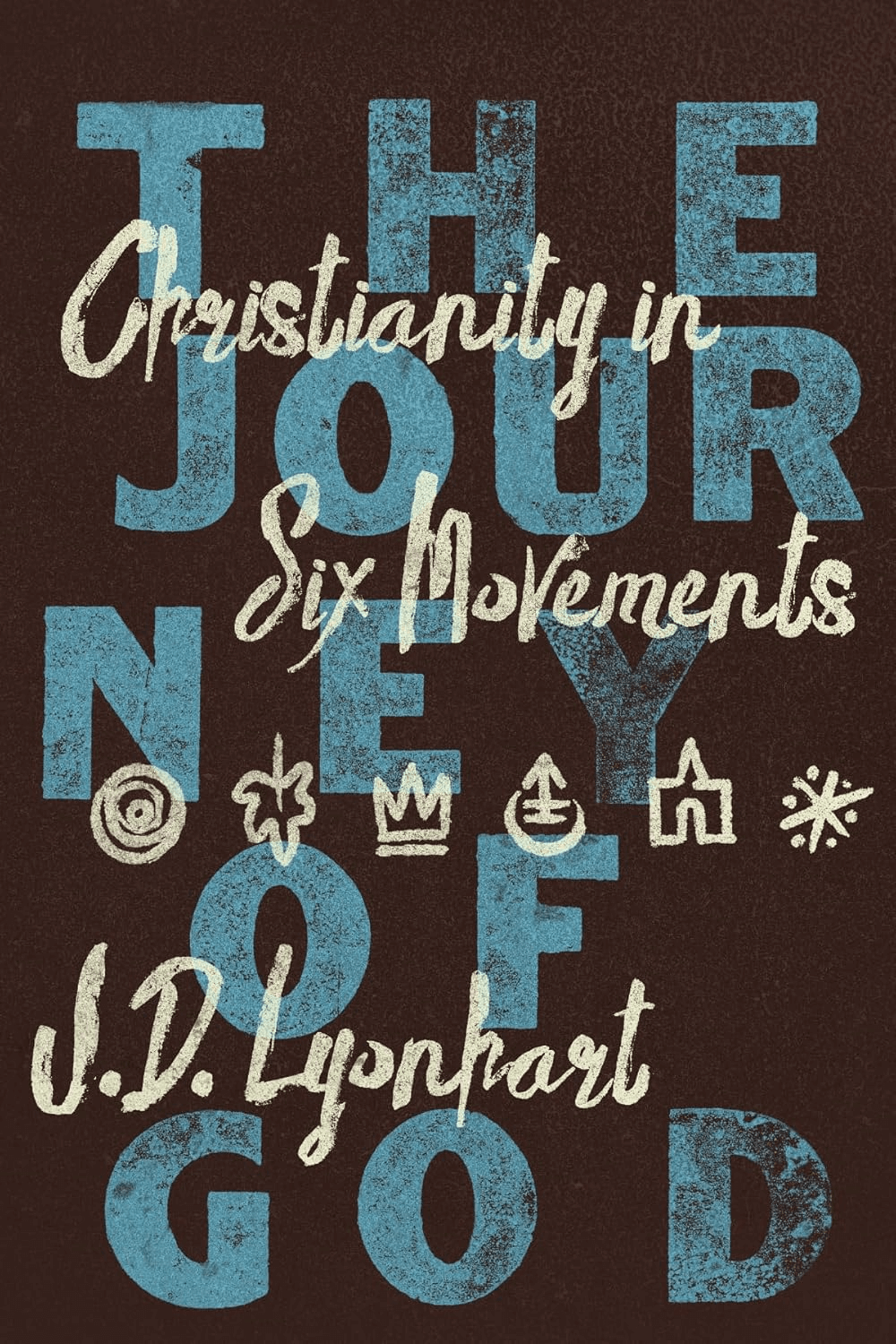
Taken from The Journey of God by J.D. Lyonhart. Copyright © 2025. Used by permission of InterVarsity Press.