In the Beginning, After All: The Big Bang, Backward
JD Lyonhart
9 min read ⭑
“In the beginning . . .” (Genesis 1:1).
With these first three words, the Bible already put its foot in it. For the Greek philosopher Aristotle had argued that the universe never began to exist but stretched back and back into infinity, without any first moment or beginning. And since Aristotle was a big deal, it seemed for a while like all the smart folks thought the Bible was wrong from the get-go. There was no in the beginning — the universe had always existed. And if the universe has always existed, then why, you might wonder, would we need a God to bring it into existence? If there is no first moment of creation, what need have we of a Creator?
Fast-forward to 1929. American Astronomer Edwin Hubble has made some fascinating observations about the universe. Hubble expected all the galaxies to be unmoving and fixed in space. He anticipated that one galaxy would be a set distance from another galaxy and that the distance between them wouldn’t change over time, any more than the distance between Paris and Berlin changes over time. Yet when Hubble actually looked through his telescope, it was as if every galaxy was moving away from every other galaxy. No matter what angle Hubble looked at it from, everything seemed to be shooting away from everything else. The universe was like a polka-dot balloon being blown up, with every dot expanding away from every other dot.
But then something even more radical happened. Astronomer and Catholic priest George Lemaître (you don’t need to remember all these names) asked: What would happen if we reversed the expansion? What if we played the tape backwards and watched the cosmic balloon shrink instead of expand? The universe would shrink and shrink until it was nothing but a one-dimensional dot, which could shrink no further. If going forward in time blows the cosmos up, going back in time shrivels it back to barely anything at all. (When I give this talk, I usually blow up an actual balloon, and at this point I’d slowly let the air flatulate out to illustrate the reversal.)

Deep Trivedi;Unsplash
Lemaître realized that if we imagined going back in time — if we played the expansion of the universe in reverse — eventually there would have been a first moment of creation, when the entire universe ballooned into being. And so the universe must have a beginning. Picture a grenade exploding in a war movie, all the fragments blowing up in every direction, expanding outward in a great circle. But then play it in reverse and see all the fragments coming back together until they meet again in the middle, at the first instant of the explosion. At the first instant of the Big Bang.
Usually, when we speak of something beginning to exist, we mean the beginning of a particular thing within time and space: The beginning of spring. The beginning of puberty. The beginning of a weeklong vacation. The beginning of some event within time. But the Big Bang is not the expansion of matter outward into space and time. Rather, the Big Bang is the expansion of space and time itself. The Big Bang is not just the beginning of our universe within time; no, it is the beginning of time itself. It is the beginning of spacetime, the beginning of there being beginnings, the very first beginning. Ours is a tale older than time. The universe may end with a whimper but it began — like all of us — with a bang.
Now, a young-earth creationist might be tempted to stop reading at this point (though there are creationists who believe in the Big Bang; they just think it happened more recently than mainstream science does). However, I’m not talking about the Big Bang to try to get you to believe in it. Rather, I’m trying to help you enter a conversation — one that has been going on for thousands of years. Since at least Aristotle in the fourth century BC, many of the brightest minds assumed that the universe was not created but had always existed from infinity past. But in the early twentieth century, mainstream science began embracing the Big Bang, and suddenly everyone was saying what Jews and Christians had said all along: that the universe had a beginning. It has not always existed, but was created at some point in the past. And if it was created, then what created it? Who is the cosmic balloon artist?

“In the beginning God created . . .” (Genesis 1:1).
So after the Big Bang, mainstream science says the universe burst outward, like a grenade exploding. Yet if everything is flying away from everything else, how did enough pieces come together to form stars and galaxies? How can you stop the force of the grenade and bring some of the fragments back together again? What force brought together enough exploding chunks of the universe so that there was sufficient matter clumped together to create stars, galaxies, planets, humans and Mark Zuckerberg?
Gravity, that’s what. The pull of gravity was just enough that some of the exploding chunks of the universe began to draw close to one another again, like gravity drawing our feet back down to earth. Gravity means that mass draws mass to it; that’s why we stand on the earth’s surface instead of bouncing about like moonwalking Teletubbies. The Big Bang explodes the fragments of the universe away from each other, but then gravity draws some of them near again. These clumps of matter are gravitationally drawn to one another, snowballing until they become big enough to form stars, galaxies and planets, which eventually allow for intelligent life.
But for this to happen, the force of gravity had to be just right. If it were even slightly weaker, the outward push from the Big Bang would have been too strong for gravity to counteract it, and everything would have kept flying away from everything else forever. But if the force of gravity were slightly stronger, then it would have been too powerful, and all the bits of the universe would have slammed back together again with a giant crunch, like the Hulk crushing someone’s skull in his fist. And so, again, no stars, galaxies or planets could have formed. Thus, the force of gravity had to be just right. In fact, if it had deviated in just one part out of 10⁵⁹, then we wouldn’t exist at all. When I give this talk, I usually make the audience watch while I write out fifty-nine zeros on the board. It takes a bit, and I have to switch writing hands halfway through. Thankfully, I now have a computer (and an over-indulgent editor):
1 out of 100,000,000,000,000,000,000,000,000,000,000,000,000,000,000,000,000,000,000,000.
That’s how big an improbability — how perfectly precise — the gravitational rate is. And gravity is merely one of dozens of such perfect conditions that had to be just right. The expansion rate of the universe could not have deviated one part in 10⁵⁵ or else we wouldn’t exist. The proportion of energy released when helium is created had to be exactly 0.007 — if it were even 0.006 or 0.008, we wouldn’t exist. The ratio of electrons to protons couldn’t have deviated one part in 1,037 or else — you guessed it — we wouldn’t exist. Sir Martin Rees, a professor at Cambridge and the former president of the Royal Society, lists six such factors that had to be just right in the early universe for us to exist.
Recognizing such statistics, Sir Roger Penrose, a Nobel Prize–winning mathematician and physicist at the University of Oxford, calculated that the odds of our universe randomly bringing together all these factors in just the right way are one out of 1 in 10¹⁰. I would have typed that number out for kicks as well, but if I typed at a rate of one digit per second, I’d still be typing when our galaxy crashes into the Andromeda galaxy five billion years from now. There are more zeros in that number than there are atoms in the universe, so even if we had forever to write it, there wouldn’t be enough ink or paper to write it upon. That’s how precisely tuned the universe is for life.
“Perhaps the initial conditions of the universe seem perfectly crafted precisely because there was a perfect craftsman.”
Now, I don’t think that this magically proves God exists. In fact, it’s probably better that you don’t suddenly change your whole belief system just because I threw some random statistics at you. Especially because there are many different ways to try and make sense of those statistics. For example, Rees, the guy who came up with those six numbers above, is actually an atheist. Rees admits that the scientific evidence makes it look like the universe is perfectly designed; he just disagrees on how to interpret that evidence. Rees takes a multiverse approach, according to which there are potentially an infinite numbers of universes, and so one (or more) would eventually get it right by chance, no matter how insane the odds. We just so happen to be that lucky one. If you have an infinite number of lottery tickets, you will strike it rich eventually.
Perhaps Rees’s thesis is right. Probability is an odd and wonderful thing — you’re only here because you were the one blessed spermatozoa out of one hundred million who won the lottery. Crazy stuff happens; maybe our universe just got lucky. Or maybe, just maybe, it wasn’t sheer dumb luck. Perhaps the initial conditions of the universe seem perfectly crafted precisely because there was a perfect craftsman. Perhaps, even if the odds of there being a God are only one in twenty, that’s still preferable to the one in a trillion million billion Brazilian reptilian odds that we just got lucky. Perhaps, “In the beginning, God created . . .”
(P.S. You might have wanted something more solid for the first verse of the Bible than just “perhaps.” But I think that uncertainty and open-mindedness are actually the perfect place for faith to begin. God cannot enter a closed mind.)
“In the beginning God created the heavens and the earth” (Genesis 1:1).
The Bible rounds out its opening statement by specifying that what God created was the heavens and the earth. The heavens up there and the earth down here, the skies and the ground, space and matter. So, you know, pretty much everything — the entire universe that stretches from down here out unto the heavens in every direction.
And isn’t it staggeringly insane that any of it exists at all? It didn’t have to. It might not have been this way; there just as easily could have been no universe. Indeed, a famous philosopher once said that the greatest mystery of all is, “Why is there something rather than nothing?” Yet we take mere existence for granted, as if this were just obviously how things had to be. We’ve become so used to our daily lives, so accustomed to sleeping, waking up, driving to and from work, that we’ve forgotten how bizarre it all is, how strange that anything exists at all! How strange that we reside on a bluish-green marble, hanging midair, suspended by nothing, frolicking around a great big ball of fire.
None of this is normal. The gift of life is not a given. Even the most assumed aspects of our existence might have been radically different. As Martin Heidegger wrote, “To philosophize means to be constantly perplexed by what common sense considers self-evident and unquestionable.” But Heidegger was a Nazi, so let’s appeal to a different source: “Unless you change and become like little children, you will never enter the kingdom of heaven” (Matthew 18:3). For Jesus, heaven is beheld by wee eyes — little children who haven’t had their senses sanded down by the dull repetitions of adulthood, glimpsing each wonder and thingamabob as if for the very first time. As children, we used to hungrily squeal, “Why?! Why?! Why?!” about every little thing, until we learned to be quiet and just pass the dang salt. We’ve grown up and come to take for granted that which is most mysterious. We’re like fish who’ve forgotten water. Like rich people who don’t remember how privileged they are. Like readers who take for granted how much time writers spend searching for the perfect analogy.
We’ve grown up and forgotten how shocking it all once seemed, forgotten how different it all might have been. There could just as easily have been no heavens and no earth. The laws of the universe might never have been or might have been totally different. Gravity might not have existed, and so matter would never have pulled itself together to form galaxies, stars or planets. Perhaps we could have been created in a universe where light and sound waves didn’t exist or where our five senses were different. Perhaps we’d get around by following our noses, or evolve to use telepathy, or communicate through farts like herrings do (this is true). Perhaps, instead of three or four dimensions, we could have been created in just two dimensions, like stick people. Or seventeen dimensions, or 525,600 dimensions. Perhaps, instead of a logical, mathematical universe, we just as easily could have been born into a crazy, illogical, “Alice in Wonderland” universe.
The fabric of space and time itself might not have been. According to mainstream science, spacetime only comes into existence at the Big Bang, and so might not have been. We can’t even take space and time for granted! Perhaps, instead of space spreading things out into distinct regions, there might have been no space at all, and so all things would have been stuffed into one tiny, unextended dot . Perhaps, instead of time existing and allowing movement and change and growth, we all might have been frozen in place like unmoving, timeless statues in a cosmic Medusa’s garden.
Nothing about the way our world works is obvious or how things had to be or just the way things are. Because once, they weren’t. Once there was no heaven or earth. Once there was no universe. Once upon a time, before the beginning of all things, there was nothing. And then suddenly, mysteriously, wondrously — and with a great Big Bang — there was something.

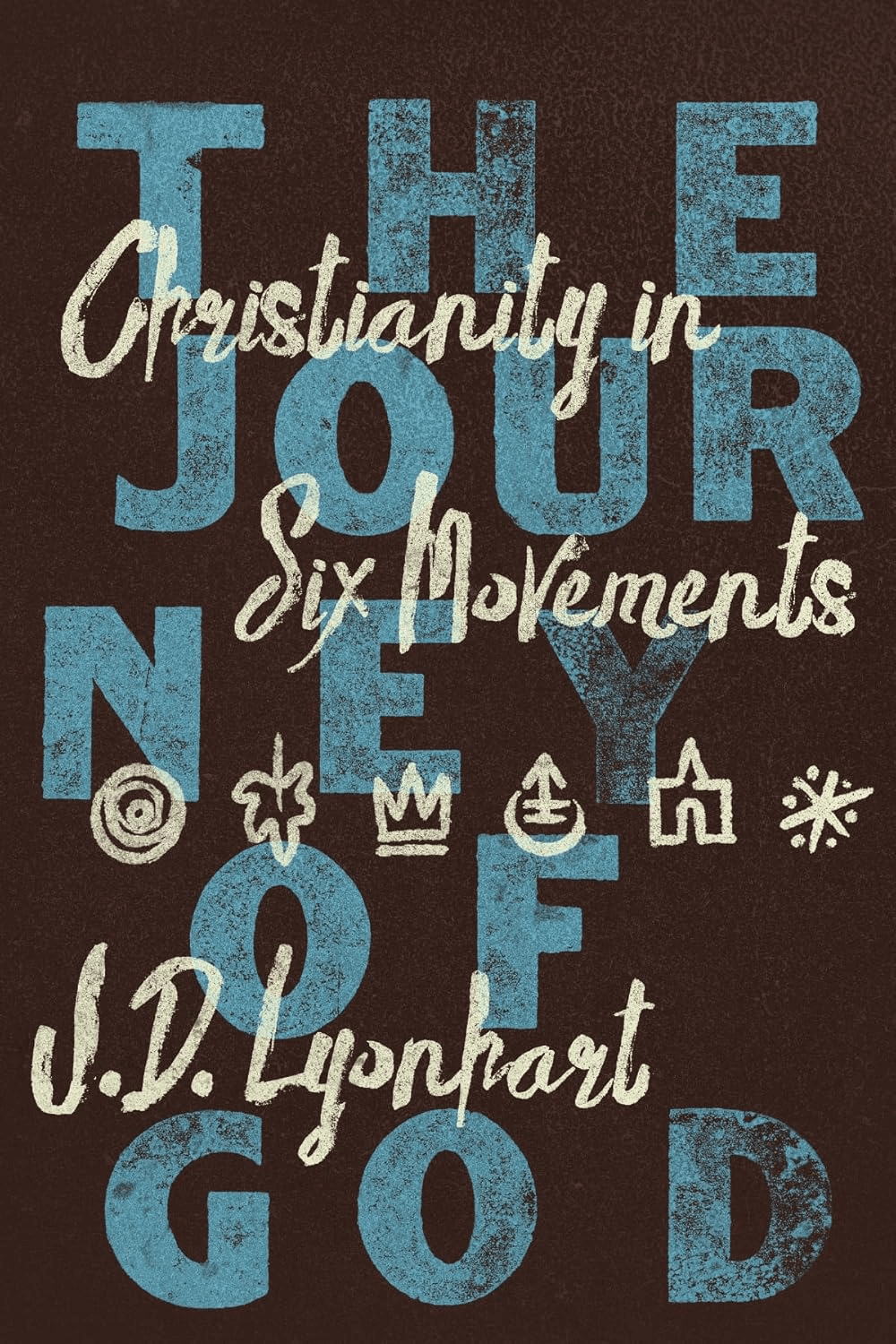
J.D. Lyonhart is a British-Canadian theologian, philosopher, author and ordained minister. He is an associate professor of religion and philosophy at the University of Jamestown, a fellow at the Cambridge Center for the Study of Platonism at Cambridge University and a co-host of the Spiritually Incorrect Podcast. In addition to The Journey of God: Christianity in Six Movements, he also authored Space God: Rejudging a Debate Between More, Newton, and Einstein, as well as MonoThreeism: An Absurdly Arrogant Attempt to Answer All the Problems of the Last 2000 Years in One Night at a Pub.
Taken from The Journey of God by J.D Lyonhart. Copyright © 2025. Used by permission of InterVarsity Press.