Gods, Creatures, and the One Who Simply Is
JD Lyonhart
16 min read ⭑
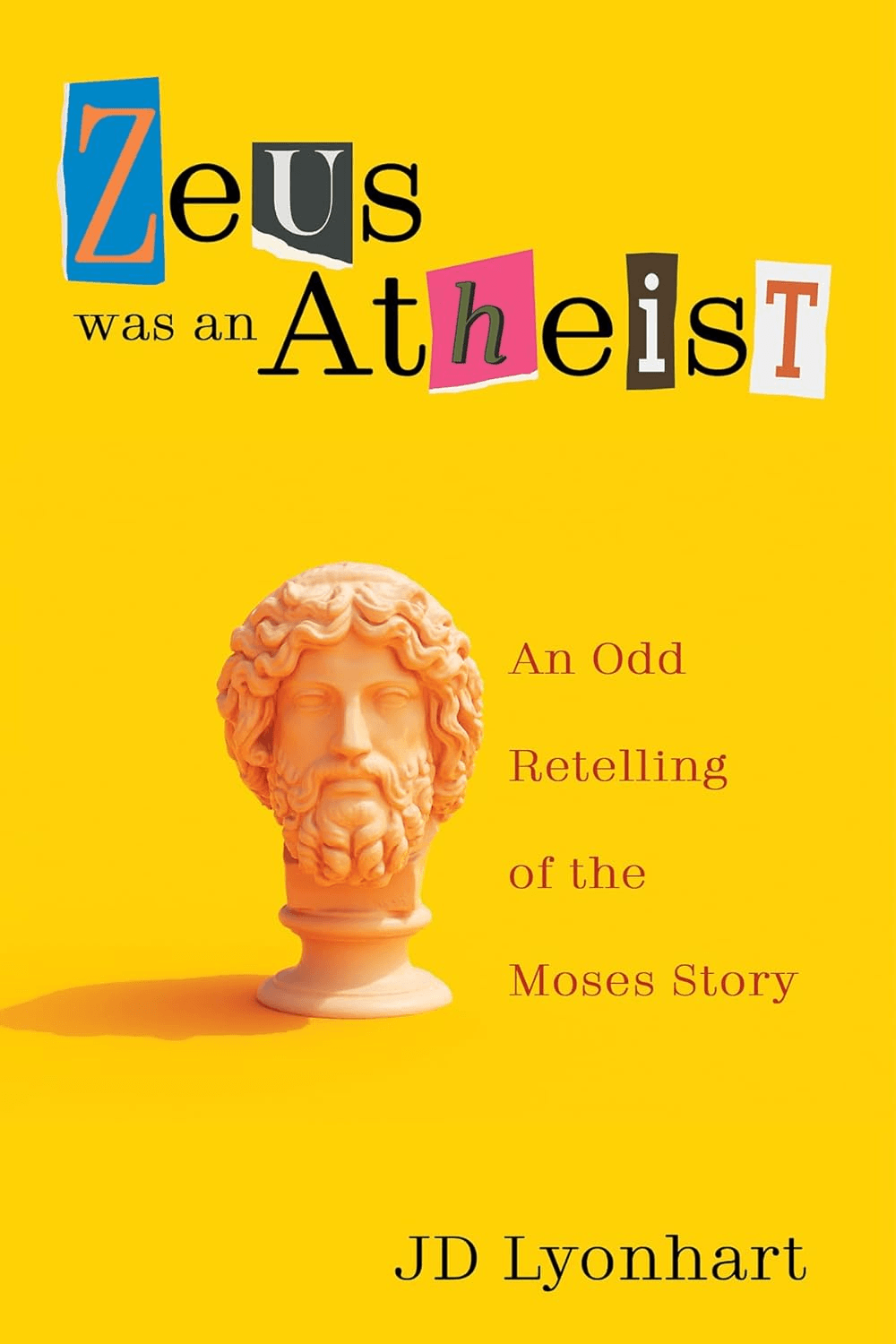
This excerpt is taken mid-story from “Zeus was an Atheist: An Odd Retelling of the Moses Story,” a creative retelling of Moses’s life from his perspective. Here we find Moses reflecting upon his childhood and the gods of Egypt.
The gods are all the same.
At least, I couldn’t tell the difference when I was a child.
They all seemed to rule one thing or another.
Ra is the god of the sun.
Hapi is the god of the Nile.
Serqet is the goddess of scorpions.
Sobek is the god of crocodiles.
Osiris is the god of the afterlife, and apparently so is Anubis.
Montu is the god of war, as if we needed to worship that some more.
And that was just in Egypt. Beyond our borders there were as many gods as there were tribes, towns and temples. A god of the sea and a god of the land; a god of wisdom and a god of foolhardiness; a god of beer and a god of wine and a god of the sleep that results from their abusage.
Indeed, there’s a god for everything. And I swear, they always sounded the same to me. They all sounded like us humans, just. . . bigger.

Wikimedia Commons
You know, you take the power of a king, the wit of a scholar, the muscles of a warrior, add in the wings of a bird, mix it all together, and there it is — you’ve got a god.
I don’t even know if the term ‘god’ is appropriate — they’re not so much gods as just really powerful creatures. They are more like fairies or giants or dragons.
That’s all these gods are — just the biggest beings among other created beings on earth. They really are just bigger badder versions of ourselves.
And they even quarrel, just like us.
Did you know, that the god Osiris slept with his own sister, the goddess Isis? And when their brother Seth found out, he was rather annoyed, so he murdered Osiris, who then became the god of the underworld.
Talk about family drama. The holidays must be just as bad in the heavens as they are on earth.
And did you know that Zeus’ father, Cronus, was so scared his children would overthrow him, that he swallowed five of them whole?
Luckily, Zeus’ mother managed to trick his father by getting him to swallow a rock instead. Raised in secret by a nymph, Zeus later returned as an adult to force his father to regurgitate his siblings.
And what is insane, is that, having incurred such trauma from his own father, Zeus then went out and did the same thing to his own pregnant wife, Metis, swallowing her when he feared the child in her belly would grow up to be wiser than him.
I tell you, these gods are all the same.
They might look different on the outside; one god has a dog’s head, another has an eagle’s wings, another has crocodile teeth. But underneath, the gods are all pretty much the same. I have no idea why you’d choose to worship one over any other.
Each god has a gimmick; a thing they are the god of. Each god has an origin story more preposterous and terrible than the last. Each god fights with the other gods about something, and that causes the rain or the thunder or the harvest or disease.
What’s more, each of these gods were united in this: they didn’t give a damn about me.
And that might sound harsh.
But I tell you, you haven’t been in my sandals. I spent my youth crying out to each and every one of those gods, waiting for them to hear my prayers, begging to be taken home.
And in a sense, I was.
I was home. Even if it wasn’t the home of my birth.
I suppose I should have been grateful. Grateful that someone found me as a lost babe. Grateful that it wasn’t one of the soldiers or some random creep.
For I was found by none other than Pharoah’s own daughter! Scooped up from the river and raised in the royal household.
Growing up, I played out what other children can only pretend at — palaces, princes, guards, golden robes and chariots. I ran through great halls and hid in war rooms; dangled from palace heights and charmed the servants. Exotic cats were my pets and everyone was my friend (on pain of death).
I was trained by only the wisest philosophers and priests and astronomers, was given the words to wax eloquent and stun the stupid.
I tasted only the finest wines, dined on only the fattest calves, slept in the softest sheets, and was wooed by the fairest maidens.
And yet, somehow, none of that matters when you don’t know where you’re from. Don’t know who your family is. Who your people are. Which one of the gods is actually yours.
I spent years trying to figure that out. Trying to get someone to tell me who my real parents were. And when I finally succeeded it was not the outcome I had been looking for.
Well, that’s an understatement. It was the worst possible outcome I could have ever possibly hoped for.
My real parents weren’t wealthy. I wasn’t from some respectable clan or the good side of the river.
No, I was the scum of the earth. Nay, not even the scum. I was the slave who scraped up the scum.
My real parents were Jews.
They were members of the twelve tribes descended from the twelve sons of Israel, whom God vowed to make a great people and lead into the promised land.
But God forgot to mention the details. Forgot to mention our chains.
You see, Pharoah was afraid when he saw how numerous and powerful the Jews were becoming in Egypt. The descendants of the twelve sons of Israel had grown and reproduced over the centuries, becoming a rival nation within the nation.
So Pharoah bound them, enslaved them, and set them to work on his pyramids and building projects. Jewish blood oiled the levers and pullies that raised Egyptian stone to the sky.
They worked young men to death, and old men like they were young. Women and children slaved away as well, for the differences between persons matters little where you are not considered a person to begin with.
Yet despite their chains, the Jews multiplied all the more, having children in slave camps throughout the land.
And to Pharoah, the pitter patter of little Jewish feet sounded a lot like the marching of future revolutionaries.
So he murdered them.
Pharoah ordered all newborn Jewish boys be thrown into the river. That was when the Nile really first turned to blood.
It was almost impossible to hide or hand off a Jewish boy or pretend he was not Jewish, for our beliefs require us circumcise our sons, cutting faith from our flesh.
Seeing no other option, my desperate mother placed me in a basket and pushed me away from shore before any of the nearby soldiers could drown me. A little bundle awash midst swells, shrieks and crocodile tails, somehow wading downstream to a new mother.
Others were not so lucky.
What could have been my entire class at Hebrew school was wiped out, just like that.
And there was me, sitting comfortably, suckling next to Pharoah’s throne.

My people were suffering, but I could barely even admit that they were my people.
Yet my heart came to terms with it before my head.
One day, I was surveying Pharoah’s latest building project when I saw a guard lashing a Jewish slave.
Probably over nothing — perhaps he dropped a mudbrick or took a break when he should have been working or took three seconds to respond when he should have taken two. Perhaps he just asked to go to the bathroom.
Whatever the reason, the guard was pounding this poor old Jew to bits. Skin and cloth peeled off his hunched back like old paint.
And before I even knew what I was doing that guard laid limp in the sand.
Blood dripped down my hands to my legs, sinking into my toes, a trail of red following my footsteps from that day on.
I’m sure you might also be willing to kill for your people. And in doing this, I was indeed admitting they were my people.
I was born a Jew.
And Jews are not safe in Egypt.
I fled before anyone could find out what I’d done. My adopted mother might have tried to protect me if I’d stayed, used her royal power to shelter her privileged pup. But some part of me died along with that Egyptian soldier. In that moment I whispered out loud to myself: “I can no longer feed from the hand that strikes my people.”
Fleeing into the dessert, I glanced back to look at my former home, watching as the pyramids became ever smaller in the distance, until their highest peak dipped beneath the horizon.
All the markers and monuments that dotted my youthful horizon were now gone, and I was left to find my own way through an ever-changing landscape of sand. Dunes poured round me left and right, like rolling waves held in place at the height of their crest, as if at any moment some invisible hand might withdraw and loose them upon me.
I managed to survive out there long enough to chance upon a few settlements, though almost no one wants to take in this mysterious refugee from afar. Almost every door and inn are shut to me, though some are willing to make quick trades and transactions, allowing me to procure what I need to travel as fast and as far away from Egypt as possible.
And after weeks of wandering, I eventually found myself in Midian, where no one had ever heard the name of Moses. God bless those people, for they alone among the desert tribes took me in, even though they had little themselves. They took me in and gave me one of their daughters in marriage — accepted this foreigner as one of their own.
I successfully hid and assimilated myself into Midian, not even daring to circumcise my own son.
My family kept growing larger and larger, and so I started shepherding sheep to support them.
My days were now filled with fields, wool and wolves, while my nights belonged to shrieking, singing, boisterous children and the mother that bore them.
And for forty years, I was free.
Free of the snobbery of my Egyptian upbringing and the confusion of my Jewish roots, with a whole desert separating me from my past.
O, how good it was to be able to delay the fight for a little longer, to be far enough away that I was able to forget and distract myself.
Able to start again.
Able to pretend that nothing was amiss in our world, and that no distant rattle of chains nor mass graves of smoke rose up to the same sky as my own.
“I stumbled to the dirt, unsure if it was the ground that was shaking or my knees. The voice continued above, and around, and within me.”
One day, I was out leading my flock across the far side of Mount Horeb.
And that’s when I smelled it.
I didn’t see it first, no, I smelled it.
Smelled burning leaves, that scent a shepherd must watch out for if he is to protect his sheep from sparks and flame.
Yet that which was usually a thing of fear now filled me also with wonder. For when I came upon the flame it did not burn up nor consume the bush but raged on without destruction. An eternal flame.
“Mooosssses! Moosssses!”
A voice bellowed with the wind, or perhaps gave shape to the wind itself.
“Here I am!” I cried, instantly regretting it.
“I AM the God of your father, the God of Abraham, Isaac and Jacob.”
At this I trembled and hid my face.
Still the voice thundered on: “The cry of my people has reached me, and I have seen their oppression at the hands of the Egyptians.”
I stumbled to the dirt, unsure if it was the ground that was shaking or my knees. The voice continued above, and around, and within me:
“I have come to rescue my people and bring them up into the promised land flowing with milk and honey. I am sending you! You shall go to Pharaoh and free my people.”
And despite how terrified I was, I suppose some part of me was still used to how things worked in Egypt, with its many gods to pick from. And so — my mouth muttering into the dirt — I dared to sputter back:
“What if I go to them and say god has sent me, and they ask: ‘What is his name?’ What shall I tell them then?”
I said this, for I knew people would wonder which God it was that sent me. Was it Anubis, Horus or Osiris? I asked, “What is your name?” as if to say, “Which god are you again??”
And to this, the voice bellowed: “I AM WHO I AM.”
“This is what you are to say to the Jews: I AM has sent me to you.”
Well, isn’t that just peachy.
I get to leave my family and go back to the most powerful empire on earth — where I’m a wanted murderer — to start a slave rebellion.
And when they ask me if I’m God’s servant, I’ll say, “I am.”
And then they’ll ask, “which God?” And I’ll say: “I AM.”
“No, which God?” They’ll retort.
“I AM.”
“Yes. I know you’re God’s servant, but which God?”
“I AAAM.”
“I know you are, but which GOD!?!??!”
“I AAAMMM!!!!”
And it’s just gonna go around in circles like that.
I mean, come on. I AM?!? I had no clue what that could even mean.
At first, I thought maybe it was just God’s way of saying, “Hey, I exist. I AM real. Notice me!”
Or maybe it was God’s way of avoiding the question. I ask, “Who are you?” and he says, “I AM WHAT I AM.” In other words, it’s none of your business who I am, Moses.
But the more I’ve thought about it, the more the whole I AM thing has begun to strike a chord.
You see, I keep asking which one of the gods ‘is’ real. But that question already assumes I know what the meaning of is, is.
What is is-ness?
What does it mean to exist — to be something that is rather than isn’t?
Where does our being come from? What is the capital B source of Being from which all lower-case beings derive their existence?
If the gods are just other beings that exist, then they must derive their existence from something else, and that source would be the true God, wouldn’t it?
I mean, just look at all these Egyptian gods, or even the Greek gods that we’re beginning to hear whispers about from across the sea.
Those gods are born and raised — they suckle, whine, defecate, grow up, fight, and can die. They derive their being from others and give it up again in death.
Zeus is supposed to be the mightiest of the gods, right?
And yet, there was a time when even he didn’t exist, a time before he was created.
Zeus was born.
He was the child of Cronus, and Cronus was the son of Uranus, and Uranus emerged from chaos.
So Zeus is not the source of all Being, no, he is just another particular being like you and me, only stronger.
Zeus is a creature — a created being.
Zeus is only a god to us, in the same way that a human might seem like a god to an ant.
Zeus is merely the strongest being amongst other beings. But he is not Being itself — not the great I AM.
You see, that day in the desert with the eternal flame, I dared to ask God which being he was and he replied that he was Being itself.
He replied that he was not just another being that happens to exist, no, he is existence itself. He is the one from whom all other beings derive their Being.
A particular being may or may not exist — may be born one day and die the next — but Being itself is ever present.
That is the difference. What many worship as gods, would only be angels or demons in the Jewish system. Powerful yet ultimately created beings.
We Jews do not worship any particular being, but the source of all Being itself. We do not worship created things, but the Creator.
In fact, I would argue that the Greeks, with all their pantheon of gods, are actually atheists.
For if Zeus was the child of Cronus, and Cronus was the son of Uranus, and Uranus was born from chaos, then at the beginning of all things is not God, but chaos.
Chaos gives birth to the universe and the gods.
And chaos is just randomness and chance — matter swirling in a void of blind, pitiless, indifference. There is no guiding, conscious, loving, intelligent source at the heart of the Greek mythological universe, just rampant disorder.
And over time random beings eventually emerge from that chaos by chance. You wait long enough and you get bugs, plants, monkeys, elephants, humans, and even super humans, which — from our perspective — might seem like gods, but are just other created beings like us.
Created beings that fight, argue and have drama.
Created beings who are born, who bleed and can die.
Created beings that are limited to one sphere; to ruling the ocean, or thunder, or the Nile.
These are but mere beings among billions of other beings on earth. They are, perhaps, the strongest and mightiest and most super of the beings, but they are still not Being itself.
They are not the great I AM.
And so I went.
I went to Egypt and told the Jews that I AM had sent me.
And I told Pharaoh, told him that the God of Being had made a demand upon the world of beings.
I AM demanded that Pharaoh let his people go. And of course, Pharaoh said NO. And that’s when things got really interesting.
I AM brought a plague upon the Egyptians. God turned the Nile into blood.
At first the water looked and smell like rust, but as the fish began to suffocate on the thickened fluid it soon made the air rancid with death.
Now, this plague wasn’t just to show off. No, this was judgment upon Hapi, the Egyptian god of the Nile. This plague showed that I AM is stronger than the random gods who may or may not exist — stronger than the river gods.
But Pharaoh still refused to let the Jews go, and so a second plague came. A second plague of frogs.
That night, you couldn’t step anywhere without cracking frog legs, nor hear anything over the constant, infernal ribbiting. This was judgment upon the Egyptian Goddess Hecket, who had the head of a frog.
Then a third plague came, and the dust was turned into lice, in judgment of Geb, the Egyptian God over the dust of the earth. Lice wriggled between our toes and blew through our hair and made the sand dunes in every direction seem alive and teeming.
Then came a fourth plague of flies, in judgment of Khepri, the Egyptian god with the head of a fly. And at least those flies ate up the dead frogs.
Then a fifth plague came, killing the livestock. This was judgment over Hathor, who had the head of a cow. Overnight, the horses, camels, cattle, sheep, goats, and donkeys of our agrarian nation perished. Just like that, the means of production had been turned upside down, and the slave without a goat suddenly found himself the equal of the rich man who formerly had hundreds.
Then a sixth plague of boils and sores arrived, in judgment of Isis, the god of medicine. And there was not enough ointment in all the world to preserve the once perfect skin of those Egyptians, who, instead of labouring in their own fields and worksites, sent slaves to darken, leather and bake in the noonday sun.
A seventh and eighth plague soon came of fiery hail and locusts from above, in judgment of Nut and Seth, gods of the sky.
Ninth came darkness, in judgment of the sun God, Ra.
Then finally, with woe, came that tenth and final plague, of which I can barely speak. We covered our doors in blood, so the wrath of God would not take us and our firstborns. But the Egyptians were not so lucky.
And it was finished.
Alas, it saddens me to say what I must say: that these Egyptians gods were but particular beings, ruling over one particular thing or another.
One being rules over the Nile, another being rules over the frogs. But our God is Being itself, and his domain is over all things that are.
The Egyptians have many gods, as do all the other nations on earth. As many gods as there are rivers, activities, animals, towns and temples.
And it’s not like all the other gods are wrong, and ours just happens to be right.
No, it’s that their claims aren’t even really about God to begin with. Most other religions aren’t even talking about the Creator at all. They keep talking about creatures!
Powerful creatures, but creatures nonetheless.
They worship particular beings, but we Jews worship Being itself. We worship the great I AM!
Many religions quarrel about whether the god of thunder, or the god of the river, or the god of livestock is stronger. Quarrel about whether god has a sword or a bow and arrow; whether god has the head of toad or the head of a goat; whether he was born from fire or from the sea.
But those questions aren’t all that interesting!
Because even if one of those gods did happen to exist, that would be neat, but it wouldn’t tell us much more about the universe than the discovery of a new species would tell us.
Because that’s all these gods would be — a powerful new species. A created class of super creatures, that are, nonetheless, creatures.
These religions are debating whether particular beings exist or not, and completely ignoring the deeper question of Being itself.
So even if Zeus is real, and he really does control the lightning. . .
Even if he really is as strong as they say, and can shut up giants and titans. . .
Even if his father, Cronus, really did try to eat all his children. . .
Even if Zeus really did take on the form of exotic swans, cuckoos and bulls in order to seduce women. . .
Even if he really can ride a storm like a cosmic firefly. . .
Even if he really did father Hercules. . .
Even if he is all the things he’s said to be, and even if did all the things he’s said to have done. . .
Even so, Zeus would be an atheist.
For staring into the cold eyes of the bastard who made then tried to consume him, Zeus would know better than anyone that his grandfather was chaos.

J.D. Lyonhart is a British-Canadian theologian, philosopher, author and ordained minister. He is an associate professor of religion and philosophy at the University of Jamestown, a fellow at the Cambridge Center for the Study of Platonism at Cambridge University and a co-host of the Spiritually Incorrect Podcast. In addition to The Journey of God: Christianity in Six Movements, he also authored Space God: Rejudging a Debate Between More, Newton, and Einstein, as well as MonoThreeism: An Absurdly Arrogant Attempt to Answer All the Problems of the Last 2000 Years in One Night at a Pub.
Taken from Zeus was an Atheist: An Odd Retelling of the Moses Story by J.D. Lyonhart. Copyright © 2026. Used by permission of the author.