Andrew Ollerton
5 min read ⭑
A few years ago, I visited a National Trust property called Woolsthorpe Manor. In the 17th century, it was home to a young and inquisitive genius who investigated the implications of an apple falling from a tree. At his family home in Lincolnshire, Sir Isaac Newton also experimented with refracted light and tried to fathom the laws of motion that govern the universe — all before the age of 24. Now, I’m not a National Trust type, but this proved to be a memorable visit. In the Science Centre, I paused to listen to a curator who was using a glass prism to show how rainbows form when light refracts through raindrops.
While in mid-flow, two young women, also not National Trust types, interrupted him: “But I thought God created rainbows?”
I wish you could have seen the look on the curator’s face. Surprise quickly turned to disdain: “That’s what people used to believe before science disproved God.”
Now I couldn’t resist joining in: “But didn’t Isaac Newton believe God established the laws of nature that cause rainbows to form?”
Before the annoyed curator had a chance to reply, one of the women said to the other: “You don’t know nothing about God. You threw a rock through a church window!”

Evie S; Unsplash
That revelation silenced all of us. Light refraction no longer seemed important. Instead, I wandered off to have my photo taken next to the famous apple tree where Newton hit on gravity.
That conversation about rainbows captures a dilemma: Does the explanatory power of science make belief in God less plausible? In particular, can we still take the creation stories in Genesis seriously? The National Trust curator articulated a popular belief that the Bible and science are opposed to each other, so you must choose between them. The secular narrative goes something like this: In the past, natural phenomena were attributed to “God” because we didn’t know any better. But now, we understand why seasons change, diseases spread, tides rise and rainbows form. We no longer need “God” or the Bible to make sense of the world. Thanks to science, we’ve grown up and moved on.
But the idea that religion and science are in a permanent state of conflict is fake news. Recent studies have shown that the percentage of professional scientists in America who profess belief in God is around 50%, and more than 60% of recent Nobel Prize winners (laureates) identified as Christians. Science has not squeezed out belief in God. Instead, there is an impressive list of groundbreaking scientists, men and women, past and present, who share a strong faith. For example, the founder of modern genetics was a Christian priest, the Rev. Gregor Mendel (1822-1884), and the head of the Human Genome Project that first sequenced DNA coding in the entire human body was a Christian named Francis Collins.
Far from science undermining faith, many brilliant minds have discovered the opposite. The more physics, chemistry and biology reveal the intricate conditions that allowed the universe to form and complex life to develop, the more they detect a mystery at the heart of reality, an inexplicable sense of design, direction and purpose. From the farthest star to the smallest cell, science is revealing new wonders that demand a fuller explanation.
The Bible itself begins with an awe-inspiring account of the origins of everything. Genesis purports to reveal not only the beginning of the space-time universe but also what it means to be human and the meaning of life itself. However, Christians disagree sharply on how to interpret Genesis. Some have tried to accommodate the findings of science; others have resisted anything but a literal interpretation of the six days of creation. Truth be told, we can’t all be right, but we do need to stay humble and open to each other. Our understanding of the Bible is partial and incomplete.
“Science can purify religion from error and superstition; religion can purify science from idolatry and false absolutes. Each can draw the other into a wider world, a world in which both can flourish.”
Nevertheless, a more basic conviction can unite us: in the end, there will be a perfect correspondence between the world God created (nature) and the words that God inspired (Scripture). On this basis, no Christian has anything to fear from accurate science, and no scientist has anything to fear from the true meaning of Scripture. Our understanding of both nature and Scripture may be faulty, but these two sources ultimately complement each other because they share the same author.
Science can reveal things about the natural world that help to expose faulty interpretations of the Bible. For example, in the 17th century, Galileo famously challenged the prevailing view that the sun revolved around the Earth. His new theory sparked a controversy with the Roman Catholic Church that culminated in the trial of Galileo (1633). However, historians have recently shown that the debate was more about personality and politics than the Bible. Galileo’s new theory primarily opposed the ideas of the Greek philosopher Aristotle (384-322 B.C.). Aristotle’s theory that the Earth was the fixed center of the universe remained dominant until the 17th century. But Galileo helped to disentangle science from this ancient error and so enabled a better interpretation of Scripture. Poetic verses referring to the Earth standing on “pillars” (Ps. 75:3, ESV) and being “firm and secure” (Ps. 93:1, NIV) were now seen for what they were — metaphors capturing the stability of our world under God’s providential care. The brilliant chemist and devout Christian, Robert Boyle (1627-1691), therefore argued that science helps us understand the “written” book of Scripture by revealing more of the “created book” of nature.
Equally, the Bible provides a fuller explanation of reality than science ever can. You cannot measure love by its height or beauty by its weight. And yet these immaterial values are more real than the objective world that we can see and touch. The tools of science only assess a limited slice of reality. Think back to the rainbow conversation. Understanding light refraction isn’t the whole story. The reason we get our phones out when we see a rainbow is because of something beyond the laws of physics, don’t you think?
When you stop and think about it, things we take for granted are nothing short of miraculous. The fact that there is something rather than nothing, order instead of chaos, conscious persons, not just inanimate matter. The more science expands our understanding of how the world works, the more it requires a fuller explanation. In his book “Return of the God Hypothesis,” Stephen Meyer shows that within the scientific community itself, there is increased openness to evidence of design, purpose and transcendence within the natural world. So, instead of feeling threatened, we can adopt a positive stance. Good science and the truth of Scripture work in harmony to provide the most satisfying explanation of life on planet Earth.

Andrew Ollerton is a theologian, author and popular speaker who makes sense of the Bible in a relevant and accessible way. He works with Bible Society and is the creator of The Bible Course, an eight-session guide to the whole story of Scripture. Andrew also works with Bear Grylls as a theology consultant to faith-based projects. Andrew lives in the U.K. with his wife, Charlotte, their three children and an eclectic mix of pets.
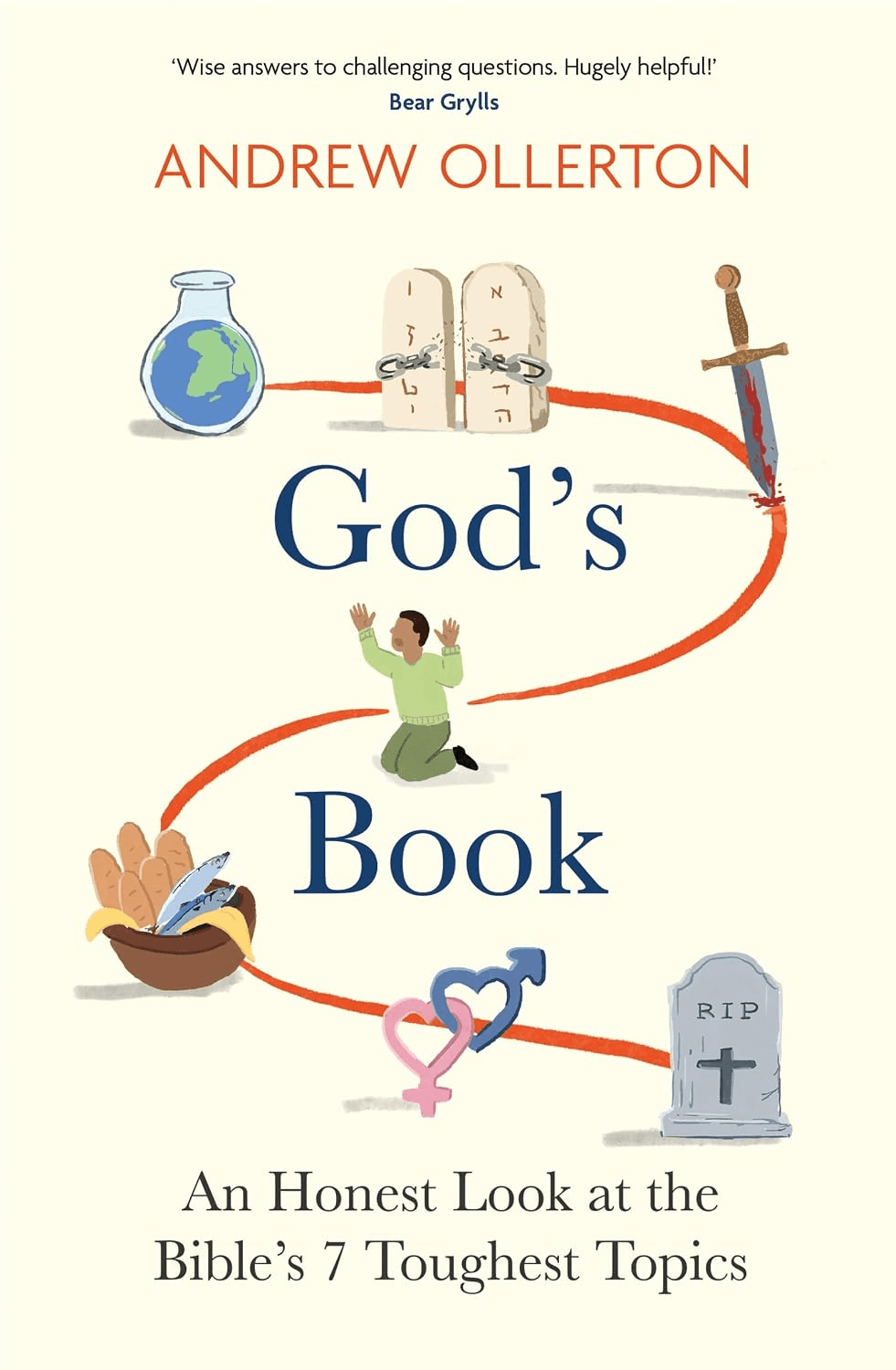
Taken from “God’s Book: An Honest Look at the Bible’s 7 Toughest Topics” by Andrew Ollerton. Copyright © 2026. Used by permission of Hodder Faith.