Maewyn's Mountain: Learning to Pray with Your Whole Life
Jennifer Tucker
7 min read ⭑
There’s an old, old story that has been passed down through the centuries — a legend about a boy named Maewyn, who lived in England long before it was even called England, when it was just an island at the edge of the world. Maewyn grew up in a wealthy family and had a fairly privileged childhood. He spent most of his days playing games and hanging out with his friends, never really having to do any chores or work. His future looked bright and relatively easy.
But when he was sixteen, Maewyn’s entire life was completely upended. Pirates raided his hometown, and he was kidnapped and taken to Ireland, where he was sold into slavery. Ireland wasn’t exactly a pleasant place at the time — most of the Irish tribes were pagan and godless. Some even sacrificed their children to idols, and many were cannibalistic. A pagan chieftain king named Milchu bought Maewyn and forced him to serve as the family’s herdsman. Overnight, Maewyn went from a life of ease and privilege to a life of hard work and cruel mistreatment. Afraid and alone, he now spent his days in the mountain fields taking care of the king’s flocks, and his future looked bleak and lonely.
But instead of spiraling into despair, Maewyn did something that transformed his life: He began to pray. When he looked at the sky, he prayed to the One who “ignites the light of the sun . . . [and] surrounds the stars and tells them to shine.” As he felt the grass beneath his feet and the warmth of the sun on his face, he visualized the presence of God shielding him and covering him. He became aware of God’s presence all around him — beneath him and above him, beside him and within him. He later wrote:
When I came to Ireland, I spent each day tending sheep, and I prayed many times during the day. Thus, I grew more and more in the love of God. And as the fear of God increased in me, so did my faith, so that in a single day I would pray up to one hundred times, and in the course of the night, I would pray nearly as many times again. When I was tending the sheep on the mountains and in woods and in the dark before the dawn, I would awaken and pray in the snow, in the frost and in the rain . . . for my spirit was always fervent.

K. Mitch Hodge; Unsplash
Maewyn prayed not just with his mind but with his entire body as he moved through his regular, ordinary, everyday life. As Sandra Pavloff Conner points out, “His prayers grounded him in the earthy and dirty reality of each day and helped him to see God everywhere: in the wind, in the water, in the poor wanderers who traveled by his mountain, and in everyday acts like napping and bathing and stretching.” Every part of his life became the source and the substance of his prayers. Every moment, every movement, and every experience became an invitation to pray — to be fully present, to notice God’s presence, and to remember his goodness and grace. This practice drew him closer to Christ and brought him a peace that transcended his difficult circumstances.
That boy, Maewyn? You probably know him better as Saint Patrick, the patron saint of Ireland. His daily rhythm of prayer strengthened his soul and deepened his connection to God, so much so that many years after escaping slavery, he returned to Ireland as a missionary to the very people who had enslaved him, and he is credited with bringing Christianity to all of Ireland.
Patrick embodied a life of prayer. Prayer was not some stagnant, monotonous task to complete; prayer was the very heartbeat of his life. He lived and breathed in constant communion with God. Prayer moved within him and through him, through every moment and movement of his days.
Modern life may feel very far removed from the days of young Maewyn and the iconic life of Saint Patrick. And maybe praying one hundred prayers a day seems a bit extreme and unrealistic. Who has time for that these days? After all, we’re not sitting on a mountainside all day with the sky above us and the grass below us. We have kids to get to school, work deadlines to meet, meals to cook, laundry to wash, and the list goes on and on. Most of us do well to remember to say a quick prayer before we eat or before we go to bed, right?
But the truth is, the same God that was with young Maewyn on that mountainside many centuries ago is with you today as you drive to work or shop for groceries or walk down the sidewalk. And you don’t have to be a monk living in a remote monastery or a contemplative saint in the middle of a field in order to experience the peace that comes from a meaningful life of prayer. You can pray like Maewyn, right in the middle of your own ordinary life, by simply paying attention to God’s presence with you in every moment and movement of your day.
All of life becomes a prayer when we invite God into all our bodily experiences. All of life becomes a continual communion with Christ when we fill our days with rhythms and movements that turn and return our attention to his constant presence and his abiding love.
“What if we could let go of the limited definitions of what we thought prayer is supposed to be and instead embrace prayer as a way of life — as a living and moving and breathing communion with God?”
Cultivating a Rhythm of Prayer
Right here in the middle of our regular, ordinary life is where we meet God. He can always be found in the present moment, here and now — as you groggily roll out of bed, as you pour a cup of coffee, as you drive the kids to school, as you commute to work, as you cook dinner, as you sit on the couch, as you scroll on your phone. He is here. The real question is, are you? Are you fully present in this moment? Are you aware of the presence of God with you right now?
So many of us get caught up in the frantic pace of life, quickly rushing from one task to the next, ruminating over the past or worrying about the future. We rarely slow down long enough to pay attention to the moment right in front of us, let alone notice God’s presence with us in every moment.
Prayer is how we can practice this present-moment awareness of God’s presence.
Prayer keeps us tethered to God when the storms of life rage or worries weigh us down. When the stress and anxieties of our circumstances press in and overwhelm us, having rhythms of regular prayer can help us remain attached to the safety of God’s love and keep us securely anchored to hope.
Cultivating a daily rhythm of prayer is not a new idea. In fact, having a daily prayer rhythm is an ancient practice that can be traced back to long before the days of Saint Patrick. As Tyler Staton explains, “In the Hebrew tradition, which contains the very roots of the Christian faith, there has always been a daily prayer rhythm: pausing to pray three times a day — morning, midday, and evening. In fact, all the great spiritual traditions insist on some kind of a daily prayer rhythm.”
Now I know you may be thinking, Sure, that sounds good in theory, but how in the world can I add more prayer into my day when my life is already filled to the brim, and I’m already overwhelmed and exhausted?
That’s the good news! Creating a rhythm of prayer is not about adding more things to your already overflowing days, and it’s not even about saying more words to God. It’s about incorporating prayer into what you’re already doing every day. Prayer isn’t a task to check off your Christian to-do list; prayer is about centering your life on the presence of God. I love how Joan Chittister describes it: “Prayer is a way of life that integrates the great values of the faith with the life we breathe. It is not something tacked on to the day. It is the heartbeat of life.” And when prayer is the heartbeat of your life, Christ becomes the anchor of your days.
Many of us likely already have some rhythms of prayer in place. We may regularly say grace before we eat a meal, or we may pray with our kids when we tuck them into bed. Many of us may even set aside quiet time every morning or evening, devoting time to Scripture reading and intentional prayer. These habits are good and wonderful and are certainly beneficial for spiritual growth. Setting aside times for stillness and silence with God, or for meditative prayer practices, can be an important part of a daily prayer rhythm. But prayer doesn’t end when you say “amen,” and God doesn’t leave when you close your Bible. As you move through your day and the stress starts to weigh you down, when the to-do list grows and the laundry piles up, when the kids are screaming and dinner is burning, God is still there. The invitation to turn to him and rest in his love is still yours. Right here. Right now.
What if we could let go of the limited definitions of what we thought prayer is supposed to be and instead embrace prayer as a way of life — as a living and moving and breathing communion with God? Prayer that isn’t just spoken but experienced as we walk with him through the mundane and momentous moments of our days?

Jennifer Tucker is an illustrator, lettering artist, and bestselling author. She received the 2023 ECPA Christian Book Award for New Author of the Year for her first book, Breath as Prayer: Calm Your Anxiety, Focus Your Mind, and Renew Your Soul. Jennifer is a devoted follower of Jesus and an advocate for mental health. She lives in Georgia with her family, and she shares her heart and art online at littlehousestudio.net.
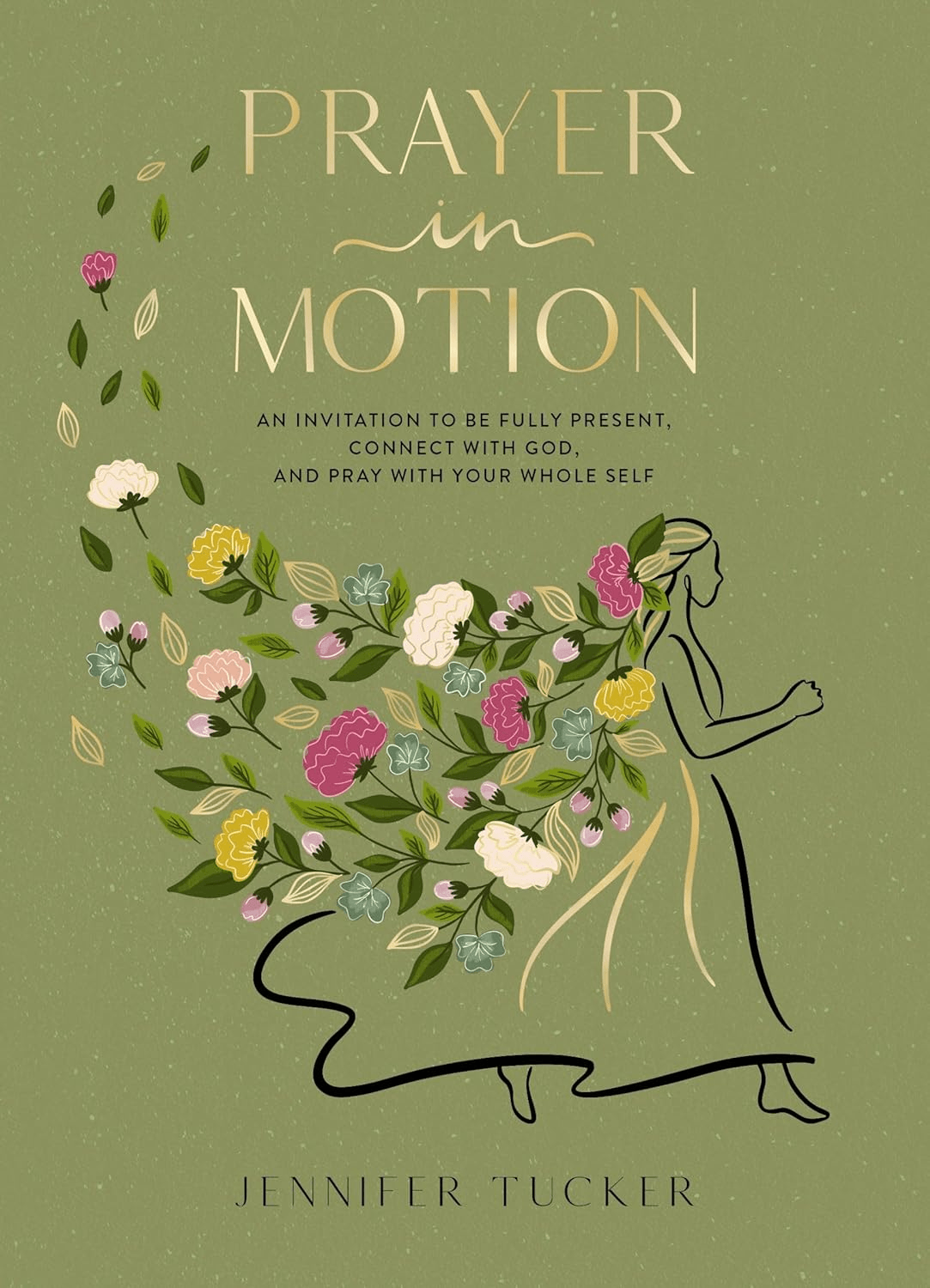
Taken from Prayer in Motion by Jennifer Tucker. Copyright © 2026. Used by permission Thomas Nelson.