Pride, Fig Leaves, and the Second Law of Thermodynamics
JD Lyonhart
13 min read ⭑
In the beginning God made the heavens and the earth. . . . And . . . it was good. . . . God created mankind in his own image. . . . The Lord God took the man and put him in the Garden of Eden to work it and take care of it. And the Lord God commanded the man, “You are free to eat from any tree in the garden; but you must not eat from the tree of the knowledge of good and evil” (Genesis 1:1, 10; 2:15-17).
So God created the world, called it good, and then made humans in the divine image. And having done so, now God puts the first choice before us, the first fork in the road. As soon as God says not to eat from the tree, we have the choice of whether to obey or disobey — whether to continue in the goodness of creation or bring evil into the world. God could have forced everyone to always do the right thing and be morally perfect carbon copies of each other. God could have created robots who followed their programming, doing exactly as they were told and saying, “I love you,” every time you squeezed them. But a forced love is no love at all. The love of a good robot means little. Which is why God made us free to love, free to roam and run and rejoice, free to do good. But with the freedom to do good there comes the freedom not to do good:
The Serpent said to the woman, “Did God really say, ‘You must not eat from any tree in the garden’?” The woman replied, “We may eat fruit from the trees in the garden, but God did say, ‘You must not eat fruit from the tree that is in the middle of the garden, and you must not touch it, or you will die.’” “You will not certainly die,” the serpent said to the woman. “For God knows that when you eat from it your eyes will be opened, and you will be like God, knowing good and evil” (Genesis 3:1-7).
And you will be like God, knowing good and evil. It is only after Eve is told that the fruit will make her like God that she eats it. Pride is the first sin. We don’t want to be finite, limited creatures. No, we want to be like God, knowing all things, being in the know, feeling in control. We want to be more than we are, bigger than we are, smarter than we are, more respected and bold and awesome than we are. We don’t want to be creatures; no, we want to be the creator. We want to be like God.

Fabrice Villard; Unsplash
Pride is perhaps the most inescapable of all sins. For while you might overcome gluttony or gossip or lust, you will then feel pride at having overcome it. As CS Lewis said: “The devil is quite content to let you overcome your minor sins, as long as you are becoming prideful at having overcome them.” Quite literally, pride comes before the fall.
[Eve] took some [of the fruit] and ate it. She also gave some to her husband, who was with her, and he ate it. Then the eyes of both of them were opened, and they realized they were naked; so they sewed fig leaves together and made coverings for themselves (Genesis 3:4,5).
Adam and Eve took what did not belong to them, bringing sin — that bogey of a word — into the world. Our culture has some baggage with the term sin, associating it with guilt trips, hypocritical preachers, and an evil almost too comic to take seriously, involving horny teenagers, dancing, and cackling demons with pitchforks. If you would find it helpful, you could perhaps take the suggestion of one author, who always swaps sin out in his head and replaces it with “the human propensity to f*** things up.” Yet I personally appreciate the Shakespearean epic-ness of the term sin and will spend the rest of this excerpt (taken from The Journey of God) attempting to better define it.
So, Adam and Eve sin. Yet the first thing that happens is not hellfire, wrath or evil things going bump in the night. No, the first thing that comes with sin is insecurity. Adam and Eve become self-conscious, realizing they are naked and hurriedly covering themselves with fig leaves. Once sin enters, vulnerability becomes a weakness, something others can expose or use against us. We can hurt each other now. Others might laugh at our bodies, or leave us for someone better looking, or make fun of our lumps and scars. So now we look in the mirror and worry: Does my stomach droop? Are my breasts too little? Is my penis too small? Am I too short? If I handed you a fig leaf right now, what part of your body would you wish you could cover with it so that others could never see it again? I know exactly what I would cover.
I knew this one woman. When she was sixteen, she wore a dress on a date, and her boyfriend made a casual joke about her calves being a little chubby. And she hasn’t worn a dress or shorts ever since. She’s in her sixties now. For nearly half a century, she’s been haunted by the memory of a cruel comment a teenage boy once made.
And as someone who spent the first twenty-five years of his life wearing a shirt in the swimming pool, I can sympathize. This is what happens to us when sin enters the equation.
This is not how it was supposed to be.

And [God] said, . . . ‘Have you eaten from the tree that I commanded you not to eat from?’ The man said, ‘The woman you put here with me — she gave me some fruit from the tree, and I ate it.’Then the Lord God said to the woman, ‘What is this you have done?’The woman said, ‘The serpent deceived me, and I ate’” (Genesis 3:9).
God asks Adam why he ate the fruit, and Adam blames his wife, Eve. Then God asks Eve why she ate the fruit, and she blames the serpent. Sin has entered the world, and with it comes guilt. We feel bad about ourselves for sinning. But we have no idea what to do with that guilt, no idea how to bear it. We are terrified of being wrong, terrified of admitting our failures, terrified of looking bad. So we pass the buck to everyone else: ‘It’s not my fault; it’s the woman’s. It’s not my fault; it’s the snake’s.’ We feel guilt when we sin, and we don’t know where to put it. All we know is we can’t bear it ourselves, so we pass the blame on to whoever’s nearest. Husbands blaming wives, wives blaming their parents, parents blaming culture, culture blaming immigrants, and on and on it goes, an infinite chain of passing the buck.
This is not how it was supposed to be.
In response to what they had done, God informs the woman that now “your desire will be for your husband, and he will rule over you”(Genesis 3:16). To the man, God informs him, “Cursed is the ground because of you; through painful toil you will eat food from it all the days of your life” (Genesis 3:17).
Throughout history, some have used this text to say men should dominate women. However, note that it’s only after sin has entered the world that it says men will try to rule over women. This implies that things were not that way before in the perfect paradise of the garden. Male dominance is not the ideal way things should be — it is just how they actually would be as the tragic result of the fall. God is not prescribing male dominance here but describing how it will infect everything once sin enters the picture. In which case, the Bible is actually exposing that male dominance is irrevocably bound up with evil, and misogyny will be the vomit our fallen world constantly returns to. This is not how it was supposed to be.
God also says to Adam that it’s not only humanity that has been tainted by sin but the earth itself: “Cursed is the ground because of you; through painful toil you will eat food from it all the days of your life.” Once humans begin our downward cycle, we draw all of creation into our falling vortex. We destroy ecosystems and rob the earth of her resources in order to erect soaring monstrosities such as the Tower of Babel. Communion with creation is replaced by tar, asphalt, plastic fields, manmade fog, black-bleeding oceans, playgrounds of garbage, and skyscrapers so tall and bright we can’t see the stars anymore. We ruin the ground until it is almost impossible to farm or till anymore. This is not how it was supposed to be.
And while some think the first statement about women is prescribing what should happen, it is telling that no one interprets men’s painful toil that way. No one says we ought to make the ground more cursed or more difficult to farm. No one thinks we ought to actively prescribe that men’s work be more painful than it needs to be. Which means there are two similar and back-to-back statements in verses 16 and 17, which people choose to read in totally opposite ways — it’s prescribing when it makes women’s lives harder, and it’s describing when it makes men’s lives easier. Humans often pick and choose the parts of religion we like and selectively interpret away the things we don’t. This too is part of the fall.
“Once we finally face the fallen reality of the human heart beating within, we can then get to the real question: What can be done about it? And that’s where there’s some good news.”
The LORD God banished him from the Garden of Eden. . . . Adam made love to his wife Eve, and she became pregnant and gave birth to Cain. . . . In the course of time, Cain brought some of the fruits of the soil as an offering to the Lord. And Abel also brought an offering—fat portions from some of the firstborn of his flock. The Lord looked with favor on Abel and his offering, but on Cain and his offering he did not look with favor. So Cain was very angry, and his face was downcast. . . . Now Cain said to his brother Abel, “Let’s go out to the field.” While they were in the field, Cain attacked his brother Abel and killed him (Genesis 3:23; 4:1, 3-5, 8).
And so it begins. Humanity has fallen from its former state of goodness, as signified by being cast out of the spiritual ideal of the garden. This is what Christians have often called the fall. Fall is the perfect word not only because it represents a past falling from a former height but because it’s easy to visualize us still falling today, tumbling further and further down. Indeed, one sin in the garden snowballs bigger and bigger until the invention of murder. Cain kills Abel; blood is in the soil. The tapestry of creation that God called good has been splattered with red. And it just keeps trickling on down. Cain soon has children of his own, and those children have children. Generational sin is passed from parent to child, with each new generation struggling to break the cycle.
Dysfunctional families create children who get married and make their own dysfunctional families. Broken homes become the norm. Children with divorced parents are now twice as likely to drop out of high school and twice as likely to attempt suicide. The vast majority of sexual abuse does not occur in back alleys or at random parties; no, statistically, most sexual abuse now occurs at home with a partner, parent, sibling, or family friend, in the place where we should have felt the most safe.
This is not how it was supposed to be.
So broken individuals lead to broken families. Put a bunch of broken families together, and you get a broken village. Put some of those villages together, and you get broken cities, countries, empires — humanity multiplying, scattering, expanding across the earth. And, of course, the more humans there are, the scarcer resources and land become, leading to the invention of war. Now we have to fight for what we want. The victors of these conflicts then get to remake society in their own image, placing themselves and those like them at the top. Soon, the Egyptians enslave the Jewish race. Egypt builds an entire economy, infrastructure and social system on top of hunched Jewish backs. Human sin is no longer just individual but social — flawed human beings create flawed social hierarchies, governments, courts, schools, workplaces, and public services. With sin comes systemic injustice, injustice that isn’t just perpetrated by individuals but by entire societies, economies, ideologies and social systems.
Such as, for example, systemic racism. In, say, America, the average Black household makes $33,000 less per year than the average White household (some studies suggest this wage gap is the same as it was in the 1950s), and has barely 10% of its median net worth. One in four Black males will go to prison at some point in his life (some studies say one in three), and receive around 20% longer sentences than white people do for the same crime. And, insanely, Black people were 50% more likely to die of COVID than White people, due to the systemic racism baked into the medical and educational systems. So I as an individual might not be racist. But the social systems I participate in, benefit from, and prop up are undeniably, ridiculously, almost comically racist.
This is not how it was supposed to be.
Now, the primary point with all this hasn’t really been the details of Adam and Eve and the snake. I mean, the serpent might as well have been a tiger, or a triceratops, or a she-bear, and the point of the story would still be the same (though much, much more awesome). God could have changed their names, and had them be Adam and Margaret or Bill and Betsy. Instead of a garden, God could have made Eden a palace or an island or a mountaintop. Because the details of the story, while they may be true, are not really the main point.
The real point is one that any honest person will recognize: something’s off. Earth is cracked, paradise is lost, perfection has been postponed. The ideal and the real are not the same thing — there is a distinction between what is and what ought to be. The world that God called good has devolved into shame, insecurity, murder, abuse, social injustice and suffering. The humans God made in the divine image have turned their creativity and reason against one another. The good life is something we can’t quite reach, something too high for us to attain and from which we’ve fallen. So, contrary to some bad sermons you might have heard, not everything happens for a reason. The fall is precisely the moment when things stop happening for a reason and start happening because humans are unreasonable. The fall is the spiritual equivalent of the second law of thermodynamics.
The real point of Genesis 3 has to do with what it says about the human condition. We didn’t just fall in the Garden of Eden; the Garden of Eden fell in us. For even if Adam and Eve had not fallen, each of us today would still be faced with that same choice they had to make. The fall isn’t just something that allegedly happened in our prehistoric past, but something that replays itself daily in our hearts. This is the dark truth lurking behind pleasant smiles, perfect-looking families on social media, and almost every book or movie or news story we encounter. As J. R. R. Tolkien said, “All stories are ultimately about the fall.” Atheists, priests, poets, politicians, philosophers, scientists, novelists, and environmentalists may all have competing narratives about how to make things right, but we all implicitly assume there’s something wrong to begin with. This is not how it was supposed to be.
In short, we are sinners. There it is, I said it. You might not like the term, and that’s okay; you can use a different one if you want. But I am not entirely sure how we could reject the underlying concept itself. For as soon as we say we’re not supposed to use shameful terms such as sin anymore because they cause guilt, repression, and self-hatred, we’ve already granted that something is not how it’s supposed to be. You can only say we shouldn’t talk about sin if you’ve already assumed something isn’t how it should be. And it is that should, that lack, that sense that reality somehow falls short of the ideal, that the Christian story tries to capture with the word sin. So perhaps in attempting to articulate the fallen nature of human sin, angry preachers have overdone it at times and only made the world worse. Indeed, Christian history is full of evil Christians doing evil deeds. But at least our story can help us make sense of why they are evil and why humans will inevitably take even the best stories and weaponize them. Humanity is fallen.
Yet it’s one thing to see that out there in the world and another thing entirely to see it in yourself. I don’t know about you, but I am constantly amazed by all the creative new ways I manage to mess things up. I see my fallenness in my questions feigning concern for others, but that are actually fueled by curiosity and gossip. I see it in the face of the older man I mocked last Sunday for not sharing my views. I see it in the girl I cruelly led on for years. I see it in the carefully curated words I spit at my spouse, which I know will hurt her in the moment but which are ambiguous enough for me to defend later on. I see it in the really messed-up deed I almost listed here, and in my chickening out and deleting it at the last moment out of shame.
Now, that doesn’t mean I hate myself. I love the goodness and beauty I also see within — those traces of the divine image. I am fallen, yes, but fallen from such great heights. I am goodness tripped off its pedestal, the heights of Vesuvius cast down to the sea, the painted image of God melted and dripping down the cosmic canvas like tears. I am awesomeness gone astray. I am overcooked filet mignon, lobster bisque with too much salt, Michael Jordan playing baseball. Yet recognizing that misplaced awesomeness doesn’t negate any of what I said before, but only heightens the height from which I fall, while deepening the crater left in the communities I fall upon. In fact, the more good that is within me, the more ghastly it is when I turn it against others — Hitler without great passion and natural talent might have just been the weird conspiracy theorist down the street.
So that’s the bad news: we’re fallen. However, once we finally face the fallen reality of the human heart beating within, we can then get to the real question: What can be done about it? And that’s where there’s some good news…

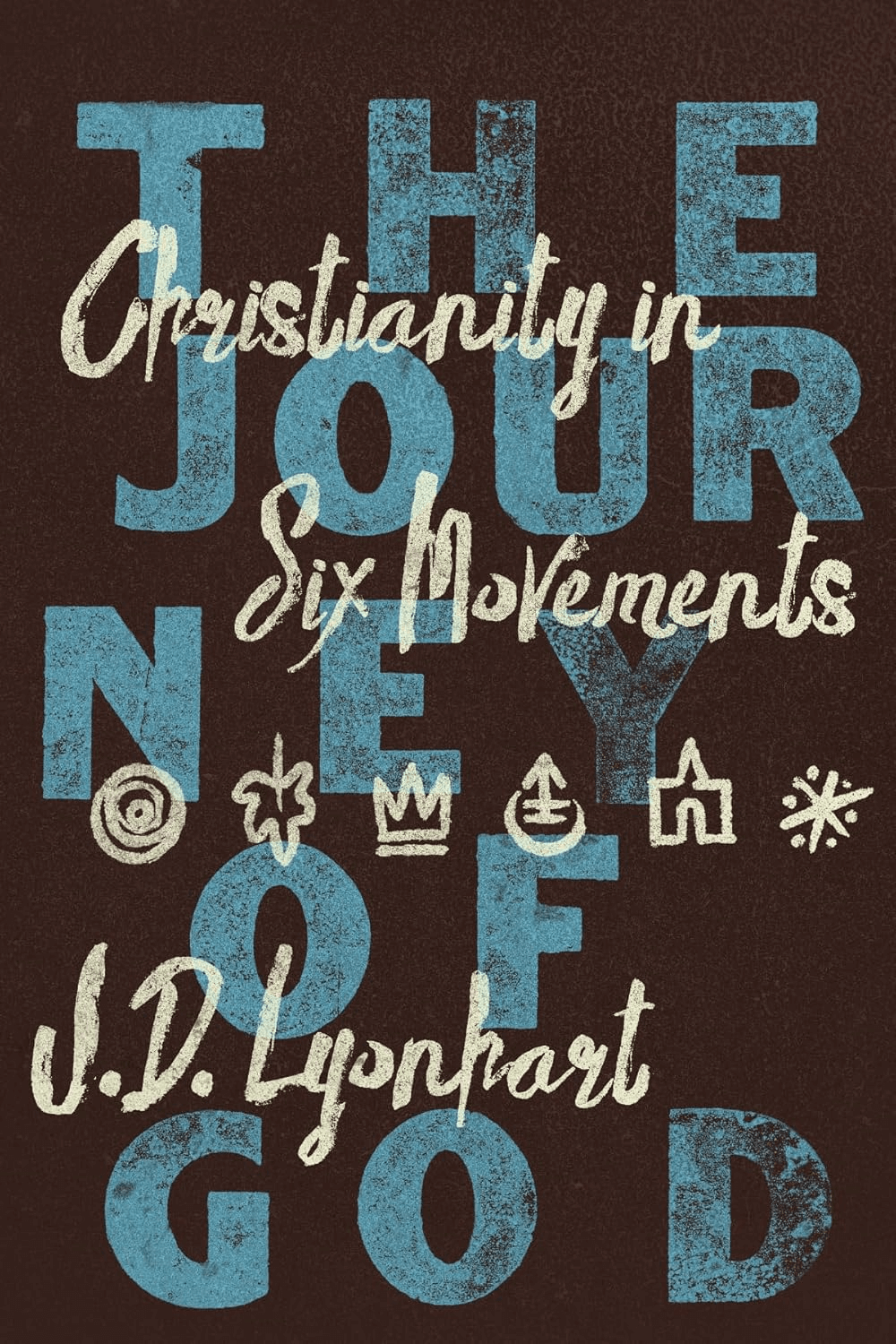
J.D. Lyonhart is a British-Canadian theologian, philosopher, author and ordained minister. He is an associate professor of religion and philosophy at the University of Jamestown, a fellow at the Cambridge Center for the Study of Platonism at Cambridge University and a co-host of the Spiritually Incorrect Podcast. In addition to The Journey of God: Christianity in Six Movements, he also authored Space God: Rejudging a Debate Between More, Newton, and Einstein, as well as MonoThreeism: An Absurdly Arrogant Attempt to Answer All the Problems of the Last 2000 Years in One Night at a Pub.
Taken from The Journey of God by JD Lyonhart. Copyright © 2025. Used by permission of InterVarsity Press.