Mark Batterson
5 min read ⭑
In 1963, Israeli archaeologists were excavating Herod the Great’s palace at Masada. As they dug, they found the usual suspects — ancient artifacts, artistic fragments, even some skeletal remains. But the most curious discovery was a sealed jar with seeds perfectly preserved inside. Radiocarbon dating gave them an age range of roughly two thousand years — somewhere between 155 BC and 64 AD. And DNA testing revealed that those seeds belonged to an extinct species of trees called the Judean Date Palm.
Those seeds were put in storage for forty years at Bar-Ilan University in Israel. In 2005, three seeds were planted in the Arabah desert. Eight weeks later, one of those two-thousand-year-old seeds sprouted, making it the oldest seed to ever be germinated. So, they named it Methuselah. By 2008, that single seed had grown into a five-foot palm tree with a dozen leaves. It flowered for the first time in 2011. And at last measurement, in 2015, Methuselah was a ten-foot-tall, pollen-producing palm tree.
In the field of botany, there are two types of seed — orthodox and unorthodox. What differentiates those two types of seed is survivability. Unorthodox seeds are unable to survive a deep freeze or a drought. Orthodox seeds, on the other hand, can survive glaciers and famines and fires. Orthodox seeds can survive centuries, even twenty centuries, like Methuselah.
Legacy is an orthodox seed.

Unsplash+
In recent years, I’ve encountered lots of leaders struggling with discouragement. Circumstances beyond their control have taken their toll. Can I tell you what I’ve told them? Even if you feel like your leadership has taken a downturn, don’t discount the difference you’ve already made! Leadership is playing the long game — long vision, long obedience and long legacy. Don’t overinflate last week’s meeting, this month’s sales or next quarter’s financials. Leadership is measured by your body of work.
The Power of a Single Seed
The kingdom of God is like is like a mustard seed, which is the smallest of all seeds. Yet when planted, it grows and becomes one of the largest garden plants, and puts forth great branches, so that the birds of the air nest in its shade (Mark 4:30-32 NIV).
A mustard seed measures less than two millimeters in diameter. Yet in a matter of months, that seed turns into a twenty-foot-tall tree with a twenty-foot span. If you didn’t know what kind of seed it was, you would never imagine what it could become. That little seed is packed with Vitamin B6, B12, C, E and K. It contains calcium, magnesium, potassium, iron and zinc. And it’s the key ingredient in one of my favorite condiments — mustard. Where are my classic yellow people? Spicy brown? Grey Poupon?
Let me ask the obvious question: why did the farmer plant the mustard seed? Don’t overthink it — the farmer wanted mustard on his kosher hot dog! But God had ulterior motives. God was writing a bigger story — “so the birds of the air can nest in its branches.” Mustard is the understory, but nesting is the overstory.
When we were planting National Community Church, our name felt like a misnomer. Nineteen people meeting in a DC public school didn’t feel national, but that name proved to be prophetic. We’ve had the privilege of impacting tens of thousands of people from across the country and around the world.
A few years ago, Dick Foth was speaking on an ordinary Sunday. That morning, he met a family that had emigrated from China; a woman from Mongolia who had won a green card; and the German wife of an American diplomat who had been appointed consul general in Hamburg, Germany. That same morning, at another campus, I happened to meet a member of Finland’s parliament. That afternoon, Dick called me, and he sounded like a kid in a candy store: “Mark, don’t go anywhere, you can reach the nations!”
National Community Church represents more than a hundred nationalities, and that’s just our immediate family. Our extended family — those who are part of our online campus — dot the globe. Did we plant NCC to reach the nations? We weren’t dreaming that big! We had a hard time believing God for our city. But God’s vision is bigger and better and longer than ours! “Ask of me, and I will give the nations.” (Psalm 2:8 NIV)
God has turned us into a nest for all nations. During our House of Prayer on Thursday nights, we’ll sometimes have people pray in different languages. It’s a beautiful thing to behold. It sounds heavenly — every nation, tribe, people and language. Like the farmer who wanted mustard on his hot dog, we had no clue what God was up to. And it didn’t happen overnight. It happened gradually, then suddenly!
“I don’t do meetings. I do relationships.”
Long Relationships
I have a friend, Kevin Warren, who is the President and CEO of the Chicago Bears. We met more than a decade ago when Kevin was the Chief Operating Officer for the Minnesota Vikings. In between, Kevin served as Commissioner of the Big Ten.
Kevin is a high-level leader, to say the least. He helped lead the building of U.S. Bank Stadium in Minneapolis, which was no small task. Kevin is the kind of person, when you’re with him, who is fully present. He makes people feel seen, heard and loved. He makes people feel like they are the only person in the room.
Many years ago, I was doing a chapel service for the Vikings, and Kevin gave me a field pass. We were down on the field before the game, and we took a picture with a woman named Millie who was celebrating her 99th birthday at the game. The last time I saw Kevin, I asked him if he remembered Millie. Internally, I’m thinking there is no way! Kevin meets so many people! Kevin said, “Yes, I do. Millie passed a few years ago and I stay in touch with the family. I check in, every now and then, to see how they’re doing.” Are you kidding me? You’re the President of the Chicago Bears now. Why would you do that? Because Kevin knows that his legacy isn’t U.S. Bank Stadium. His legacy is people, and so is yours!
After that chapel for the Bears, Kevin made an off-handed comment I will always remember: “I don’t do meetings. I do relationships.”
That’s a totally different posture.
That’s a totally different objective.
Honestly, I think that’s how Kevin has risen through the ranks. As President and CEO of the Chicago Bears, he has to make unpopular decisions. And in the world of sports, you’re only as good as your last game! But it’s Kevin’s likability factor that has opened doors of opportunity.
That conversation was a game-changer. I tend to be task-oriented rather than relationship-oriented. I’ve got places to go, things to do. But I’ve stopped doing meetings and started doing relationships. I try to be more fully present with people. I try to make them feel seen, heard and loved. I try to treat them as the apple of God’s eye!
What if you stopped doing meetings? What if you started doing relationships?
One way to put this principle into practice is to pray for the people. Who? Anyone and everyone you encounter! When I pray for opportunities to show God’s love, those opportunities have a way of presenting themselves! While you’re at it, pray over your calendar. It’ll turn some of those appointments into divine appointments.

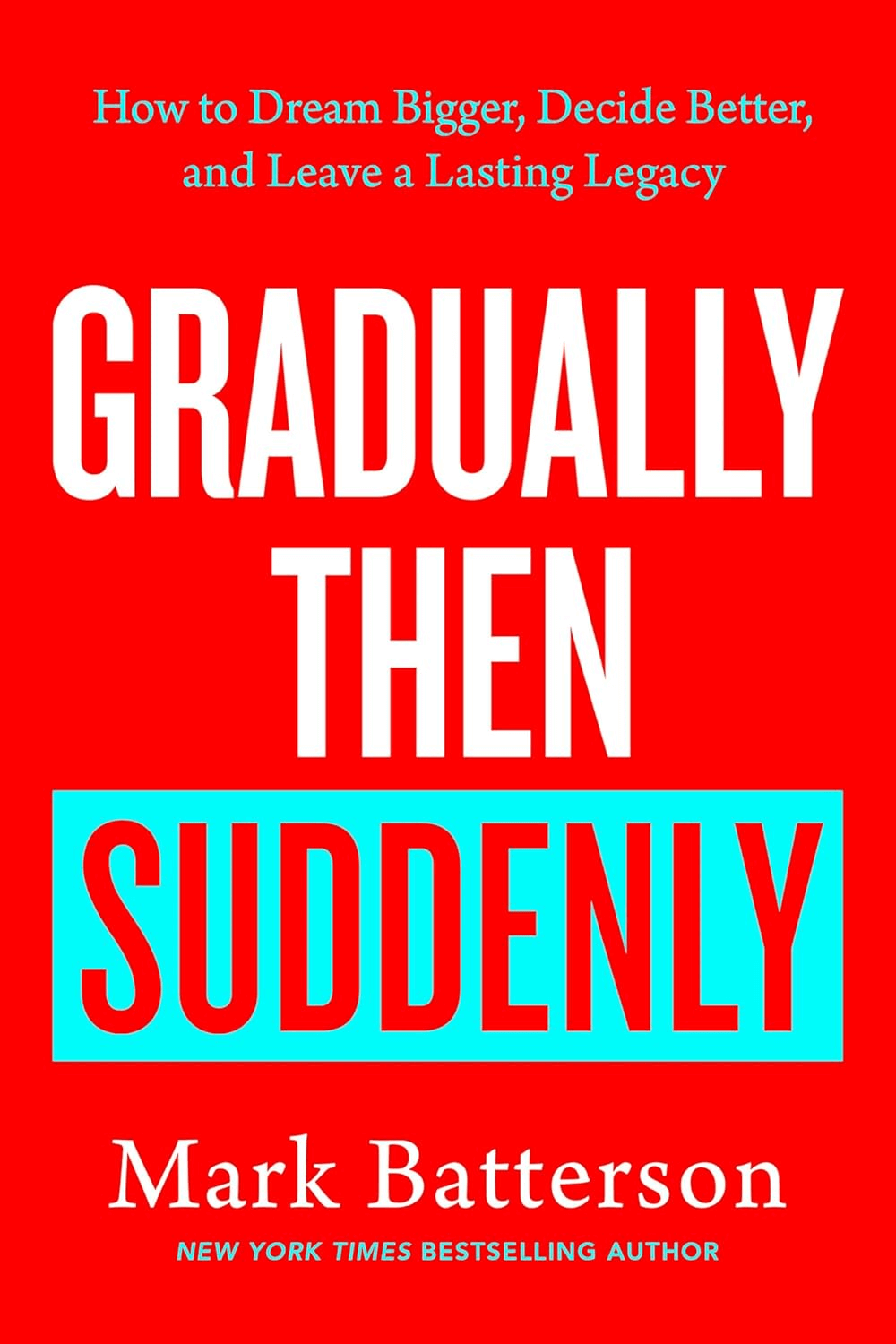
Mark Batterson is the New York Times bestselling author of 26 books with more than 10 million in print worldwide including his latest, Gradually Then Suddenly, How to Dream Bigger, Decide Better, and Leave a Lasting Legacy. He’s also the founding pastor and lead visionary of National Community Church (NCC) in Washington, D.C. Mark holds a doctor of ministry degree from Regent University. He and his wife, Lora, have two adult children.
Taken from Gradually Then Suddenly by Mark Batterson. Copyright © 2025. Used by permission of Multnomah.