Who Counts? The Revolutionary Ethics of God
Andrew DeCort
7 min read ⭑
At heart, the question, “Who is my neighbor?” interrogates the scope of our moral community. It asks, “Who is related to us, and who is other? Who am I obligated to care for, and who can I overlook, exclude or even attack without regret?” All human beings have an inherent sense of moral right and responsibility — to tell the truth, to protect others, to share and serve. But the question is, who counts as morally significant, and who falls off our radar?
Think of morality as a circle. Those inside the circle are people we recognize, respect and want to see flourish, or at least to treat fairly and do justice to. Others outside the circle are those we consciously or unconsciously ignore, exclude or attack. The question is how we draw this circle and thus who is in, who is out and why. Who is our neighbor?
This question searches to the heart of Hebrew Scripture and its ethical vision for humanity. On the one hand, the Hebrew Bible or Christian Old Testament affirms that all people have been created by God, bear God’s holy image and descend as one family from shared ancestors. In this way, the Hebrew Bible presents us with a universal moral vision in which there are no “others.” This was a revolutionary breakthrough in ancient morality. Building on this vision, God’s promise to Abraham was ultimately to bless “all peoples on earth” (Gen 12:3), and Moses commanded his community, “Love your neighbor as yourself ” (Lev 19:18). The circle seems to surround everyone — as wide as the world.

Garvit Nama; Unsplash
But on the other hand, Israel was one nation among many others, surrounded by people it saw as “enemies,” and sometimes in danger for its survival. For Israel, neighbor generally meant a fellow Israelite and worshiper of Israel’s God, thus potentially limiting the scope of its moral community. Israelites were called by God to be a community of love and justice for the neighbor. But Israel’s qualified definition of the neighbor raises the question of just who counts as a neighbor.
Israel’s law — the circle of its moral community — contains troubling limitations in who we’re called to see as neighbors and how others should be treated in light of Israel’s religious nationalism. As we wrestle with the text, we’ll see that some non-Israelite neighbors could be ignored or excluded. Others could be enslaved from generation to generation. In extreme cases, whole groups of “enemies” could be hated and exterminated, including women and children.
Of course, there are places in the Old Testament that show just how groundbreaking and countercultural Israel’s neighbor-love ethic truly was, especially in light of the cultures of surrounding societies. The story of Ruth and Boaz is particularly inspiring, as we’ll see. But Israel’s ethic didn’t include everyone or completely abolish othering.
Ruth: The Divine Love That Overcomes Othering
The book of Ruth is one of the smallest in the Bible, but it narrates one of the Bible’s most powerful stories of overcoming othering and loving the enemy. It’s the story of Ruth and Boaz and their countercultural relationship. As we’ve seen, the Moabites were othered as Israel’s hated enemies. Moses commanded Israel never to allow Moabites to enter the community or even to show them kindness (Deut 23:3-6). Moabites were seen as descending from a dirty, incestuous ancestry and they were resented for betraying Israel when it was journeying through the desert after escaping slavery in Egypt (Gen 19:36-38; Num 24).
This othering became so severe that King David brutally massacred and enslaved the Moabites (2 Sam 8:2). After the exile, the reformers Ezra and Nehemiah then reinforced Moses’ law against the Moabites: they had all of them rounded up, separated from their Jewish families, and systematically excluded them (Ezra 10; Neh 13). Twenty passages in the Hebrew Bible have nasty, othering things to say about Moabites.
This is the crucial background for understanding the radical ethics of the book of Ruth, because Ruth herself was a hated other: a Moabite.
In this seemingly innocent story, an Israelite woman named Naomi and her husband migrate to neighboring Moab in search of food during a famine in Israel. Soon enough, Naomi’s husband dies. While still in Moab, her two sons marry Moabite wives, but the sons also die. It is likely that Israelite observers would have seen Naomi as cursed by God. After all, she voluntarily defied Moses’ command and mixed with the despised Moabites. Her family is dead, and her life is falling apart.
After the famine ends, the bereaved Naomi decides to move back to Israel, and her widowed daughter-in-law Ruth insists on coming with her. Strikingly, Ruth is called a “Moabite” seven times in this story (Ruth 1:4, 22; 2:2, 6, 21; 4:5, 10). In the Bible, seven is the number of fullness, like the seven days of creation in Genesis 1. The author wants us to see Ruth as the total Moabite — as Moabite as it gets. Nevertheless, Naomi daringly welcomes Ruth to come home with her.
This is where the story becomes truly scandalous and subversive. Back in Israel, Naomi sends Ruth to work as a daily laborer in the field of a respected Israelite named Boaz. He is presented as a person of covenant love or hesed (Ruth 2:13, 20; 3:10; 4:13; see Ruth 4:15). This is extremely important because God names Godself as “abounding in hesed” when God reveals God’s core character to Moses in perhaps the most significant divine revelation recorded in the Hebrew Bible (Ex 34:6). In fact, almost fifty verses in Hebrew Scripture name hesed as God’s essential attribute, which is alluded to in the first chapter of Ruth (Ruth 1:8).
“Jesus’ teachings were as challenging as they were inspiring, and love for the enemy became their signature.”
So Boaz is a man of God, a human who embodies God’s own loving character. How, then, will he respond to Ruth, the sevenfold Moabite? Will he exclude her as Moses commanded in the law and Ezra demanded in his “purified” community? Or will he do something different?
Against all expectations, Boaz proactively welcomes Ruth the Moabite to work in his field. In fact, he shows her special kindness. As if that weren’t already too much, Boaz ends up fully embracing Ruth the Moabite and marries her. For Boaz, Ruth is “a woman of noble character” (Ruth 3:11), and her character matters to him far more than her othered identity.
Provocatively, then, Boaz is presented as the embodiment of God’s covenant love precisely in his decision to break the Mosaic law and love an othered enemy as his own wife. In this story, love transcends law. Or, better said, Boaz’s love for the other re-stretches the law back to its universal scope at the heart of creation and Abraham’s calling to bless all people. Thus, the lawbreaker who should seemingly be condemned by God and expelled from the community becomes the archetype of God’s own essential character and a crucial link in the community’s ancient story. At the end of the book, we learn that Boaz and Ruth become the great-grandparents of King David (Ruth 4:22).
Even more shockingly, Ruth, the sevenfold Moabite, is listed as one of the great-grandmothers of Jesus in the first chapter of the New Testament (Mt 1:5). Boaz’s practice of transcending biblical law with love for the enemy gives birth to the Messiah and participates in the fulfillment of God’s promise to Abraham. The author thereby gives us an important clue into how we should set our expectations for who Jesus will become and how he will see others. The heteronautic Messiah will follow his great-great-grandparents’ path and take it further than many imagined possible. Unsurprisingly, then, Christian interpreters have seen Boaz as a prototype of Jesus.
The book of Ruth is small but radical. It serves as a profound precedent for human character and divine love overcoming human othering and entrenched exclusion. In fact, Ruth gives an example of love abolishing othering even when that othering was justified by Scripture itself. Boaz’s love for Ruth breaks out of the hardened pattern of othering neighbors into enemies and instead embraces them as family.

But with Jesus of Nazareth, we discover a revolutionary breakthrough in culture and ethics — the radical expansion of neighbor love into a universal movement. For Jesus, the neighbor to be loved was not simply a fellow Jew or follower of Moses’ law. Jesus insists the neighbor is everyone, including excluded outsiders and hated rivals. In fact, Jesus expands the command of neighbor love and declares for the first time in Israel’s history three extraordinary words: “Love your enemies” (Mt 5:44). Indeed, in his most famous story about the meaning of neighbor love, Jesus makes his society’s most hated enemy the loving neighbor who crosses every boundary of religion, ethnicity and politics to help a suffering stranger. Jesus is provocative and profound: the one we are most tempted to other is our neighbor. A universal belonging is unlocked.
What was so revolutionary in Jesus’ teaching was that he drew the moral circle of love around everyone. Now no one was left outside. Othering was abolished. For Jesus, it didn’t matter whether you were a fellow citizen or “foreigner,” righteous or “sinner,” friend or “enemy,” man or woman, rich or poor, child or adult — all people were valued as precious neighbors. And thus all others were to be treated as neighbors with respect, compassion and self-giving love.
In fact, Jesus seems to make loving our enemies a condition for enjoying an authentic relationship with God (Mt 5:45; Lk 6:35). This is the paradox of his teaching of neighbor love: we exclude ourselves from full belonging only when we exclude others from it. For Jesus, God is a neighbor lover without limits, and thus, to fully participate in the life of God’s family, we too must be neighbor lovers without limits. Jesus’ teachings were as challenging as they were inspiring, and love for the enemy became their signature.

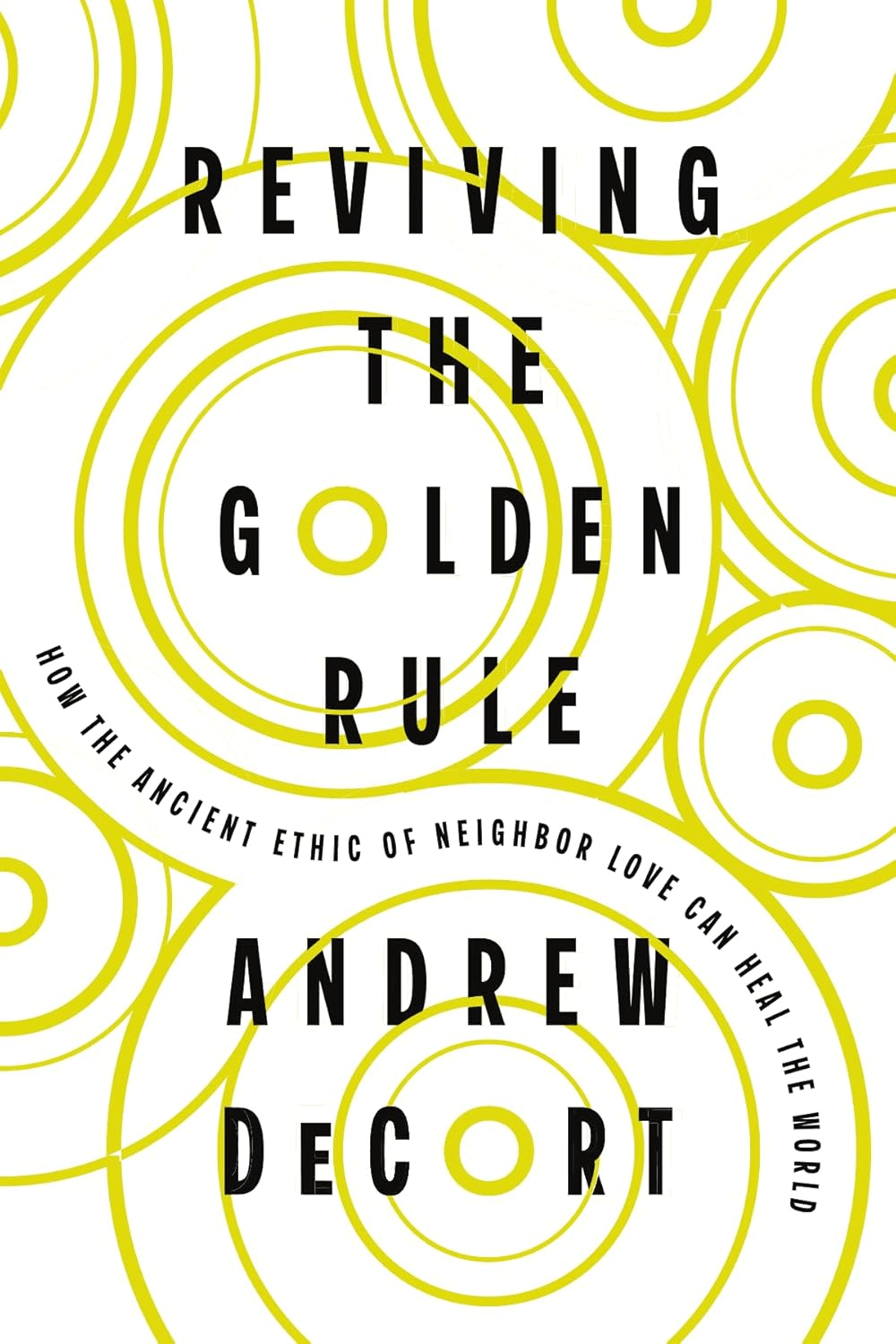
Andrew DeCort founded the Institute for Faith and Flourishing and cofounded the Neighbor-Love Movement in Ethiopia, which have reached over 20 million people with the invitation to nonviolent spirituality. He’s taught at Wheaton College, the Ethiopian Graduate School of Theology and the University of Bonn. He’s the author of Reviving the Golden Rule, Blessed Are the Others and Flourishing on the Edge of Faith, and writes the Substack Reframe and newsletter Stop & Think.
Taken from Reviving the Golden Rule by Andrew DeCort. Copyright © 2025. Used by permission of InterVarsity Press.