The Prayer That Didn’t Take: A Faith That Does
Jonathan R. Bailey
18 min read ⭑
Because of the distance between us, the speaker was in miniature, but there was a largeness in his voice. All throughout the night, I remember him thundering rhythmically about sin, repentance and the urgency of accepting Christ as my personal Lord and Savior.
As he came to a close, his voice slowed and softened, and he said, “I want you to bow your heads and close your eyes.”
Everything went dark except for those starlike patterns you see when you squeeze your eyes shut tight.
His voice returned, “If I could pass this microphone around the auditorium, you’d hear dozens of stories of transformation, all because people asked Christ into their hearts.”
I remember my forehead balancing on the seatback in front of me, and in each nook of my ten-year-old eyes, tears were beginning to form. I wanted to be a Christian. I wanted to stop sinning. I wanted to be transformed.
“In just a minute,” he said, “I’m going to ask you to raise your hand.”
Trying not to move my head, I glanced in the direction of my parents, and then in the direction of my siblings. It was a strange feeling. I was embarrassed for crying, and then a little guilty for feeling embarrassed.
Once more, the speaker’s voice came low and rumbling: “No one looking around, please, eternal lives hang in the balance.”
I could feel myself holding back, afraid to move.
What would my parents say?
What would my siblings think?
Were they going to raise their hand?
Was I?
What if they did and I didn’t?
What if I did and they didn’t?
I didn’t know what to do. But even as a ten-year-old, I knew I wanted to be a Christian. I wanted to be different. I wanted to change.
Then his voice summoned: “With no one looking around, I want you to raise your hand. Don’t wait. Tonight is your moment.”
I have to, I thought. I don’t care what anyone thinks. I have to do this. I pushed my arm high into the air.
This was my transformational moment.

Lawrence Krowdeed; Unsplash
Getting It Right
Fast-forward a couple of years.
I was now participating in what seemed to me the biggest thing going: Youth Group. I remember huddling in a living room with my closest friends. We were listening to the final lesson at our weekend retreat.
“Sometimes our lives get complicated and messy,” the youth leader said. “Do you ever feel that way?”
I wasn’t old enough to know about complicated, but I knew something about messy: I couldn’t stop thinking about female body parts, repeating profanities or glancing at my neighbor’s exam when I “forgot” to study.
The leader spoke again: “In those moments, wouldn’t you give anything to get back to that feeling of newness you had when you first became a Christian?”
Honestly, I didn’t even know if I was one.
The experience I’d had as a ten-year-old hadn’t changed me. I don’t know what happened to that little boy in the auditorium. All I knew was it didn’t work, or that I didn’t do it right. I knew this because there was no discernible difference between my non-Christian friends and myself. Well, there was one difference — I went to church a lot and they didn’t.
But this time was different. I was older. I knew what I was doing, and my longing was real.
I did want newness.
I did want to be a Christian.
I did.
And I wasn’t alone this time; my friends were with me. Everyone, it seemed, was caught in the momentum of the weekend, each retreat day building on the next like an unstoppable wave.
The leader closed: “Transformation means to turn something old into something new. Remember how Jesus healed people who were sick and made them well. He can take your life and make it new tonight. If you want newness — if you really wish to change — then repeat this prayer with me. You can say it quietly under your breath, or in your heart.”
I remember closing my eyes tight and, with considerable volume, saying the prayer out loud. I wanted everyone to hear. I wanted to change.
I wasn’t getting this wrong again.
Walking Out
I’m a high school senior sitting in the sanctuary on a Sunday morning and white flecks of donut icing won’t brush off my sweater. No matter how many times I swipe, they only sink deeper into the fabric.
Donuts were the high point on Sunday mornings, and I liked sneaking them into the service. On this particular morning we had a guest speaker, and thankfully he was wrapping up his sermon: “I want you to bow your heads and close your eyes.”
Assuming the position, I balanced my head on the seatback in front of me. That’s when I noticed the glaze. It’s amazing what you can find bent over for eight or nine minutes. Up to this point, I had gone to church all my life, multiple times per week, but I still wasn’t different. My teenage “conversion” had the same result as my ten-year-old one.
It didn’t take. Nothing came of it.
I suppose there were a couple of weeks of reading my Bible in the mornings and some genuine attempts to stop using profanity, but whatever momentum I had fizzled.
What made all this so frustrating, not to mention unhealthy, was the frequency of these “transformational” experiences. In any given week, I might be taught to:
• have the courage of David and face my giants;
• commit to abstinence and refrain from first, second, and definitely third base;
• become like Blind Bartimaeus and grow desperate for Jesus.
If I wanted any of this to happen, I needed to “raise my hand,” “come forward” or “say a prayer.” It was as simple — and toxic — as that.
I repeated these experiences again and again, constantly trying to get it right, wanting to change, wishing to find transformation, but the pattern was painfully the same — nothing happened. I didn’t change.
Oddly enough, I never really rejected Christianity. I just cooled to it. I couldn’t make sense of how it worked. I couldn’t put it into practice.
If this prayer doesn’t end soon, I remember thinking, the seatback in front of me is going to tattoo my forehead.
Fortunately, he was ending: “God can remove your unrighteousness and transfer Christ’s righteousness from his account to yours if you’ll only believe. I want you to come forward if you want this righteousness. Right now. Don’t wait.”
The words still have a haunting effect. I remember hearing people beginning to move forward. This was my chance. I raised my head from the seatback, stood up straight, shuffled toward the aisle, and instead of walking forward, I walked out the back.
Maybe there were a few donuts left.
Transactional Christianity
At the time, I didn’t realize I was living through one brand, of one denomination, of one branch of Christianity. I thought it was Christianity.
If I had to label my experience, I’d call it transactional Christianity.
If I did A, I’d get B.
It was a formulaic approach, and many from my Western, evangelical tradition grew up relating to God in that way. Transactional Christianity was the product of nineteenth-century British and American revivalism — the birthplace of the “altar call,” the “public profession,” and the “decision for Christ.”
These post-sermon techniques were invented to summon non-Christians to publicly confess their faith. But unfortunately, they evolved into one of the primary ways professing Christians thought they could grow in it.
The reason altar calls made the leap from revival meetings to weekly services, I suspect, is because evangelicals found them attractive and satisfying. Now every sermon could offer an emotional crescendo, immediate results and instant change:
Raise your hand if . . .
Say this prayer if . . .
Walk this aisle if . . .
It was immediate gratification at its worst. I couldn’t remove the donut icing with a swipe of my hand, but I could remove all the unrighteous ness from my life by raising it?
Perhaps it worked for others, but it never worked for me.
Never receiving the “B” side of the transaction left me feeling exhaustingly hypocritical — my words saying one thing and my actions saying another. The only way I knew how to deal with it was to stop trying altogether. This was probably wrong, but at least it was honest. I don’t remember telling anyone. I didn’t need to make a dramatic announcement.
I simply checked out.
Spirituality Wrongly Understood
Fast-forward one last time, to my college years.
I remember being home on break, waking up early and walking downstairs into the living room, where my dad was doing some devotional reading. I loved reading with him. He usually had a candle lit, some instrumental music playing in the background, and a pot of coffee on. I try to recreate that same environment with my kids.
I remember sitting down and picking up the first book I saw on the floor. I thumbed through each chapter, reading the quotes at the top. It was the quote at the top of chapter two that shifted the entire trajectory of my life. Here’s what I read: “Spirituality wrongly understood or pursued is a major source of human misery and rebellion against God.”
Yes. That’s precisely what those growing-up years felt like: I didn’t understand Christian spirituality, the way we live what we profess. And that’s what I had always been looking for. How does Christianity work? How does transformation happen? How does it get lived?
When I look back on my life, I realize so many of my longings were legitimate and sincere, but my understanding was just wrong. I didn’t know how to live the longings within me. And that misunderstanding made me miserable.
After reading that quote, I remember looking down for the author’s name. It was unusual: Dallas Willard.
I immediately ordered one of his books. I devoured it. Here was someone who knew exactly what I had experienced, and not only knew it, but was offering me something to do about it. After the first book, I ordered everything else I could find — not just the books, but I tracked down every CD and cassette tape I could find.
I was awakening.
Dallas showed me a kind of spirituality that worked, one I could make sense of. He gave me a singular, concrete vision for transformation, which was not about trying to embody everyone and everything I read about in the Bible, but simply embodying Christ. It was from Dallas’s work that I learned of Richard Foster, a wonderfully practical person. Richard’s work gave me a field guide for spiritual practices, helped me tackle the main challenges of a training life, and encouraged me to abandon denominational extremes and embrace the beauty and balance of the Christian tradition.
So in a very short time, I traded
• a vision that was about embodying the Bible, for one that was about embodying Christ;
• an intention that was sporadic, for one that was woven into the flow of my daily life;
• and means that were basically emotional pledges, for timeless Christian practices.
In short, I traded transactional Christianity for transformational Christianity.
That made sense. My new trajectory was set.
The Threefold Way
That was twenty years ago.
Dallas and Richard were bridge builders, trailblazers, practitioners who not only got me going, but got me curious. They were always urging me to go back to the Christian tradition and explore.
Dallas would often say, “Go back and read Teresa of Ávila’s ‘Interior Castle,’ or “You must try Frank Laubach’s ‘Game with Minutes.’” Richard would frequently remark, “You really must look into ‘The Journal of John Woolman,’” or “Go out and get a copy of Brother Lawrence’s ‘Practicing the Presence of God.’” It was like they had a Narnian wardrobe of their own, and they kept saying, “Go through! Go through!”
I did. And I couldn’t believe what I found.
Here was a myriad of Christian pilgrims — Orthodox, Catholic and Protestant — not consumed by their theological differences but centered on articulating a universal way of dwelling with Christ in order to become like him. Each of these saints lived in a unique time and place, and yet buried within their pages were striking similarities.
Many talked of purification, cleansing, shedding of sin, a kind of detachment from the distractions that hindered their relationship with Christ. Others described a process of illumination, a deepening of their awareness, a recognition of the Spirit’s transforming presence, marked by increasing clarity and growth in virtue. And it was impossible to miss their insistence on unity or oneness, as if they were arriving at a deeply intimate friendship or union with God.
The more I read, the more I realized that these weren’t just rare experiences unique to a few; they were developmental stages everyone encounters on the journey to becoming like Christ. I was reading dispatches — firsthand reports from people who had actually been there. I was tracking footprints — these saints were sharing transformational terrain. What would happen, I wondered, if all of these footprints were brought together? Would a wider path form?
It was only a matter of time before I realized that people already had.
For example:
• In “The Life of Moses,” Gregory of Nyssa, a Christian bishop from the fourth century, pictured the journey as a kind of mountainous ascent.
• In “The Interior Castle,” Teresa of Ávila, a sixteenth-century Spanish nun, envisioned the soul moving inward from room to room through a diamond castle.
• And in his space trilogy, C.S. Lewis, writing in the mid-twentieth century, imagined spiritual transformation as interplanetary travel between worlds.
These works, and others like them, were called spiritual itineraries — books that trace the soul’s journey toward God, describing the movements and experiences of transformation. Each expressed, in its own way, the same threefold pattern at the heart of Christian spirituality.
This wider path is known today as the “Threefold Way.”
Three Stages of Transformation
The Threefold Way describes the transformational journey through three distinct stages of growth: purgation, illumination and union.
Simply put:
• Purgation means pruning for growth.
• Illumination means receiving transformation.
• Union means deepening oneness with God.
Each stage is a discernible phase of our maturation into Christ’s likeness, with its characteristic themes, patterns and experiences. Each is also a unique way of being with him, a distinct mode of dwelling in Christ. Recognizing this has been a gift, offering me direction without being prescriptive, form without being formulaic.
To be sure, the Threefold Way doesn’t capture everything, but it’s a reliable framework. That’s why it has become my map — a map of spiritual country, a kind of geography of the soul, transformational terrain.
One of my favorite discoveries was the realization that I was already on the path these saints were describing. I didn’t need to know about it to experience it. I was already training with spiritual practices, albeit a little haphazardly. I had already been puzzling over my affliction, questioning how anything good could come from it. And I was already in the throes of temptation, struggling with how to think about it.
What I’m trying to say is that knowing the path isn’t a prerequisite to walking it. But one of the great gifts of coming to know the Threefold Way is how it drew me into a more thoughtful participation in grace. And in time, the fruit of that grace began to appear in ways I hadn’t expected.
All of this worked a special joy inside me, a joy in seeing myself as part of something larger, of living into a great synthesis, a solidarity between saints — their footprints producing a path for mine.
Some of these Christian pilgrims spoke of the Threefold Way by name, while others simply described the transformational movements within it. Through their lives and writing, they amplified the three stages — like jazz musicians riffing off each other’s music. That’s what I want to do in this book.
I want to riff.
To do that, I’m organizing the book around each stage — purgation, illumination and union — while also letting my own journey from an old transactional mindset to a more transformative faith shape the flow. By weaving in my own stumbling journey, I hope to offer you a modern-day perspective of this ancient path.
“I could breathe. I could change. What a relief.”
What Is Purgation?
When we begin purgation — the introductory season of our transformation — our journey is new and exciting, but also hard and unsettling. In my own life, I have especially sensed purgation as a season of deep conflict — “Why can’t I do what I want to do!?” (see Rom. 7:15). Why do I keep betraying the life my heart so longs to live?
Our Christian ancestors tell us that the purgative stage is a period of purification and renewal, where we begin our break from the prison of self-centeredness into the freedom of other-centeredness.
Think of purgation as the childhood stage of our transformation, the season where we work to learn trust, gain basic skills and take initiative for our developing life. Our spiritual training is genuine but self-focused, sometimes heroic. Affliction is spurned; we haven’t recognized its role as one of our primary teachers in humility. And temptation frequently trips us up, in more ways than one.
The writers of Scripture describe purgation as the stripping of the sins that so easily entangle us (Heb. 12:1). Or being purged with hyssop and made whiter than snow (Ps. 51:7). Or being pruned to bear more fruit (John 15:2).
What Is Illumination?
Illumination is the middle stage, the springtime of our transformation, that vigorous period when branches broaden, sprigs shoot and pansies push through the earth. It’s the season where death gives way to life, vitality and growth. Our transformation becomes visible, progress is pronounced — but more is needed.
What I’ve noticed about illumination is the gradual growth of freedom, although most of it has come in the form of “Two steps forward, and one step back.” Maybe others grow in a straight line, but my growth has always been a mix of progression and regression.
A major illumination has been discovering the many illusions I’ve lived by (and no doubt still live with). Though painful, it’s been necessary to let these pieces of my old mindset fall away.
And finally, the way I participate in my transformation has become less heroic, more modest and rhythmic — a quieter way of being formed in love as I settle into my apprenticeship to Jesus.
Honestly, the illuminative stage is a little like adolescence; it puts me in a kind of in-between state. I’m growing, but I long for more freedom. I ache for my Christ-self to mature.
Scripturally, illumination is about becoming light in the Lord (Eph. 5:8). It’s about overcoming evil with good (Rom. 12:21). It’s about developing the mind of Christ (Phil. 2:5).
And I’ve noticed this: Entering the illuminative stage doesn’t mean I leave purgation behind. Purgation and illumination are intrinsically linked:
• Emptying makes way for filling.
• Burning begets brightness.
• And pruning produces growth.
Purgation and illumination go together. Truth be told, all three stages do. They’re deeply involved with one another. We may be journeying through the purgative stage and find ourselves touched by moments of illumination, even union. Or we may find ourselves in the unitive stage and old purgative echoes resurface. In this way, all the stages can be active within us at any given time, ebbing and flowing together.
What Is Union?
As a young boy, I can remember my twin brother and I making treasure maps, burning the edges of construction paper to give them that worn, old-fashioned feel. It was a delicate operation, not just for the artistic effect, but because the real challenge was doing it quickly so the smoke scent wouldn’t give us away.
Our maps were filled with what you’d expect: pirate ships, deadly forests, secret passageways, and always a large X at the end.
Union is the X, the treasure at our journey’s end. But what exactly is the treasure? What characterizes the unitive stage? The ancient Greeks had a word for this: telos. A telos was something’s inherent purpose, the ultimate reason for its being, the goal for which it was created or made. For example:
The telos of a clock is to keep time.
The telos of a caterpillar is to take flight.
The telos of a bridge is to connect divided lands.
But what’s the telos of a human being? What’s our inherent purpose? The goal for which we were created? Scripture hints at it in the very beginning: “Then God said, ‘Let us make humans in our image, according to our likeness ” (Gen. 1:26, NRSVUE).
I had long read this verse as a story of beginnings. Then I discovered, to my surprise and delight, that Kallistos Ware — an English bishop and beloved teacher in the Eastern Orthodox Church — understood it as pointing to our destiny, our telos: “The image is that which man possesses from the beginning, and which enables him to set out in the first place upon the spiritual Way; the likeness is that which he hopes to attain at his journey’s end.”
In other words, from the image we began, to the likeness we end. Being made in the image of God is our origin; it’s how we came out of God’s hands. Becoming the likeness of God is our destiny; it’s how we’re shaped by those very same hands.
It’s as we learn to exercise the image of God within us — or put differently, as we begin journeying across the threefold path — that our habits of thinking, feeling, speaking, and acting sprout into the divine likeness.
If I had to capture all of this in a few words, I might say:
The image is given,
the likeness is gained.
Or:
We’re designed in God’s image,
in order to develop in God’s likeness.
So back to our original question: What will we find at the end of the Threefold Way? What’s our treasure? Our telos? What’s the unitive stage all about?
To become like God.
This was the divine plan from the beginning. Every human being lives with this immense possibility, this staggering potentiality, this divine destiny. Every one of us is created not only to participate in divine life but to replicate it.
But, of course, we’re not created to be God; we’re created to be like God.
We do not become additional members of the Trinity. We do not become omniscient, omnipresent or omnipotent. The distinction between Creator and creature is preserved; but we do become like God (John 1:12) — plunged into the ocean of divine life, the very same life that’s been going on forever.
All of this may sound shocking, even sacrilegious. It did to me. But, then again, what did I think Jesus meant when he said to become perfect, “as your heavenly Father is perfect” (Matt. 5:48, NIV)? Or what did I think the apostle John was implying when he called us “children of God” (John 1:12)? Isn’t one of the obvious connections between a father and a child their likeness? Or what did I assume Peter and Paul meant when they urged their readers to grow in godliness? (1 Tim. 4:8; 6:6; 2 Tim. 3:12; 2 Pet. 1:5-8; 3:11).What did I suppose godliness was?
No, our divine destiny was right in front of me the entire time, written in plain sight across the pages of the New Testament. We’re created to become “participants of the divine nature” (2 Pet. 1:4, NRSVUE).
We’re made for eternal life (John 3:16).
This is what we find in the unitive stage, our transformational destiny, the culmination of the twin dynamic of purgation and illumination. Finally, we reach a transformational tipping point, a moment when all those small, incremental conversions become substantial enough to cause a thorough and more significant change.
I’ve experienced hints of this kind of union, but nothing more. So at this point, I shift from explorer to onlooker. Here, we can rely on the saints, those who’ve experienced this deep fulfillment of the Christian vision, where so much of their inner dividedness was drawn into a divine unity. These saints speak of:
• Their will becoming united with God’s will.
• Their heart melting into God’s heart.
• Their consciousness becoming wonderfully others-centered instead of self-centered.
This is the kind of union we’re made for — the deepest dwelling in Christ — the aim of our lives, the reason for our existence, the only thing that will satisfy us.
Delightfully Different
This threefold journey has been made by countless Christian pilgrims, known and unknown. They’ve formed it for us, with their own feet.
Now it’s our turn.
They can’t make the journey for us, but we can benefit from their experience and wisdom, from the lives that shined with a light beyond themselves.
These pages trace the key experiences of this threefold path, with my personal journey thrown in. You’ll see how I shed my transactional mindset and began to live a transformational one. I share this not only to encourage you to participate more fully in your own transformation, but also to help you break free from the transactional patterns that so easily distort our relationship with God.
Honestly, the more I turn to the three stages, the more I see a model I want to live by. I see the opposite of nominal and popular Christianity. I see something genuine and rare, something long sought and hard-won. Walking this path I’ve slowly, awkwardly, painfully become different — not flawless, not even close — but delightfully different.
I want to be careful not to overstate it.
I still struggle daily against ingrained sin, habits that cause me to wound others and myself. I’m still too self-interested. I know that.
But I’ve changed.
I love more than I used to. And perhaps most important — I want to love more than I love now. As you’ve probably gathered, I don’t think you’ll finish this book and be transformed. But I am hoping you’ll gain a fresh understanding of the transformational journey, an understanding that’s both rooted in tradition and works for today. I want to nudge your trajectory, like Dallas did for me all those years ago. I can still remember it clearly.
I could breathe.
I could change.
What a relief.
I wasn’t walking aisles anymore. I was walking a path.
In Sum
Awakening begins with longing. Many of us start the journey with a sincere desire to transform — but we often lack the understanding to support it.
The early Christian path offered something deeper: not quick conversions, but a long journey of becoming. The tradition has always pointed to transformation through a lived faith, not a momentary decision.
The Threefold Way — purgation, illumination and union — offers a reliable framework for understanding how we change over a lifetime. It helps us notice where we are, where we’re headed and how God is shaping us along the way.
Purgation is transformation through three unique experiences — training, affliction and temptation — these are the ingredients that open us to grace.
Illumination deepens that work as awareness grows; light dawns within us, and we begin to live with more intention, attention and love.
Union happens when our will and God’s will move together; we’re freely and fully participating in the Trinitarian community of love.
To dwell in Christ is to develop in Christ: to journey deeper into his life until his life becomes our own.

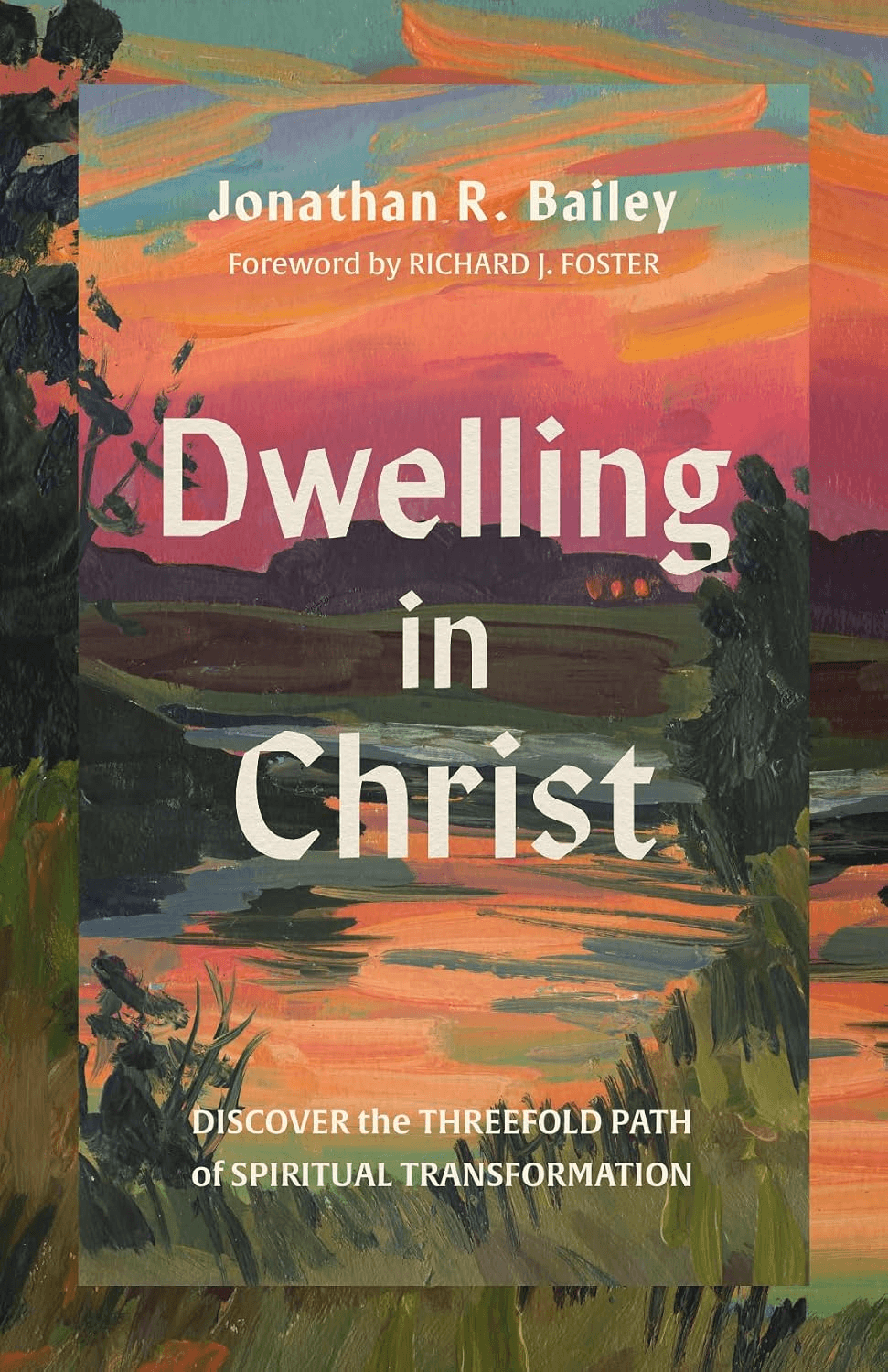
Jonathan R. Bailey is a co-founder of Dwell, an audio Bible app helping people rediscover the ancient practice of listening to Scripture. He wrote Dwelling in Christ: Discover the Threefold Path of Spiritual Transformation. He writes Three Weekly Lights, a newsletter that helps readers participate more deeply in their transformation. He also serves on the Board and Ministry Team at Renovaré. Jonathan lives in Frisco, Texas, with his wife, Kori, and their three children.
Taken from “Dwelling in Christ” by Jonathan R. Bailey. Copyright © 2026. Used by permission of InterVarsity Press.