
Rick Hamlin
10 min read ⭑
“Jesus told us to love the Lord our God with all our heart, all our soul, all our mind, all our strength. I needed to recover that part of my heart.”
Rick Hamlin is deeply interested in people’s prayer lives — how they pray, where they pray and what they say to God. As a longtime contributor to Guideposts and an author, he often shares honest, uplifting insights into his own prayer journey and his communion with Jesus. Over the years, he’s written numerous books on these topics, including Ten Prayers You Can’t Live Without, Finding God on the A Train, Even Silence Is Praise and his latest, Everlasting Jesus.
Below, he offers a peek at his favorite foods from around the world in his Manhattan neighborhood of Washington Heights, how he encounters Jesus on the subway and why he never passes up a chance to give to those in need.
QUESTION #1: ACQUAINT
Food is always about more than food; it’s also about home and people and love. So how does a go-to meal at your favorite hometown restaurant reveal the true you behind your web bio?
We live in Washington Heights, upper Manhattan, overlooking the Hudson River. Ever seen Lin-Manuel’s film “In the Heights?” That’s our ’hood. Over the years, it’s been a haven for immigrants. I can step out the door and hear multiple languages. After World War II, it was known as “Frankfurt on the Hudson” because of the thousands of German-Jewish émigrés; the last one still around was sex therapist and talk show host Dr. Ruth. Remember her?
As you might guess, there are multiple cuisines. For Indian food, we love Kismat (makes me want to sing something from the Broadway musical). Top-notch Dominican food can be found at the Radio Hotel (often with live music). The Uptown Garrison is right down the steps (called Garrison, I assume, because 250 years ago, this was the site of the battle of Fort Washington). But I am especially fond of the Ethiopian cuisine at Addey Ababa — big plates of spicy stew served up with injera bread.
But just so you know how clueless I am, the first time we ate there, I looked around for a fork or at least a spoon. Zippo. There was only the injera bread. My wife, Carol, who is much smarter than I, tore off a corner of the bread and dipped it in the stew, gathering it up like lentils in an envelope, then stuck it in her mouth and chewed. Here were our utensils. No fork or knife. Just the bread. Delicious.
Louis Colbee; Unsplash
QUESTION #2: REVEAL
What “nonspiritual” activity have you found to be quite spiritual, after all? What quirky proclivity, out-of-the-way interest or unexpected pursuit refreshes your soul?
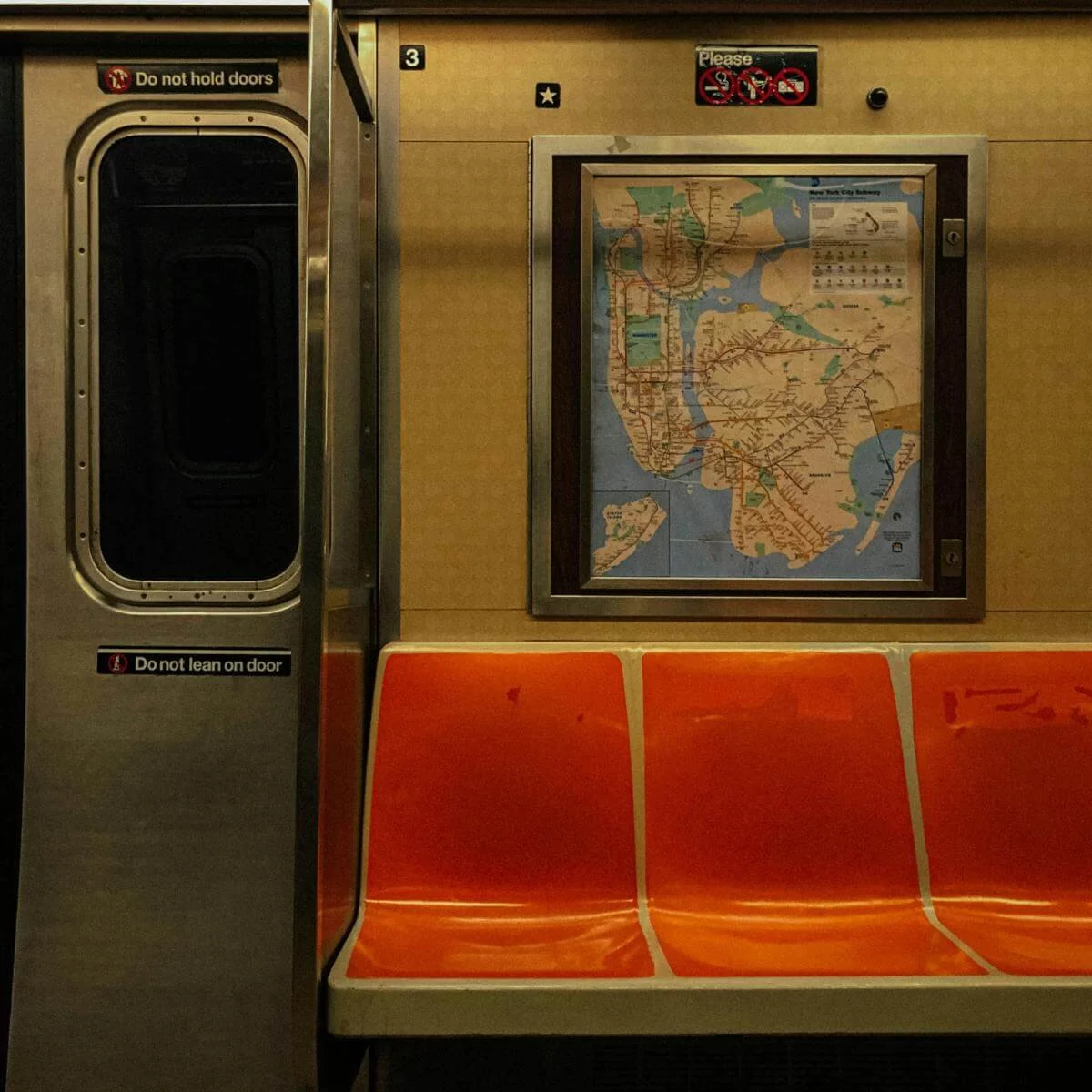
We get around in New York by taking the subway, the fastest and easiest way to get anywhere. I also like looking around on the subway and taking in the different people sitting there or standing, strap hangers, almost everybody staring into their phones these days. People of all ages. It is our community.
We live near the A train, and it’s a quick shot to get downtown from here, a direct flight, if you will. For years, I took it to get to the office, and when the kids were little and home was a more hectic place, it was my prayer place. I prayed on the subway. Even wrote a book called “Finding God on the A Train” (sometimes mistakenly referred to as “Finding God on the/a Train.”) I’d take out my pocket Bible, read a Psalm or two, then close my eyes and pray.
Once, a photographer from The New York Times called and said he wanted to take a picture of me on the subway. “Sure,” I said. He met me on the platform at 181st St., and we got on board. I got a seat, and he started clicking. “Let me see you pray,” he said.
“Wait,” I told him. “If I close my eyes, I won’t be praying. I’ll be thinking of you taking a picture.” Understood. We made a deal. He could shoot me while I was reading my pocket Bible. Then he got off at 125th St., and I closed my eyes in prayer.
QUESTION #3: CONFESS
Every superhero has a weakness; every human, too. We’re just good at faking it. But who are we kidding? We’re all broken and in this thing together. So what’s your kryptonite, and how do you confront its power?
I’m incredibly judgmental. The script that often runs in my head is not a pretty one. “Look how fat that dude is. Doesn’t he know how bad that is for his health?” “I can’t believe she got that face-lift, or whatever it is. Does she really think she’s fooling anyone?” “They can’t afford that house. Why did they even buy it?” The criticism goes on and on, without a moment of self-criticism.
One day, a fellow choir member at church, who happens to be a judge, said, “I’m paid to be a judge at work. I don’t need to do it here.” Wow, that was insightful. Then I looked over at a guy in the pews who drives me nuts. He talks all the time, a real know-it-all. Smart, but just too talkative. Wait, I thought. Isn’t that because you’re a lot like him?
Not long after, I did a deep dive into the writing of psychiatrist Carl Jung. He talks about the “shadow self,” that dark side we all have. As he explained, if we don’t recognize our evil side and confront it in ourselves, we project it onto others. We see their faults instead of looking at our own. It was a lightbulb moment: Isn’t that what you’re doing, Rick? Irritated at someone else’s so-called faults instead of confronting your own? Whenever the self-righteous judgmental side rears up, I try to remind myself of that.
QUESTION #4: FIRE UP
Tell us about your toil. How are you investing your professional time right now? What’s your current obsession? And why should it be ours?
A couple of years ago, I landed in the hospital, diagnosed with a bacterial infection that had hit my heart. They had to do open-heart surgery on me. Ugh. I was in the hospital for three weeks. They fixed me up. I could walk, exercise again, eat and be at home, but I had so much work to do to recover emotionally and spiritually. Jesus told us to love the Lord our God with all our heart, all our soul, all our mind, all our strength. I needed to recover that part of my heart.
I thumbed through my Bible and looked at the stories Jesus told, the parables, the memorable quotes. “I am the vine, you are the branches,” he said. “Those who abide in me and I am them bear much fruit” (see John 15). That’s where I wanted to be. “Rabbi,” they called him. Teacher. He was showing his followers how to live a rich, fulfilling, transformative life. “Follow me,” he said. Yes, yes, help me follow you, I thought.
I started writing things down, going back to stories I’d heard my whole life long. I found them speaking to me personally in ways I’d never thought before, and I wanted to share that. It turned into a book, “Everlasting Jesus: 40 Days of Timeless Wisdom for Modern Living.” I was flattered that someone wanted to publish it. But the real joy has come from sharing Jesus. We are the branches bearing fruit. He is the vine. Let’s follow him.
QUESTION #5: BOOST
Whether we’re cashiers or CEOs, contractors or customer service reps, we all need God’s love flowing into us and back out into the world. How does the Holy Spirit invigorate your work? And how do you know it’s God when it happens?
I believe we’re meant to give to the poor. I always keep a couple of bucks in my pocket so that I can respond to whoever asks, that grubby dude on the subway platform, the young mom who carries a box of sweets she offers to sell — a baby in her backpack — the woman holding up a sign outside the grocery store.
Some tell me that you shouldn’t give money to people like that. You have no idea where they’re going to spend it. On drugs, drink? I understand, but I don’t want to ignore them. At least we can share a word or two. Remarkably enough, in this most secular of cities, they almost always say, “God bless you.” I do other things, like volunteering at our church soup kitchen and giving to church charities, but these direct interactions have meaning.
I would always give to this one guy I saw on my way to work. I just did it. Wasn’t even sure he remembered me. Then one summer day, I was taking our two sons, young teens at the time, to a game at Yankee Stadium. We were on the subway heading up to the Bronx when a guy staggered down the car. He paused and looked at me. It was the man I gave to on my way to work. “My man,” he said, slapping me a high five. Then he turned to my kids and said, “Your dad is a good man.” Blessed are the poor.
QUESTION #6: inspire
Scripture and tradition beckon us into the rich and varied habits that open our hearts to the presence of God. So let us in. Which spiritual practice is working best for you in this season?
Prayer is essential. Prayer is necessary. I start out most every day sitting on our lumpy sofa, eyes closed, listening to God, listening to my distracting thoughts — catch and release — looking for the silence. “Listen to me,” my mom used to say. “Stop talking so you can listen.” The same is true for our heavenly Parent. I even wrote a book about the practice: “Even Silence Is Praise.”
But there’s another way of prayer that I treasure: singing. Singing to myself, singing at church, singing in a choir. As someone once said, “The one who sings prays twice.” I can feel that. When I turned 60, I sang into my phone and posted a song a day for 60 days. Was it for others? It was as much for me.
In the evenings, when it’s possible, I love to walk to a promontory in our neighborhood overlooking the Hudson River, the George Washington Bridge in the distance. “Going on my sunset walk,” I tell my wife. And when I’m there, watching the sky blush with brilliant color, I sing a favorite song, “Somewhere,” from the musical West Side Story. Living, loving, forgiving. What a prayer. No accompaniment, a cappella, just me and the air. The sublime music, the yearning for peace and the trust in the divine power above, on earth and in us.
QUESTION #7: FOCUS
Looking backward, considering the full sweep of your unique faith journey and all you encountered along the way, what top three resources stand out to you? What changed reality and changed your heart?
The three books I’d recommend are “The Not-Yet God” by Ilia Delio, “Falling Upward: A Spirituality for the Two Halves of Life” by Richard Rohr and “God of Becoming and Relationship: The Dynamic Nature of Process Theology” by Rabbi Bradley Shavit Artson.
Certain things can be godsends, helping us survive, even thrive, in our fast-paced world. Does technology ever help you this way? Has an app ever boosted your spiritual growth? If so, how?
When I go for my morning run, I always listen to a podcast, something that will help me in my spiritual growth. I’m a big fan of “The Bible for Normal People” with Pete Enns and Jared Byas. I also check into “Misquoting Jesus” with Bart Ehrman and Megan Lewis. I’m no biblical scholar or theologian, but I’m amazed at how much I’ve learned over the years. With Scripture, there is always more to learn.
Lastly, or maybe I should put it at the top of my list, is “Hunger for Wholeness” with Ilia Delio. She is an amazing woman, a Franciscan nun with a Ph.D. in theology and in science. As she would say, science needs religion, but then religion needs science. She’ll often have scientists as guests, and the discussion veers into the mystical realities of quantum physics or the advent of AI, how it might well be part of human evolution. But then she’ll circle back to the mysticism of Jesus, a side that we can lose. She can be critical of the patriarchal bias of the church, but then she is always full of hope. “God is the newness of everything that is and is coming to be,” she writes. “God is ever newness in love.”
QUESTION #8: dream
God’s continually stirring new things in each of us. So give us the scoop! What’s beginning to stir in you but not yet fully awakened? What can we expect from you in the future?
The dream is now, the moment is now. Believers like me can get discouraged when they see the decline of churchgoers and the increase of “nones” — those who check the box that says “none” when asked about religion. On the other side of things, you can see the painful divisiveness of fellow Christians. Didn’t Jesus tell us to love our enemies and pray for those who persecute us?
And yet, all of this feels like an opportunity to me. When things fall apart, we have a chance to build something new. That’s the calling I feel is mine. Forgive me if this sounds arrogant. I am no pastor or priest — although I’ve got a son who is ordained in the Episcopal ministry. I’m hardly a rock star. But every moment as I sit and pray, I can feel it coming. A world that is unified in God’s love. And with every word I write and every soup kitchen guest I speak to and every quiet moment of prayer, I know I’m being called to fulfill that vision. I think of something one of those soup kitchen guests said to me, “You might not believe in God, but God believes in you.”
Wars, fires, floods, world poverty, hunger, illness, despair, and yet in the midst of suffering, we can find ourselves changed. Love comes down. Love takes us up. Love moves us forward. God is ready to fill us with transforming love. We’re here to pass that on.
Too often, when Christians think of giving to the poor, they imagine starving children in a country halfway across the world. And while every hurting human being is worthy of our compassion, our time and our generosity, people in need are often far closer than we realize.
In the U.S. alone, there are 36.8 million people living in poverty, according to federal data. And in 2024, there were 771,400 American individuals without homes.
When God moves our hearts to give, we don’t have to look far for a recipient. Sometimes, the need is right in front of us. Lord, give us eyes to see and hearts to respond.
Rick Hamlin is the author of numerous books, including Everlasting Jesus, Finding God on the A Train — a Book of the Month alternate selection — as well as Ten Prayers You Can’t Live Without and Pray for Me. He has served on the staff of Guideposts, most recently as executive editor, and contributes to their various publications, including the devotional Walking in Grace. Rick has written op-eds for The New York Times and The Washington Post. In connection with his book Even Silence Is Praise, he has been a guest on international podcasts. He lives in Manhattan, New York.